Macaw tells mom his elbow hurts, shows parrots can use words meaningfully
Hook, a macaw, pointed to his elbow and said his bobo hurt, a clip that suggests parrots may pair words with meaning, not just mimic them.
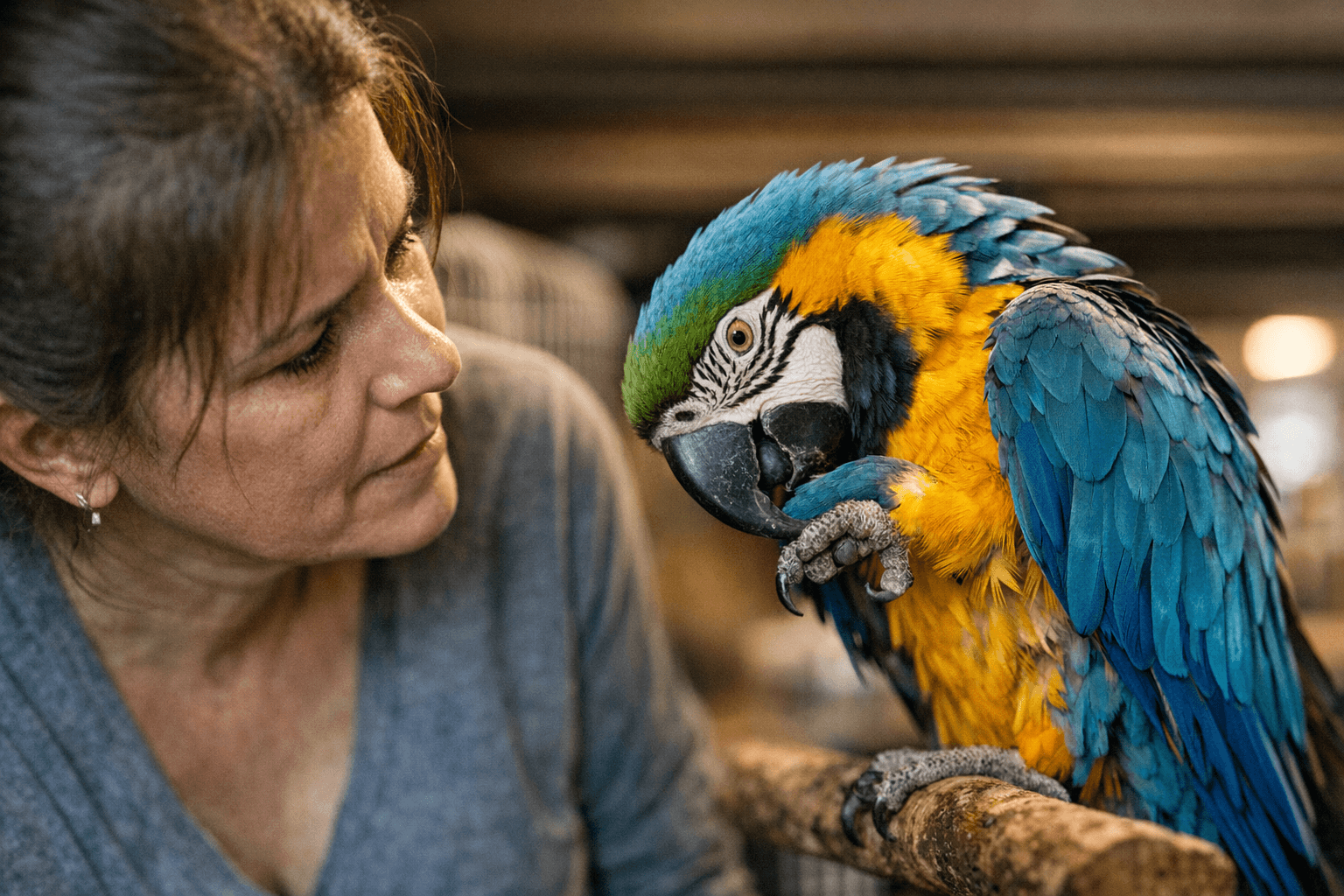
Hook did more than chatter for the camera. In the clip, the macaw told his mom, “He is telling me his Bobo hurts and he’s going to cry,” while pointing toward his elbow, a sequence that made the moment feel less like random mimicry and more like a bird choosing words for a body part and an emotion.
That is why the video landed so hard with parrot people. Hook was not just repeating a phrase he had heard before. He seemed to connect language, location, and distress in one small exchange, the kind of behavior that makes macaws look less like novelty pets and more like emotionally aware companions with a sharp sense of context. The contrast has helped turn him into a memorable online personality, especially for viewers who have already seen his rougher side, including the earlier clip in which he played with his dad’s empty beer can and swore at mom.
The science behind that reaction has been building. A 2024 study from The Open University found that parrots could use tablet-based speech boards to communicate wants and feelings, including abstract concepts such as feelings, with the work co-authored by Professor Clara Mancini. Related research on a Goffin’s cockatoo looked at persistence in requests, seeking out displaced representations of preferred foods, and reactions to unexpected outcomes, all signs that point toward intentional communication rather than simple copying.
That matters because birds often hide pain. Veterinary sources say behavioral and vocal changes can be some of the clearest warning signs when something is wrong, and a review on pain recognition in birds says recognizing pain-related behavior is crucial to proper care. The MSD Veterinary Manual notes that pain assessment depends on history and behavior changes, because vital signs alone may miss the source of pain. For a bird like Hook, that means a changed voice, repeated phrasing about a body part, pointing, a drop in activity, or a sudden refusal to move normally should be taken seriously before a vet visit.
The broader context helps explain why Hook’s brief complaint hit so many people as more than a cute trick. Alex the African grey parrot, studied over roughly 30 years by Irene Pepperberg, learned labels for about 50 objects, 7 colors, 5 shapes, and quantities up to six, helping establish that parrots can use human words with real meaning in some contexts. A recent review also found parrot cognition research has accelerated, with more than 50 new studies appearing in a little over four years after a 2018 review. Hook’s elbow complaint fits that lineage neatly: one small, vivid moment that asks caregivers to listen closely when a bird sounds like he means exactly what he says.
This article was produced by Prism’s automated news system from verified source data, official records, and press releases, then run through automated quality and moderation checks before publishing. The system is built and supervised by the people who set the standards it runs under. Read our full AI policy.
Did this article answer your question?