AAV Free Guides Help Parrot Owners Master Veterinary Care Essentials
Print these free AAV brochures and post them on your fridge: the vet-backed cheat sheets every parrot owner needs before the first emergency arrives.
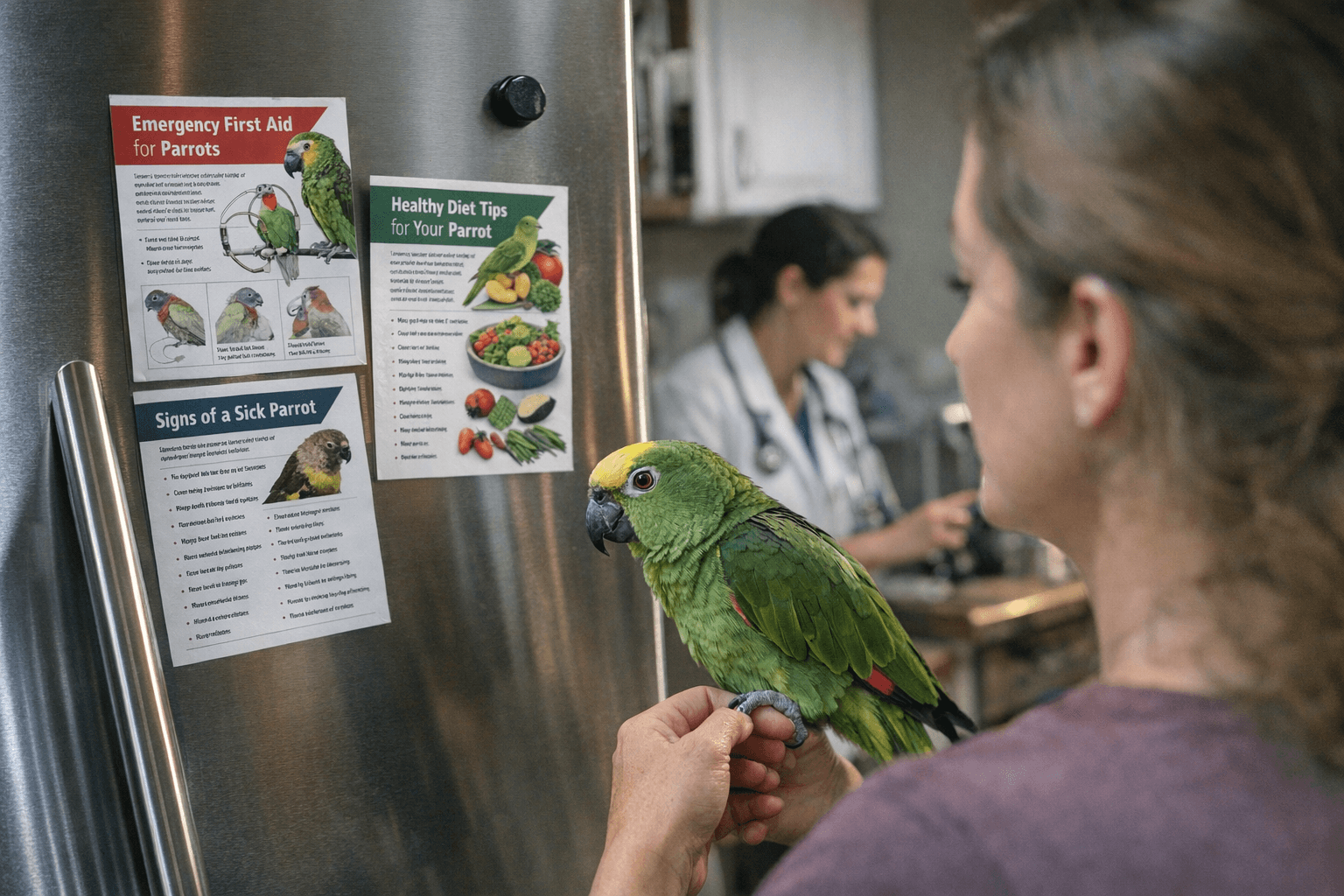
The moment your parrot goes quiet, you realize you needed the avian vet's number before that moment, not after. A bird that stops talking, eats less, or sits fluffed at the bottom of its cage is a bird that may have been quietly sick for days already. Parrots are expert concealers of illness, an evolutionary survival strategy that works against the owners who love them. That gap between what's normal and what's urgent is exactly the space the Association of Avian Veterinarians (AAV) has spent decades trying to close, one free downloadable brochure at a time.
The AAV is the leading professional body for avian veterinary medicine, and its public-facing brochure library at aav.org is one of the most underused resources in the parrot community. These handouts are written by veterinarians, reviewed against current best practices, and offered free of charge to any bird owner willing to print them. Think of them less as light reading and more as a print-and-post toolkit: a curated set of one-page references designed to live on your fridge, inside your bird carrier, and in your vet-visit folder.
The Core Library: What to Print and When
The AAV's brochure series covers the full arc of companion bird ownership, from choosing a vet to managing a medical emergency at home. Not every handout is equally urgent, so here is where to start and when each one earns its place on your wall.
"Finding a Veterinarian for Your Feathered Friend"
Print this one before you bring any bird home. The AAV's own recommendation is that every companion bird have an established relationship with an avian-experienced veterinarian, not just any small-animal clinic. The organization's Find-a-Vet search tool at aav.org is the fastest way to locate a qualified practitioner in your area. Local bird clubs and veterinary schools are also flagged as reliable referral sources. Doing this search after an emergency is too late.
"Basic Care for Companion Birds"
This is the handout for new bird quarantine and the first thirty days of ownership. It covers cage construction standards (bar spacing, nontoxic materials, grate placement), appropriate substrate (plain paper, never wood chips or kitty litter), social needs by species, and diet foundations. The AAV also uses this brochure as the entry point for directing owners toward companion resources like the "Foraging for Parrots" handout, which pairs enrichment with feeding strategy. A quarantine-period read of "Basic Care" sets baselines that make everything else easier to track.
"Signs of Illness in Companion Birds" and "When to Visit a Vet"
These two belong together, taped directly to the fridge. The warning signs the AAV flags include sudden changes in droppings, appetite loss, altered feather condition, and respiratory symptoms: the same cluster that experienced parrot owners learn to read after their first scare. Because birds mask illness until they can no longer sustain the performance, the window between "slightly off" and "critical" is narrower than it is for dogs or cats. These handouts give owners a concrete checklist rather than relying on instinct alone.
"Veterinary Care for Your Pet Bird"
This is your first-vet-visit preparation guide. The brochure walks owners through what to expect step by step: the bird will first be observed in its travel carrier before handling begins, which means the carrier you choose and how your bird behaves inside it matters. Avian wellness exams differ substantially from small-animal check-ups. The diagnostic toolkit routinely includes blood panels, fecal analyses, and specialized imaging, tests that require species-specific interpretation. Knowing what to expect reduces the anxiety of that first appointment and helps you ask better questions.
"Transitioning Pet Parrots Away From a Seed Diet"
This handout is the one to pull out at any vet appointment where nutrition comes up, which, for seed-heavy birds, is most appointments. Seed-only diets are consistently flagged by avian vets as a leading contributor to preventable illness, and the transition to formulated pellets and fresh foods is a process that benefits from a structured plan. Keep this one in your vet-visit folder alongside the Basic Care brochure.
"Feather Loss: Cause and Treatment" and the Medication Guide
The feather loss brochure is the one to reach for when nail and wing care decisions intersect with health: owners often confuse normal molt, stress barbering, and pathological feather destruction, and misreading the difference delays appropriate care. The AAV's broader brochure series also addresses medicating your bird at home, covering proper restraint technique, dosing schedules, and follow-up protocols. For anyone managing a bird through a treatment course, that guide is the difference between a correctly administered dose and a stressed bird that spits it out.
Your Fridge Checklist: One Page to Rule Them All
The AAV's individual brochures are detailed, but the distillation that belongs front and center in your kitchen is simpler: a single reference card covering the red-flag symptoms to monitor daily, your avian vet's contact information and after-hours emergency line, the name and address of the nearest avian emergency clinic, your bird's baseline weight (weighed weekly on a kitchen scale), and the date of its last wellness exam. Healthy parrots require annual check-ups at minimum; older birds or those with chronic conditions may need more frequent visits. Anchoring those dates visually, the way you would a child's vaccine record, is the kind of habit the AAV's materials are designed to build.
Questions to Ask Your Avian Vet: A Script for the First Visit
Walking into an avian appointment without a list of questions is a missed opportunity. Use this framework as your starting script:
- What should my bird's droppings look like on a normal day, and what changes warrant a call?
- What baseline blood work do you recommend for this species and age?
- How do I safely restrain my bird at home for medication administration?
- What is your after-hours emergency protocol, and which emergency clinic do you recommend?
- Is my current diet appropriate, and how should I approach a transition if not?
- How often should we schedule wellness exams given my bird's age and species?
- What household hazards (cookware, cleaning products, plants) are most relevant for my setup?
Bring this list printed. Avian appointments move quickly, and the questions you forget to ask are always the ones that matter later.
Record-Keeping, Emergency Prep, and the Bigger Picture
The AAV's brochures return repeatedly to two habits that separate prepared owners from reactive ones: keeping detailed records and building emergency infrastructure before it's needed. Medical history, diet logs, and behavioral notes give your veterinarian a longitudinal picture that a single appointment can never provide. Your emergency kit should include a secure transport carrier appropriate for your bird's size, a contact list of local avian vets and emergency clinics, and a clear sense of which symptoms require a same-day visit rather than a scheduled appointment.
The AAV's brochure library is also available in multiple languages, including Spanish, French, German, Japanese, Korean, and Portuguese, making it a practical resource for multilingual households and for rescue organizations working across diverse adopter communities. For shelters and foster programs, the AAV maintains a dedicated Guide for Shelters, a parallel resource that applies the same veterinary standards to the specific challenges of birds moving between environments.
The brochures are free. The veterinary knowledge behind them is not. Printing them, posting them, and reading them before the quiet bird moment arrives is the simplest form of advocacy a parrot owner can offer the bird already living in their home.
This article was produced by Prism’s automated news system from verified source data, official records, and press releases, then run through automated quality and moderation checks before publishing. The system is built and supervised by the people who set the standards it runs under. Read our full AI policy.
Did this article answer your question?