How to Build a Stimulating, Safe Environment for Companion Parrots
Mango the Eclectus screamed every morning for months. The fix wasn't medication or a new cage: it was a boredom problem that a one-week environment overhaul resolved.
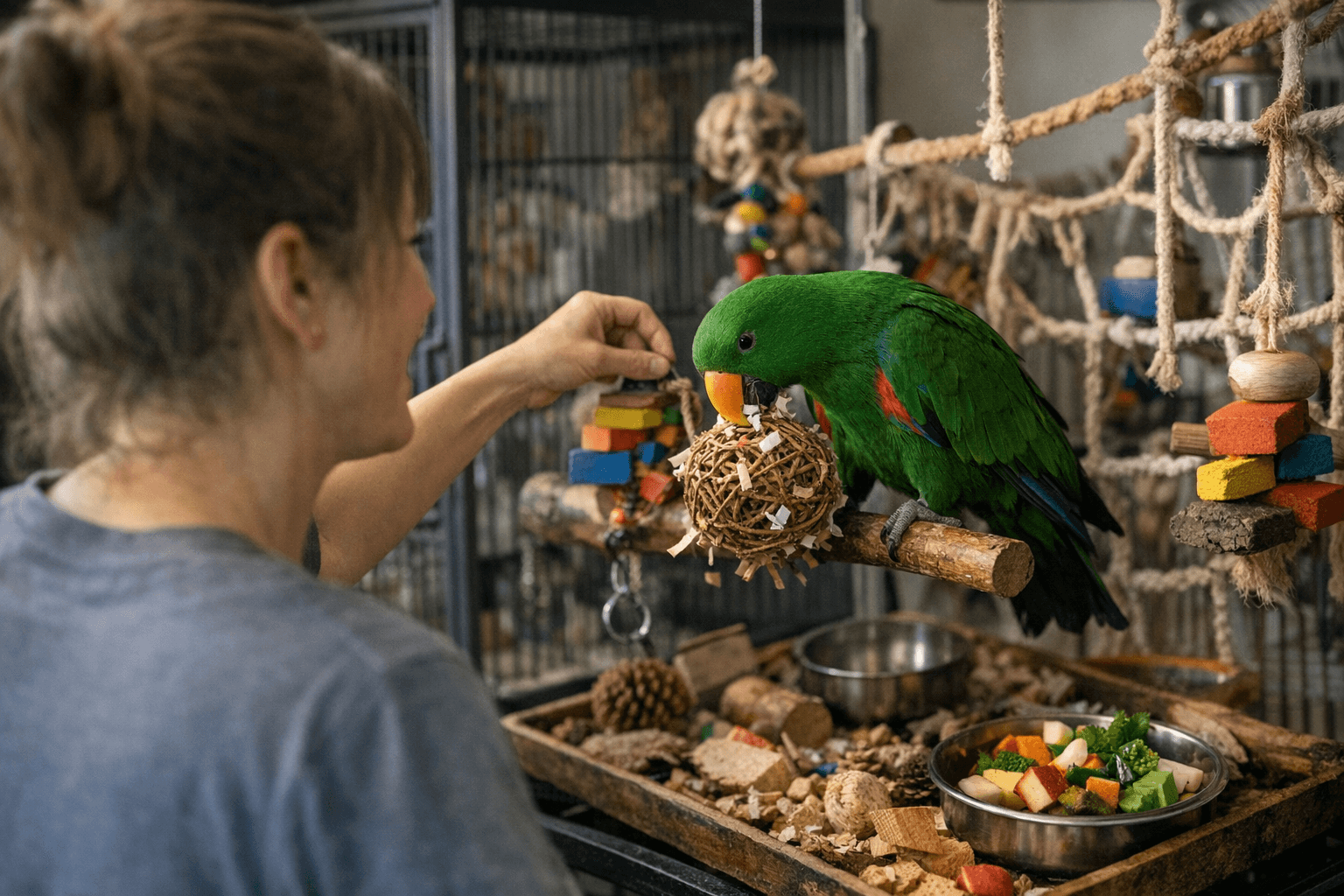
Mango, a five-year-old Eclectus, had been screaming for the better part of each morning for three months before his guardian traced the problem to its real source: the same four toys hanging in identical positions since the previous year, no foraging opportunities, and a cage parked in a corner near the kitchen stove. Nothing to solve. Nothing to destroy. Nowhere new to climb. Just a highly intelligent bird announcing his frustration at full volume every day by 8 a.m.
This is boredom, and it is a behavior problem, not a personality quirk. In the wild, parrots spend 70 to 80 percent of their waking hours foraging, problem-solving, and socializing. A captive environment offers safety, but without active effort from a guardian it becomes a sensory desert. Research published in peer-reviewed literature estimates that between 10 and 17.5 percent of companion parrots develop feather-damaging behavior, and separate studies have found feather-damaging behavior occurs more frequently in birds receiving less cognitive enrichment and fewer training interactions. Screaming, biting, and destructive chewing follow the same logic: a bird with no outlet for its intelligence will find one, and the choices it makes unassisted are rarely quiet.
The plan below addresses this directly. It is a seven-day cage refresh and enrichment schedule built around one principle: small, specific daily changes produce measurable behavioral results within weeks.
Start with the Cage Itself
Before a single new toy is introduced, audit the enclosure and its placement. The cage should be the largest safe size for the species: a cockatiel needs room to move between perches freely; a macaw needs enough interior space to fully extend both wings without touching the bars. Placement matters just as much. Positioning the cage near the kitchen exposes the bird to polytetrafluoroethylene (PTFE) fumes from non-stick cookware, which can be fatal within minutes, as well as aerosol sprays, cooking smoke, and scented candle fumes, all of which cause respiratory damage. Drafty spots near exterior doors and high-traffic corridors that cause repeated startling add a chronic stress load that undermines every enrichment effort. A wall-adjacent position with a partial sightline into the main living area gives most parrots the social stimulation of household activity without constant alarm.
Inside the cage, perch variety is a foot health issue as much as an enrichment one. A single wooden dowel of uniform diameter causes pressure points over time and can contribute to bumblefoot in larger species. Aim for at least three perch types: a natural hardwood branch at varying diameters, a rope or sisal perch for grip variation, and a flat corner platform perch for resting. Manzanita and apple wood are both bird-safe hardwood options that double as chew material.
The 7-Day Enrichment and Cage Refresh Plan
Day 1: Audit, Clear, and Observe
Remove all current toys from the cage. Clean the bars, perches, and dishes. Note which toys the bird had actually interacted with versus ignored. Any toy untouched for two weeks goes into a rotation reserve rather than back into the cage immediately. This reset creates a fresh behavioral baseline before new items are introduced.
*Shopping/DIY list:* A reserve pool of 4 to 6 replacement toys in mixed styles (shreddable, chewable, puzzle), a small notebook or phone note for behavioral observations.
Day 2: Build a Foraging Station
Foraging is the highest-return enrichment intervention available. Research on foraging enrichment has specifically shown improvement in feather condition in birds that previously exhibited feather-damaging behavior, because the activity satisfies the same behavioral drive that plucking misdirects. Set up a foraging box: a shallow cardboard tray or clean food container filled with shredded paper, vine balls, and a few safe wood chips, with a portion of the bird's regular food hidden inside. A low-cost DIY version uses a small plastic cup with a few holes punched in the base; place one large treat inside and partially cover the opening so the bird must tip or manipulate the cup to reach it. Scale complexity upward as confidence grows.
Day 3: Upgrade the Perch Line
Add at least two new perch textures or diameters. Natural branches from bird-safe species (apple, willow, manzanita) work well and offer both chewing and climbing variation. Position perches at different heights: higher perches for alert, watchful resting and lower ones for exploratory behavior. The goal is a vertical environment the bird actively chooses to navigate.
*Shopping list:* Manzanita or apple wood branch perch, sisal rope perch, flat corner platform.
Day 4: Establish a Destructible Chew Zone
Chewing is a biological need. Without appropriate outlets, it redirects to cage bars, furniture, and anything else in reach during out-of-cage time. Dedicate one cage area to destructible toys made from safe materials: untreated pine blocks, palm frond strips, cork bark, and compressed paper toys all qualify. A five-minute DIY option: cut paper towel rolls in half, stuff them with folded newspaper and a pinch of dried safe herbs, and attach them to the cage bars. Most medium parrots will demolish these with focused enthusiasm, which is precisely the point.
Day 5: Introduce Sensory Variety
Enrichment is not only tactile. Soft music or recorded nature sounds played at low volume, a bird-safe clump of fresh browse such as lemongrass clippings, or a foraging toy in a contrasting color all introduce novelty through different sensory channels. Rotate the sensory element every few days to keep the response engaged. Watch the bird carefully when introducing anything new. Signs of overstimulation (frantic movement, excessive alarm calls, feather sleeking tight to the body) mean the stimulus should be removed immediately and the bird allowed to return to a calm baseline. If a distress response repeats across multiple sessions, the appropriate next step is consultation with an avian veterinarian or certified behaviorist.
Day 6: Pair Enrichment with a Training Session
Positive reinforcement training does something toys alone cannot: it gives the bird a sense of agency. Spend 10 to 15 minutes on a simple target-training exercise or an existing trick, rewarding with a high-value treat. For Mango, scheduling this session just before the usual 8 a.m. screaming window preempted the behavior by replacing the energy burst with a structured, rewarding interaction. Research specifically links reduced feather-damaging behavior to increased training frequency, reinforcing that training functions as cognitive enrichment in its own right.
Day 7: Lock In the Rotation Cycle
Swap two of the week's introduced toys for items from the reserve pool. Set a calendar reminder to rotate 2 to 3 toys every week going forward. Most avian care specialists recommend maintaining at least 4 to 6 toys in the cage at all times, with the mix covering shreddable, puzzle-type, and chewable designs. Rotation is what keeps novelty working: toys that disappear and reappear after a few weeks feel new again.
- Ongoing materials checklist:*
- Shreddable: palm leaf, seagrass, balsa blocks
- Puzzle feeders: acrylic foraging boxes, treat kabobs, stacking cups with hidden treats
- Chewable: untreated pine, manzanita, cork bark
- Sensory: foot toys, leather strip toys, fresh safe browse
Safety: The Non-Negotiables
Enrichment only protects a bird if the environment is physically safe. Beyond kitchen fume risks, ceiling fans pose a direct strike hazard during out-of-cage time and should always be switched off before free flight. Doors and windows must be secured before any bird is released into a room. For toy hardware, stainless steel is the standard; avoid galvanized metal clips due to zinc toxicity, and never introduce glass beads, charm bracelets, or lead-weighted components into the cage.
Introducing a New Bird
For households adding a second or first parrot, a minimum 30-day quarantine in a physically separate room is essential before any contact with existing birds. New birds should be introduced to enrichment gradually: an over-stimulating environment on arrival produces fear responses rather than curiosity, and it is confidence, built slowly, that makes enrichment effective.
Behavioral problems are among the most common reasons parrots are surrendered to rescues. They are also among the most preventable. Within two weeks of his cage refresh, Mango's screaming had dropped from three daily bouts to occasional contact calls. The cage was the same size. The room was the same room. What changed was that every morning the bird woke up to a problem worth solving.
This article was produced by Prism’s automated news system from verified source data, official records, and press releases, then run through automated quality and moderation checks before publishing. The system is built and supervised by the people who set the standards it runs under. Read our full AI policy.
Did this article answer your question?