AAV outlines five enrichment types, spotlighting bird-chosen play for parrots
AAV says parrots need more than toys: the best enrichment gives beaks and feet real work. Its five-part framework starts with bird-chosen play.
sensory enrichment
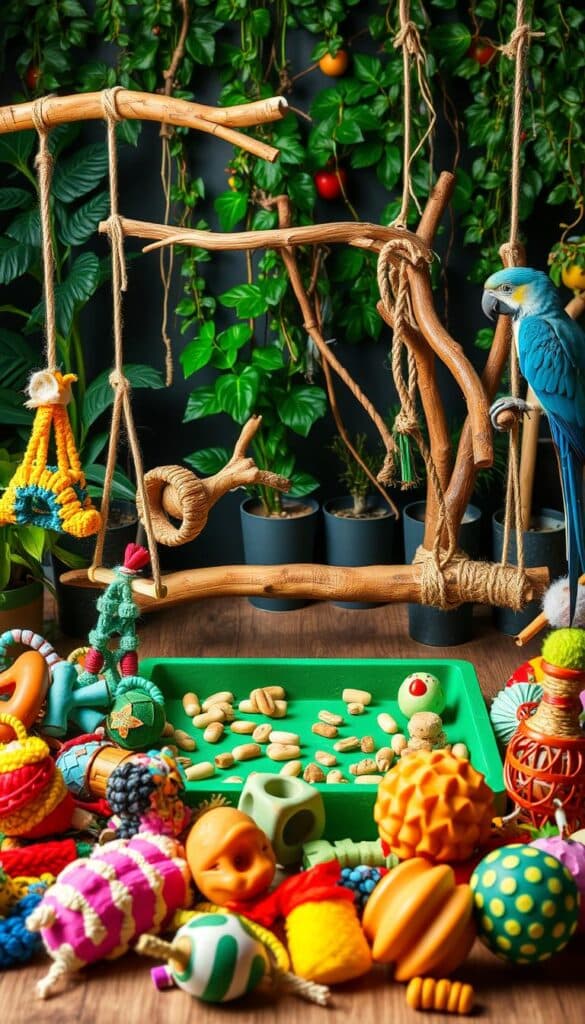
A parrot that chews furniture or works a cage bar is often telling you the room is too flat, too familiar, or too easy to ignore. The Association of Avian Veterinarians breaks enrichment into five types, and sensory enrichment is the reminder that a bird experiences its world through far more than sight alone.
That matters in a pet-bird population that is now primarily captive-bred, after mass importation of wild-caught psittacines was curtailed in the mid-1980s. A richer sensory setup gives a bird more to notice before it starts making its own entertainment out of baseboards, trim, or cage hardware. Small changes in texture, placement, and the feel of a space can turn a static cage into a place that asks for attention instead of demanding destruction.
nutritional enrichment
Food is one of the easiest ways to give a bored parrot a real job. In the AAV framework, nutritional enrichment pushes meals beyond the bowl and into the bird’s problem-solving world, where foraging and control matter as much as calories.
The clearest proof comes from captive red-crowned and sulphur-crested cockatoos, where foraging enrichment helped reduce oral repetitive behaviors. A separate parrot study found that Grey parrots may choose to work for food instead of taking it for free, which is exactly the kind of detail that changes how you think about breakfast time. The same study found feather-damaging Grey parrots showed less of that contrafreeloading behavior than healthy birds, a sharp reminder that food-based challenges can reflect both welfare and behavior, not just entertainment.
manipulative enrichment
This is the category that most directly answers the bird that picks at cages, strips toys apart, or seems busy but never satisfied. The AAV also calls it occupational enrichment, and the key idea is simple: the bird gets an option of whether or not to engage. That makes it bird-chosen play, not forced busywork, and it is a crucial distinction for parrots that are curious, cautious, or highly persistent.
For a beginner bird, the best starting point may be a toy with one obvious moving piece, something easy to inspect without demanding instant commitment. An intermediate bird can handle objects that move and turn, giving the feet and beak a more active role. A highly destructive parrot, especially one that already disassembles toys and even cages, needs the full version the AAV describes: a toy that lets the bird move and turn parts, tighten or loosen elements, and chew.
- A cautious bird can start with one simple object that invites touch without pressure.
- A more confident bird can graduate to parts that rotate, shift, or click into place.
- A heavy-duty chewer needs hardware-level challenge, with pieces to work, loosen, and destroy safely.
A 2015 review of juvenile psittacines widened the idea even further by tying occupational enrichment to exercise and psychological enrichment. That is the heart of the category: the best manipulative enrichment gives a bird something meaningful to do with its beak, feet, and brain, while still leaving the final choice in the bird’s hands.
environmental enrichment
Environmental enrichment is where the whole cage and room start working together. The AAV’s five-part framework pushes owners to think about layout, access, and the physical setting, not just the object hanging inside it.
That matters because a parrot in a static setup quickly learns every inch by heart, then starts looking for something new to investigate. A better environment gives the bird reasons to climb, move, and reorient throughout the day, instead of treating the cage as a dead end. For birds that pick at bars or chew the same corner over and over, a more complex layout can reduce the pressure to manufacture novelty out of the cage itself.
behavioral enrichment
Behavioral enrichment is where the other four types turn into daily habits. It creates opportunities for natural behavior, choice, and interaction, which is exactly what intelligent parrots need when they are surrounded by human schedules and limited space.
The 2016 review on psittacine cognition is the caution flag here, because parrots do not all learn or process information in the same way. One bird may dive into a challenge, while another may ignore it, and a third may need time before touching anything new. That is why enrichment works best when it is observed and adjusted instead of bought once and forgotten. In a world of captive-bred parrots, long-lived companions, and stubbornly inventive beaks, the winning setup is the one that keeps offering healthy choices and gives a bird real work for both its feet and its mind.
This article was produced by Prism’s automated news system from verified source data, official records, and press releases, then run through automated quality and moderation checks before publishing. The system is built and supervised by the people who set the standards it runs under. Read our full AI policy.
Did this article answer your question?