Avian Behavior Conservancy explains safe free-flight training for parrots
Free flight is not casual outdoor time. Avian Behavior Conservancy frames it as advanced training that only starts after recall, planning, and hard risk checks.
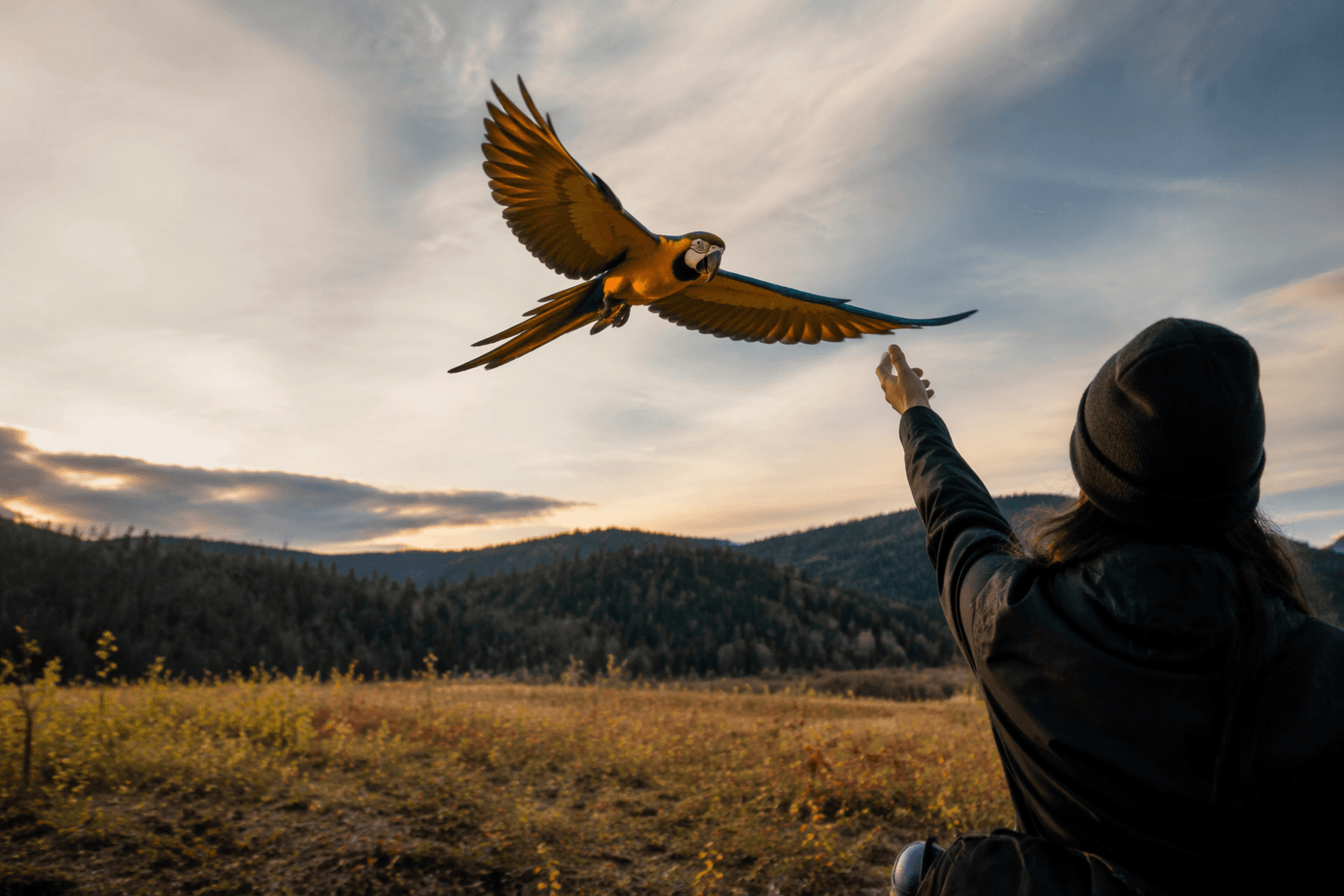
The Avian Behavior Conservancy files _So you want to train your pet parrot for free flight_ under animal training and parrot behavior. It frames the skill as learning, reinforcement, and risk management, not a novelty trick. For any keeper weighing indoor recall against open-air work, a bird that is not ready can end up facing predation, disorientation, or permanent loss.
Why the conservancy page draws a hard line
The conservancy puts the subject in the same conversation as recall cues, stationing, body language, and reinforcement history. That is a long way from the casual idea that a parrot can simply be taken outside and trusted to “know” how to come home.
That caution has been around for years. Steve Martin’s November 2002 PsittaScene piece, _To Fly Or Not To Fly That Is The Question_, shows that serious debate about outdoor free flight has been part of parrot training circles for decades. The core issue has not changed: once a bird is out in open air, the handler loses the controlled environment that makes training safe.
What has to be in place before outdoor flight
A responsible free-flight program starts with proof, not hope. You need reliable recall, not just in a quiet room but under distraction. You also need stationing, handler engagement, and a bird that responds predictably to reinforcement, fear, and environmental change, because those are the pressure points that decide whether a flight ends safely or not.
- Indoor recall should be strong before any outdoor work begins.
- Stationing matters because a bird that cannot hold position on cue is already showing weak control.
- Handler engagement is essential, since a parrot that ignores you indoors will be even less dependable outside.
- Temperament counts, because some birds are simply too reactive, fearful, or easily overstimulated for open-air work.
- Weather and location planning are part of the job, not extras, because wind, noise, and unfamiliar spaces change how a bird behaves.
- Emergency planning is non-negotiable, since a mistake outdoors can turn into a rescue situation fast.
BirdTricks' free-flight training course lists a minimum of 4 to 8 weeks in most cases, and some birds may need 3 to 4 months. That timeline is a rough yardstick from one commercial training program, not a promise that every bird will be ready.
What the conservation literature shows
In the June 8, 2021 paper _Parrot Free-Flight as a Conservation Tool_, Constance Woodman, Chris Biro, and Donald J. Brightsmith placed the practice in a conservation context. A training technique that parrot owners had practiced for decades was being used to establish new bird flocks in the wild, and Texas A&M and Phys.org identified Chris Biro as a globally recognized free-flight trainer on September 3, 2021.
In November 2024, Phys.org covered researchers using free-flight training to prepare captive parrots for life in the wild. The 2024 MDPI result, _Free Flight Training as a Tool for Psittacine Reintroductions_, treated controlled flight conditioning as part of reintroduction work rather than as a pet trick. Conservation birds are being prepared for a very specific release pathway, under structured oversight, not given a spur-of-the-moment outdoor spin.
The 2021 conservation paper records no parrots lost to predation or disorientation during more than 500 months of free-flight time.
The welfare backdrop keeps the decision serious
A Facebook post in the search results claimed 58 percent of all parrot species are in decline, but that figure is not from a primary scientific publication, so it should not be treated as a hard conservation statistic. Even without that number, habitat loss, deforestation, and trade continue to weigh on psittacines.
Bird-keeping communities repeat the same practical advice: build indoor recall first, then move cautiously to controlled outdoor practice if the bird’s training, temperament, and environment truly support it. Some keepers turn to harness work or stop at indoor enrichment altogether when a bird is not a strong free-flight candidate.
This article was produced by Prism’s automated news system from verified source data, official records, and press releases, then run through automated quality and moderation checks before publishing. The system is built and supervised by the people who set the standards it runs under. Read our full AI policy.
Did this article answer your question?