Avian veterinarians favor sedation before euthanasia, survey finds
A 201-response survey found most avian vets sedate birds before euthanasia, favoring a slower, lower-stress process over a bare-bones procedure.
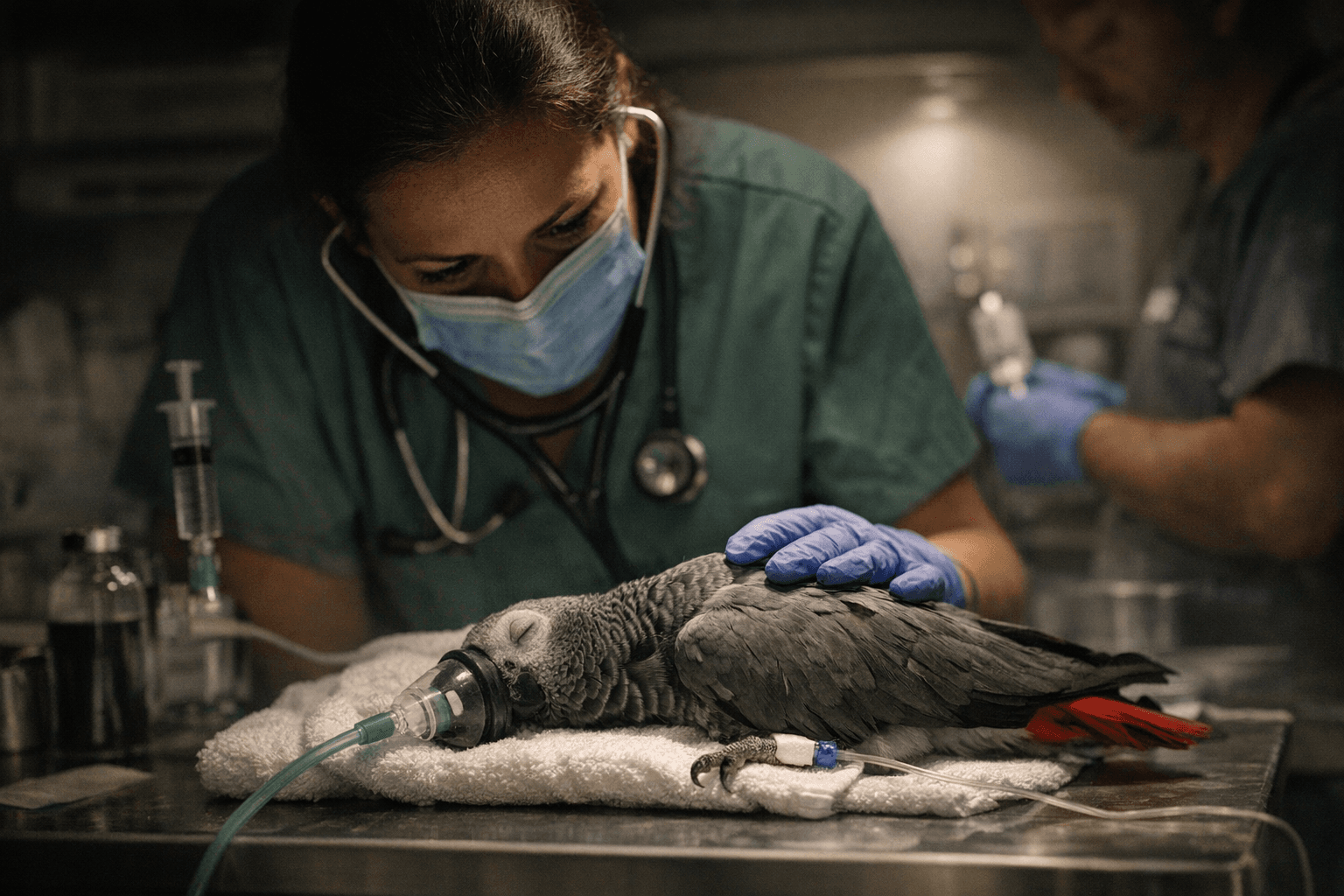
A parrot that flaps, screams and twists in a handler’s arms is one reason avian veterinarians are leaning on sedation before euthanasia. In a survey that closed after 201 responses, more than half of respondents said they routinely use sedation or anesthesia first, treating it as a humane safeguard that can blunt handling stress, reduce wing flapping and vocalizations, and make the last step less distressing for both the bird and the team.
The results sketch a profession that is being shaped as much by welfare as by technique. LafeberVet reported that 51.24 percent of respondents were from North America and 29.35 percent from Europe and Central Asia, a spread that suggests the conversation is broad but still heavily rooted in regions where companion-bird medicine is more established. For owners, the takeaway is plain: euthanasia in birds is not handled like a simple one-step event, and many avian clinicians are intentionally building in a calmer transition.
When medication is used, intravenous administration remains the preferred route, with barbiturates such as pentobarbital commonly used. If IV access is not possible, some clinicians turn to intracardiac injection, but typically only after the bird has been sedated. Cervical dislocation also appears in the avian euthanasia discussion, but not as an easy default. The survey frames it as a selective option, one that depends on training, appropriateness and welfare considerations rather than convenience alone.
That caution fits the larger reality of avian medicine. Birds are not small dogs or cats. Their anatomy, stress responses and tiny patient size make end-of-life care more complicated, and a recent avian anesthesia review noted that anesthesia-related death risk can be up to 20 times higher in birds than in dogs and cats. A 2021 review in the Journal of Avian Medicine and Surgery said procedural sedation in birds has become routine over the past 10 years, and this survey shows that practice extending into euthanasia protocols as well.
The broader literature remains limited, and much of the older euthanasia research focused on commercially raised poultry rather than companion birds. One 2017 AVMA journal study on anesthetized house sparrows and European starlings found that both intraosseous pentobarbital and thoracic compression produced rapid loss of irreversible EEG activity, although thoracic compression caused grossly visible hemorrhage in 14 of 17 birds examined at necropsy. That kind of detail helps explain why many avian veterinarians prefer a staged, sedation-first approach when the goal is to avoid any added suffering.
The survey also notes that owner presence significantly influences euthanasia protocols. That matters in a bird room, where grief, restraint, and the wish for a quiet goodbye often push clinicians toward low-stress, carefully paced care. The approach aligns with the American Veterinary Medical Association’s euthanasia guidelines, which are intended to help veterinarians relieve pain and suffering and are reviewed at least every 10 years, with the 2020 edition currently referenced by NIH Office of Laboratory Animal Welfare. In avian practice, the direction is clear: more preparation, more sedation, and more attention to the last minutes of a bird’s life.
This article was produced by Prism’s automated news system from verified source data, official records, and press releases, then run through automated quality and moderation checks before publishing. The system is built and supervised by the people who set the standards it runs under. Read our full AI policy.
Did this article answer your question?