Open University study tests tablet speech boards for parrots, boosting communication
Ellie the Goffin’s cockatoo helped test speech boards that grew from 55 to 462 choices, and the lesson is clear: build for the bird’s world.

Ellie’s four-year test is changing how parrot communication gets designed
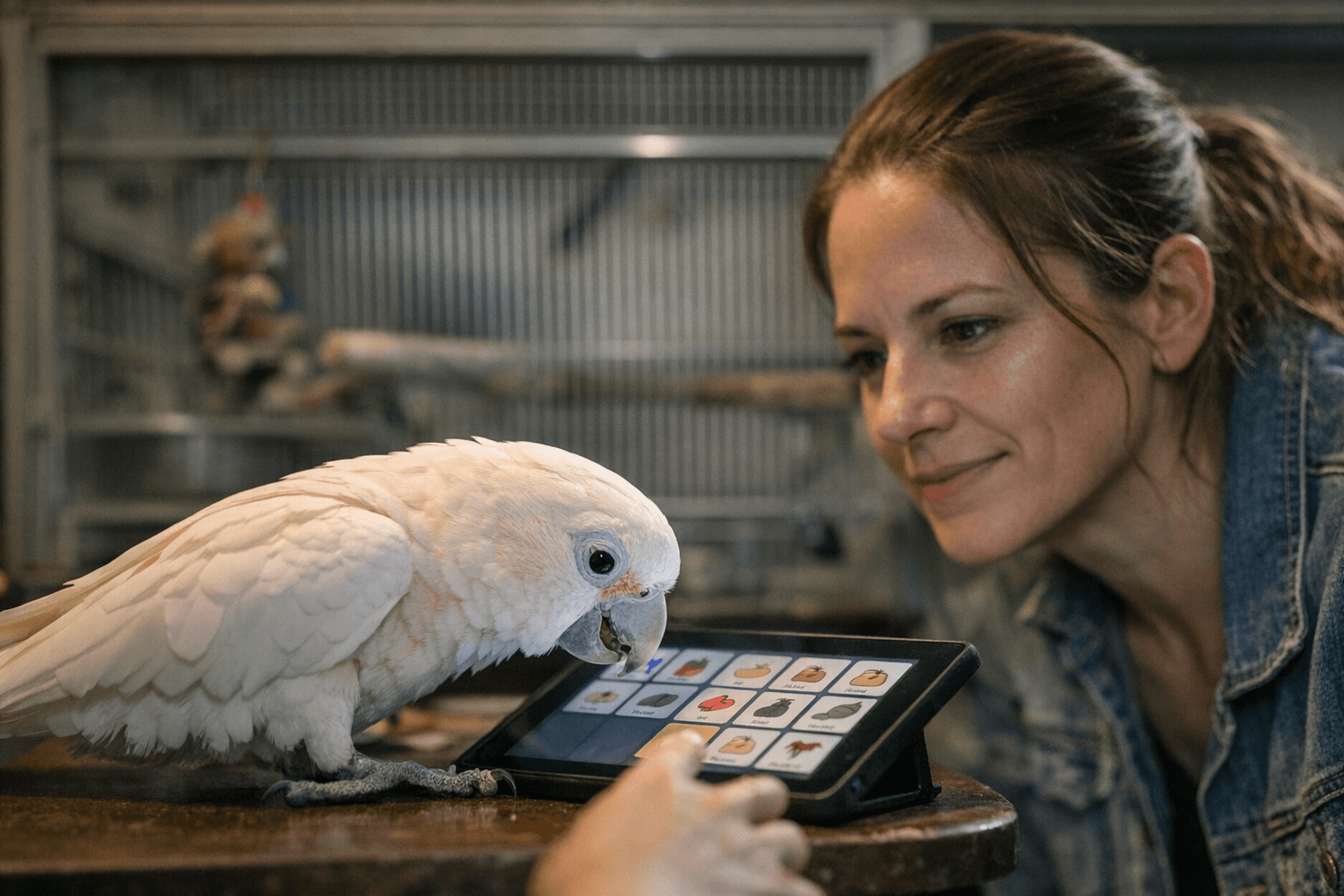
Ellie, a Goffin’s cockatoo, spent four years living with three different tablet-based speech board designs in her everyday environment, and that long run matters more than any one clever button. The Open University study tracked how her use changed as the board expanded from 55 representations to 462, then examined about 8,500 interactions to see what actually helped communication and what got in the way.
That scale gives parrot care a much more practical takeaway than a simple yes-or-no verdict on touchscreen talking. The question is no longer whether a parrot can touch symbols. The more useful question is how to build a board that fits the way a parrot perceives, chooses, and learns.
The design lesson is bigger than the device
The research compares different interface features, including the kinds of symbols used, how detailed those symbols were, how many options were available, and how the items were arranged. That is the real headline for owners and caregivers: the best communication tool is not automatically the one that looks most human-friendly.
One of the clearest findings is that photos of real objects from the parrot’s environment, along with simple drawings of familiar items that stand for broader ideas, may let parrots recognize meaning with less training. In plain terms, if the bird already knows the bowl, the perch, the favorite toy, or the travel carrier in daily life, the board can lean on that lived experience instead of forcing the bird to decode abstract human-style icons.
For everyday care, that means the board should start with the bird’s world, not the person’s vocabulary. A parrot does not need a complicated menu to make a meaningful choice. It needs options that feel concrete, recognizable, and worth using.
Why this project is about welfare, not just technology
The team behind the project is not treating the tablet as a novelty. The stated goal is to improve avian usability, wellbeing, and agency, which puts the study squarely in welfare territory. The broader idea is simple but important: interactive tools can give animals more control over what happens around them and, potentially, a better way to express themselves.
That framing is exactly why the work stands out in the parrot community. A device that helps a bird request, refuse, or indicate a preference is not just entertaining. It can become part of daily enrichment, reduce frustration, and give caregivers a clearer read on the bird’s needs and mood.
The collaboration also spans The Open University, Purdue University, and Parrot Kindergarten, with Clara Mancini leading the Open University side and Corinne Renguette working on the Purdue University team. Jennifer Taylor-O’Connor, Ellie’s caregiver and collaborator through Parrot Kindergarten, is central to the project because this kind of work only succeeds when the bird’s routine and the human’s handling stay tightly connected.
The earlier evidence makes the new findings stronger
The new study did not appear out of nowhere. Earlier work in 2024 had already shown that parrots can use speech boards to communicate with people, and the CHI paper on Ellie documented seven months of sustained use across 129 sessions and 190 days. That paper also reported that 92% of corroborable selections were validated by behavior, which is a strong sign that Ellie’s choices were not random taps.
A later December 2024 conference paper added another important layer. It argued that Ellie’s interactions aligned with Jakobson-based communication functions and suggested intentional communication, including requests that continued when unmet, attempts to seek displaced representations of preferred foods, and responses to unexpected outcomes. That kind of pattern matters because it moves the conversation beyond “can a parrot press a symbol?” and into “is the parrot using symbols with purpose?”
For caregivers, that shift changes how you read the bird. A touch on a board is not just an action on a screen. It may be a request, a protest, a preference, or a repeated attempt to be understood.
What to do differently in enrichment and training
The practical takeaway for homes, aviaries, and training setups is straightforward: build from familiarity outward. If you are using a tablet board or any choice-based cue system, anchor it in objects and routines the bird already knows well, then add complexity slowly as the bird shows consistent use.
A few design principles follow directly from the study:
- Start with real-world items the bird encounters every day, not abstract categories.
- Keep symbols visually simple when they stand for broader ideas.
- Place options in an arrangement that mirrors the bird’s routine and likely priorities.
- Expand the board only as the bird’s use shows it can handle more choices without losing clarity.
- Treat repeated selections as meaningful behavior, especially when the bird keeps returning to an unmet request.
This has a very practical enrichment payoff. A smaller, well-chosen board can give a parrot more confidence than a crowded screen full of labels it does not yet need. For training, that means one or two meaningful choices can do more than a huge grid, especially if the options are tied to food, social interaction, or favorite activities the bird already recognizes.
Why the wider parrot world should pay attention
Parrot communication has been debated for decades, with people often asking the wrong question: whether talking parrots are simply mimicking human speech. This project takes the more useful route, asking how to design interfaces that let parrots communicate on their own terms.
That is the part owners, trainers, and rescue volunteers should keep in mind. If the goal is better communication, the burden is not only on the bird to learn a human-made system. The human side has to adapt too, by choosing symbols, layouts, and routines that match how parrots actually see and make decisions.
Ellie’s long tablet trial suggests a future where speech boards are less like gadgets and more like shared language tools, built around avian perception, avian choice, and avian wellbeing.
This article was produced by Prism’s automated news system from verified source data, official records, and press releases, then run through automated quality and moderation checks before publishing. The system is built and supervised by the people who set the standards it runs under. Read our full AI policy.
Did this article answer your question?