Fall River Restaurant Takes In Lost Parakeet, Seeks Owner on Easter
A green Indian ringneck parakeet turned up at Alianca Platter House's front door on Easter morning, prompting Fall River's Susie Amaral to launch a community-wide Facebook search.
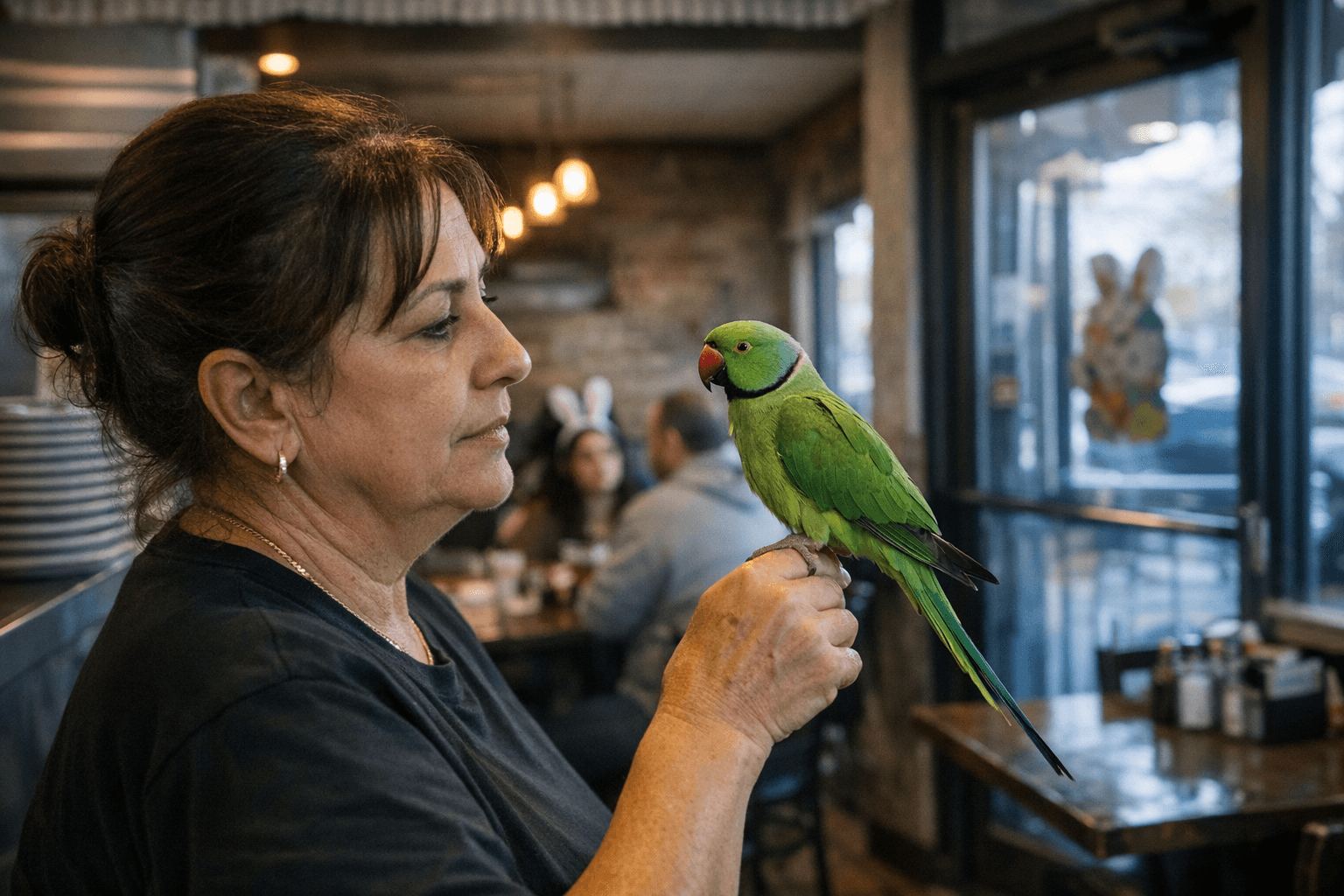
A bright green Indian ringneck parakeet materialized at the front door of Alianca Platter House in Fall River, Massachusetts on Easter Sunday morning, showing up like a holiday guest who had somehow lost the address.
Susie Amaral, the restaurant's owner, found the bird on April 6 and immediately posted on the establishment's Facebook page asking for help locating the owner. Staff brought the parakeet inside and settled it in a back storage room, keeping it warm, calm, and sheltered while the social-media search got underway.
The community leaned in quickly. Fall River resident Jae Ramos had posted a short video earlier that same morning of a similar-looking bird perched on someone's shoulder, and neighbors began flooding the comments with questions: could it be the same animal? Local news carried the story as it developed, but as of Easter evening the parakeet's owner had not yet come forward. The restaurant said it would continue to hold the bird and keep the public appeal open.
The species matters here. Indian ringnecks are common companion birds in the parrot-keeping world but have no business surviving a New England April on their own. They are identifiable on sight: vivid green feathering, a slim build, a pale beak, and in adult males a delicate neck ring that gives the species its name. They are also, as any ringneck keeper will confirm, gifted escapees the moment supervision slips.
If you find a loose parakeet or any companion bird in your neighborhood, resist the instinct to chase it. Pursuit drives the bird higher and farther. Crouch to its level, move slowly, and offer a finger or a familiar-looking object as a perch. Once you have the bird, place it in a ventilated box or carrier in a quiet, draft-free spot; a darkened carrier reduces stress while you make calls. Birds that have been outside in early spring are often cold and dehydrated, so keep the space warm.
The first call in Fall River goes to Fall River Animal Control at (508) 324-2037, which operates 8 a.m. to 4 p.m. daily, with after-hours emergencies handled at 508-676-8511. Post photos immediately to Nextdoor, any Fall River and Bristol County Facebook groups you belong to, and the Alianca Platter House page, which remains active in the search. Two national lost-and-found registries, 911 Parrot Alert and Parrot Alert, generate shareable geo-tagged flyers automatically and cross-post to social media when you file a report. If no owner surfaces, Foster Parrots, Ltd., the largest avian rescue organization in the Northeast, and Northeastern Avian Rescue (NEAR), an all-volunteer group covering the region, are both equipped to step in for long-term care or rehoming.
For anyone keeping an Indian ringneck or any companion parrot, the Fall River story is a useful checklist moment. A closed-band leg ring, and a microchip where your avian vet supports it, gives a found bird a direct path back to you. Recall training, the cue that brings a bird reliably back to hand, is worth building before warm-weather window-opening season arrives. And the escape point in most stories like this one is the same: an exterior door opened while an interior one was still ajar. A two-door protocol, never opening an outside door while a bird has access to it, remains the simplest line of defense.
The Easter parakeet in Fall River was safe and in good hands. Its owner just needs to find their way to Alianca Platter House.
This article was produced by Prism’s automated news system from verified source data, official records, and press releases, then run through automated quality and moderation checks before publishing. The system is built and supervised by the people who set the standards it runs under. Read our full AI policy.
Did this article answer your question?