Foraging Toys That Reduce Boredom and Enrich Your Parrot's Life
A cardboard tube stuffed with seeds can stop a parrot from plucking. These foraging toy ideas, scaled from parrotlets to macaws, show you exactly how to build them.
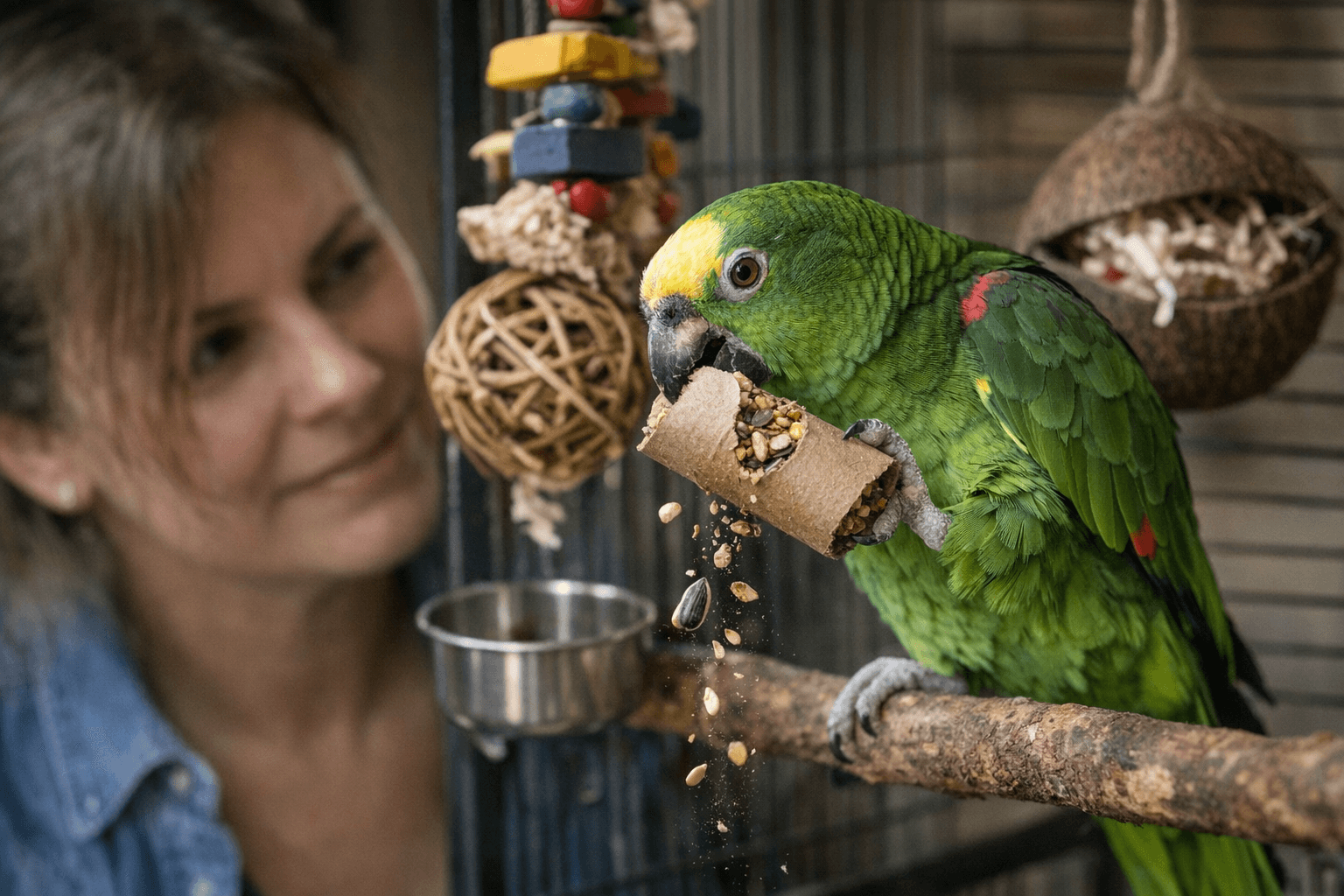
Sage, an African Grey, spent three hours one afternoon dismantling a paper towel roll packed with dried mango and sunflower seeds. Her owner had expected ten minutes of interest at best. What happened instead was a focused, industrious session that left Sage calm, occupied, and visibly satisfied in a way that her standard pellet bowl simply never produced. That shift, from passive eating to active problem-solving, is exactly what foraging enrichment is designed to create.
Parrots in the wild spend the majority of their waking hours searching for, extracting, and processing food. In a captive environment, that drive doesn't disappear; it simply finds other outlets, often destructive or distressing ones. Feather-plucking, incessant screaming, and repetitive cage behaviors are frequently rooted in understimulation. Foraging toys address the source directly by giving birds a species-typical route back to feeding. They stimulate natural problem-solving, reduce boredom-based behaviors, and cost, in many cases, almost nothing to make.
Starting Simple: Toys for Smaller Birds
For conures, parrotlets, and other small species, the paper roll treat is the natural entry point. Take an empty cardboard toilet or paper towel tube, fold one end slightly to create a seal, fill it with a mix of seeds or dried fruit, then fold or pinch the other end closed. The bird must manipulate and tear the tube to extract the treats, directly mimicking the peeling and nest-foraging behaviors these species perform in the wild. The materials cost nothing, the toys are disposable for sanitation purposes, and they can be refreshed daily without any additional effort.
Tug-and-pull fleece mats work well for small to medium birds that enjoy tactile engagement. Tie fleece strips to a mat backing and weave treats between the strips so the bird must pull and rearrange the fabric to uncover the food. The soft texture is appealing to smaller beaks, and the unpredictable placement of treats keeps the activity genuinely engaging rather than mechanical.
Building Complexity: Medium-Bird Puzzles
Medium birds, cockatiels, caiques, small amazons, benefit from layered challenges that require sequential thinking. The layered box puzzle uses a shallow cardboard box divided into compartments by cardboard spacers. Place favorite pellets or nut pieces in alternating sections, then cover each compartment with softer paper that the bird must shred or slide away to reach the reward. The multi-step structure means the bird cannot simply grab the food on first contact; it has to work through the puzzle layer by layer.
Foraging ropes with knotted beads suit the size range from conures up through cockatoos. String chewable-safe wooden beads and food pieces into knots along a cotton rope and suspend it inside the cage so the bird can tug, swing, and untie the knots to release the food. One important safety point: avoid loose metal hardware and synthetic fibers that can fray. Frayed synthetic rope can entangle toes quickly and without obvious warning, so inspect these toys before every use.
The cupboard swap works across all sizes under supervision. Take a small plastic cup, drill or punch a few 5 to 8 mm holes for airflow and waste, place a single large treat inside, and partially cover the opening. The bird must tip or manipulate the cup to access the reward. The partial cover is the key variable; it introduces just enough obstruction to require active problem-solving without making the challenge discouraging.
Large-Beak Options: Macaws and Amazons
For macaws and other large-beaked birds, the shell-hide is the appropriate scale of challenge. Place nut meats inside coconut shells or halved gourd shells that have small extraction holes. The bird must crack into and work around the shell structure to reach the food, engaging both the beak and grip in a way that smaller toys cannot. This directly mirrors the large-seed and hard-shell foraging these species perform in range.
The ladder of cups scales well for large birds with long wingspans and high activity needs. A vertical ladder has each rung fitted with a tiny foraging cup holding a different food item or a small puzzle. The bird is rewarded not just for solving each individual cup but for traveling vertically along the ladder, engaging its body and mind simultaneously. Different food categories in each cup add a sensory dimension, so the bird is constantly encountering new smells, textures, and flavors as it moves.
Habitat-Level Enrichment: The Forage Board
The forage board is the most ambitious option and the closest approximation to a natural foraging habitat you can create inside a home. Mount natural branches horizontally on a plywood base and intersperse glued safe bark chunks, rope sections, and toothy wood blocks with hidden treats. The bird interacts with the entire surface, investigating different materials and textures to locate food, rather than returning to a single point. This works for all sizes and functions effectively as a permanent enrichment station rather than a temporary toy.
Ice Treats and Sensory Novelty
On warm days, particularly for tropical species, ice treat blocks introduce both sensory novelty and cooling enrichment. Freeze cut fruit or diluted juice into a block with pellets embedded inside. The bird pecks and melts its way to the food, engaging its beak against an unusual resistance while receiving both hydration and nourishment. The sensory experience of cold, wet, melting food is meaningfully different from anything else in a typical cage environment, and that novelty alone drives sustained engagement.
Construction, Safety, and Sanitation
The material list matters as much as the design. Use only untreated hardwood, cotton, stainless steel, and leather that is explicitly labeled bird-safe. Zinc and galvanized metals are toxic and must be excluded entirely; even small ingested flakes from a galvanized component can cause heavy metal poisoning. Clean toys weekly using a diluted bleach rinse or a bird-safe enzymatic cleaner, and allow them to dry completely before returning them to the cage. Residual moisture inside cardboard or wood can grow mold rapidly, which poses a respiratory risk.
When selecting commercial food puzzles from pet suppliers, always choose sizes rated for your bird and trial them under supervision before leaving the bird unattended. Small parts that detach under beak pressure are an ingestion risk; check every component before and after each session.
Introducing Foraging Gradually
Birds that have never encountered foraging toys need a scaffolded introduction. Start with 10 to 20 minute supervised sessions and use the easiest possible version of each toy, with treats placed obviously and extraction requiring minimal effort. As the bird's confidence and skill build, increase the difficulty progressively. For fearful or stressed birds, pair every foraging session with calm vocal praise and a predictable routine. The goal is to associate the toy with safety and reward rather than confusion or frustration. If a bird shows extreme avoidance even after gradual exposure, consulting an avian behaviorist is the appropriate next step rather than pushing through.
Rotation: The Variable That Keeps Enrichment Working
Even the most engaging toy loses its pull over time. Rotate toy types and treat categories on a weekly schedule to prevent habituation, and if a bird's interest in a particular toy drops sharply, remove it and reintroduce it after two to three weeks. The break resets the novelty response. Keeping four or five toy types in regular rotation and varying the treats inside each one means the enrichment program stays genuinely stimulating across months rather than weeks.
A Note on Beak Health
If a bird that regularly uses foraging toys suddenly stops eating or shows any sign of beak trouble, including chips, abnormal wear patterns, or reluctance to bite, seek avian veterinary evaluation promptly. Beak pathology can develop quietly and may be masked by the novelty of a new toy in the short term. What looks like disengagement can occasionally be pain-avoidance, and early veterinary intervention produces significantly better outcomes than delayed care.
Well-designed foraging enrichment is among the highest-impact changes you can make to a companion parrot's daily life. The investment is low, the materials are largely already in your home, and the behavioral returns, reduced plucking, quieter mornings, a more confident and curious bird, compound over time. A parrot that forages is a parrot that is doing what it was built to do.
This article was produced by Prism’s automated news system from verified source data, official records, and press releases, then run through automated quality and moderation checks before publishing. The system is built and supervised by the people who set the standards it runs under. Read our full AI policy.
Did this article answer your question?