Tiny Parrotlet Turns Dishwashing Into a Cheerful Kitchen Pep Rally
Talon, a Pacific parrotlet, turned dishwashing into a one-bird pep rally, chirping and mimicking from his human’s shoulder. The clip shows how tiny parrots can remake daily chores.
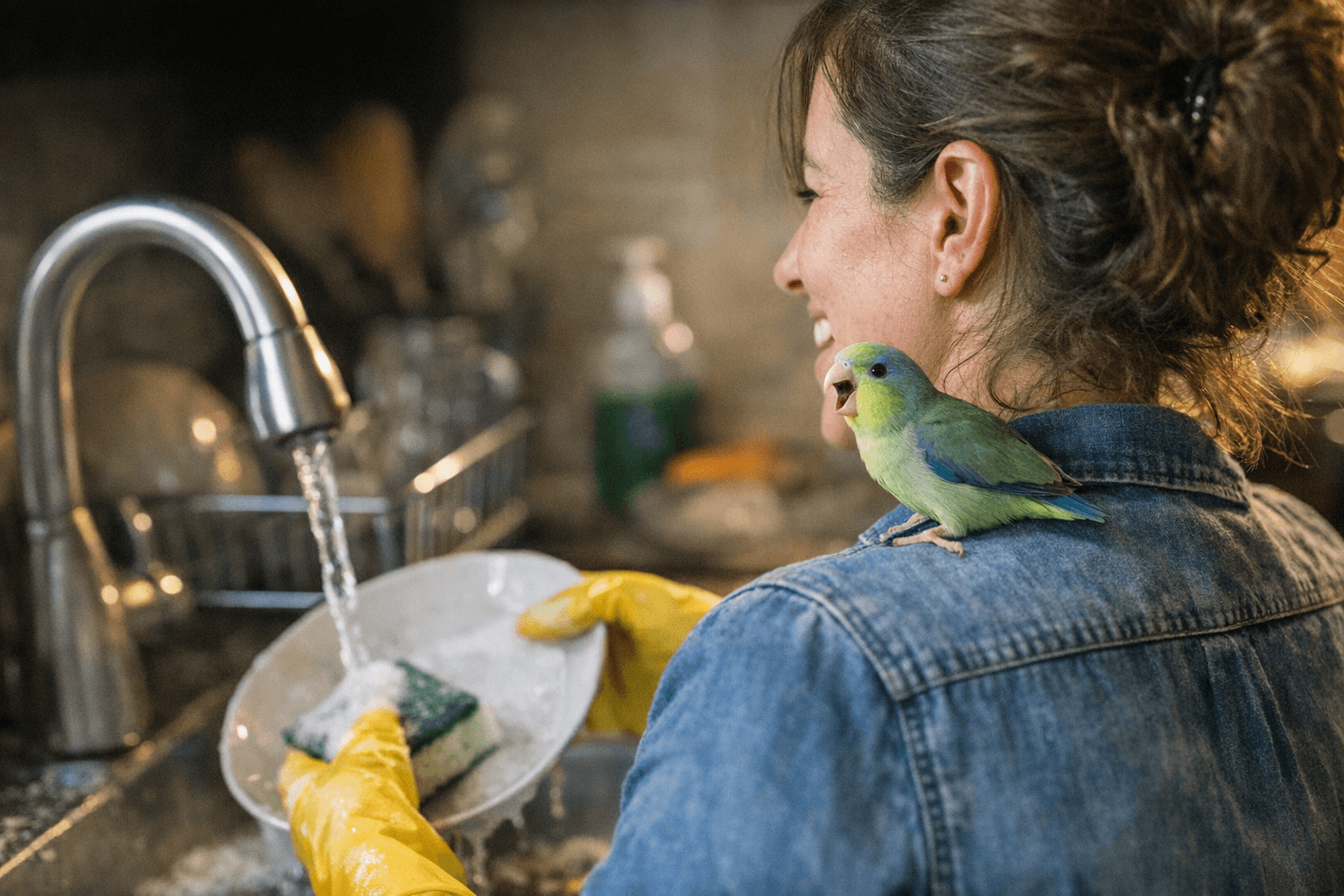
Talon made a sink full of dishes look like a group project. Perched on his human’s shoulder, the Pacific parrotlet piled on water noises, cheerful chatter, and the kind of running encouragement that makes a basic kitchen chore feel like a small victory lap.
That is the charm of a parrotlet like Talon, and it is also the lesson. Pacific parrotlets are tiny, sparrow-sized parrots native to western Ecuador, western Peru and far southwestern Colombia, but their presence is anything but small. In the wild, they usually move in small flocks and give high-pitched, metallic chirps and chatters. In a home, that same wiring can turn into a bird that wants in on everything, including the nightly cleanup.
The reason Talon’s routine works so well on screen is simple: parrots are vocal learners. They hear sounds and imitate them, which is why a little bird can pick up household noise, human speech and the rhythm of a routine that repeats every day. Talon is not just hanging around the kitchen. He is participating, and that sense of participation is exactly what makes a parrotlet feel like a full-time housemate instead of a decorative pet.
For owners, the payoff is real, but so is the responsibility. The Association of Avian Veterinarians breaks enrichment into five categories: sensory, nutritional, manipulative, environmental and behavioral. A shoulder ride during dishwashing can fit the behavioral side of that picture, as long as it stays brief, supervised and calm. The goal is engagement, not making the bird your shadow. Keep the bird away from hot pans, sharp knives, standing water and anything slippery, and do not let kitchen time become the only time the bird gets attention.
That matters because parrots can get clingy fast if every exciting moment centers on one person and one routine. A parrotlet that learns to scream for access to the sink is not being witty; it is rehearsing dependence. Better to use the moment as shared enrichment, then move Talon back to a cage or play stand stocked with safe chew items, since chewing is an important parrot behavior. Regular veterinary checkups also belong in the mix, because the same bird that sings through the dishes still needs the same health care as any other companion parrot.
BirdLife says the Pacific parrotlet’s global population has not been quantified, and tree cover in its mapped range has declined by 4.5 percent over the past 10 years. Audubon has also featured a Pacific Parrotlet named Obi in a flight-test story, a reminder that the species is drawing attention both as a pet and as a bird worth studying. Talon’s kitchen pep rally lands for the same reason: a tiny parrotlet can make an ordinary life feel louder, funnier and a lot more alive.
This article was produced by Prism’s automated news system from verified source data, official records, and press releases, then run through automated quality and moderation checks before publishing. The system is built and supervised by the people who set the standards it runs under. Read our full AI policy.
Did this article answer your question?