Bologna Certifies Authentic Fresh-Egg Pasta to Protect Traditional Artisans
Bologna awarded its De.Co. mark to roughly 600 sfogline and sfoglini, protecting hand-rolled egg pasta from industrial imitation at a ceremony inside Palazzo Pepoli.
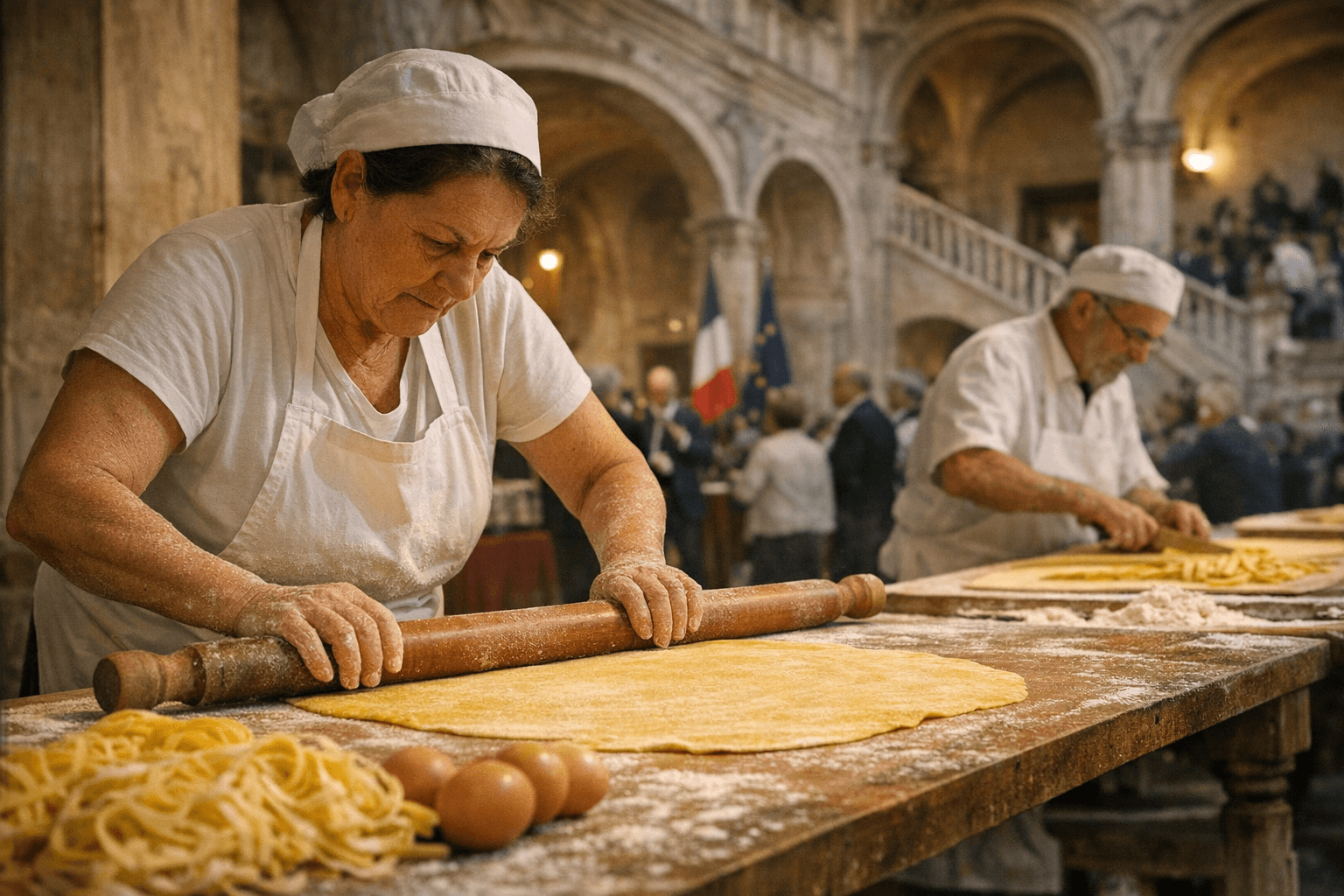
At Palazzo Pepoli in Bologna's historic center, the municipality formally granted its Denominazione Comunale di Origine, the De.Co. mark, to the city's sfogline and sfoglini, certifying authentic hand-rolled fresh egg pasta as an officially recognized and protected craft. Agricultural councilor Daniele Ara presided over the ceremony, which concluded an approval process started the previous July following a joint proposal by CNA Bologna and two of the city's most established pasta producers: Sfoglia Rina and pastificio Dalfiume.
The certification targets la sfoglia, Bologna's hand-sheeted fresh egg pasta, and the artisans who produce it. To qualify for the De.Co. designation, a sfoglina or sfoglino must demonstrate the ability to produce a smooth, elastic dough, roll it out exclusively with the mattarello, and cut the shapes that define the city's culinary identity: tagliatelle, lasagne, and tortellini. Around 600 practitioners currently work across Bologna and its metropolitan area, spanning professional laboratori, family operations supplying local markets, and the handful of shops whose names have become synonymous with the craft.
The De.Co. concept was originally conceived by Luigi Veronelli, the influential Italian journalist, gastronome, and enologist who argued that municipalities needed their own instrument to celebrate local excellence. Unlike European-level protections such as DOP or IGP, which regulate quality and geographic provenance, the De.Co. mark signals territorial belonging: it ties a skill or product to the place where it evolved rather than imposing production quotas or ingredient-sourcing requirements. Bologna had established its own De.Co. framework in 2020, and the sfogline certification stands as one of its most culturally visible applications since.
The move was driven in part by concern over what dilution looks like on a market shelf. Industrial or machine-sheeted products marketed under the broad banner of "fresh pasta" have steadily crowded Bologna's retail and restaurant supply chains, making it harder for small producers to communicate the difference between machine output and a sheet rolled by hand. Alberto Solini, owner of pastificio Dalfiume with nearly four decades of experience, has highlighted the daily difficulty of finding young workers willing to learn the craft, a labor shortage threatening continuity just as consumer interest in provenance has peaked. His laboratorio employs 16 people, scaling to 22 during the Christmas rush when demand for fresh tortellini surges.
For chefs sourcing pasta, the De.Co. label now provides a traceable signal for procurement decisions. For students and hobbyists training in Bologna's courses and competitions, including the Matterello d'Oro, the certification raises the institutional weight of the skills they are acquiring. Whether the scheme's administrative requirements prove manageable for sole-trader sfogline beyond the city's main workshops will determine how widely the mark spreads, but the directional intent is unambiguous: Bologna has decided that the mattarello, and the people who wield it, need formal protection.
This article was produced by Prism’s automated news system from verified source data, official records, and press releases, then run through automated quality and moderation checks before publishing. The system is built and supervised by the people who set the standards it runs under. Read our full AI policy.
Did this article answer your question?