BUA Foods Posts N1.77 Trillion Revenue, Citing Strong Demand for Pasta and Staples
BUA Foods posted N1.77 trillion in 2025 revenue, with pasta a named demand driver; a deal with Italy's FAVA will push the company's annual pasta output to 900,000 metric tonnes.
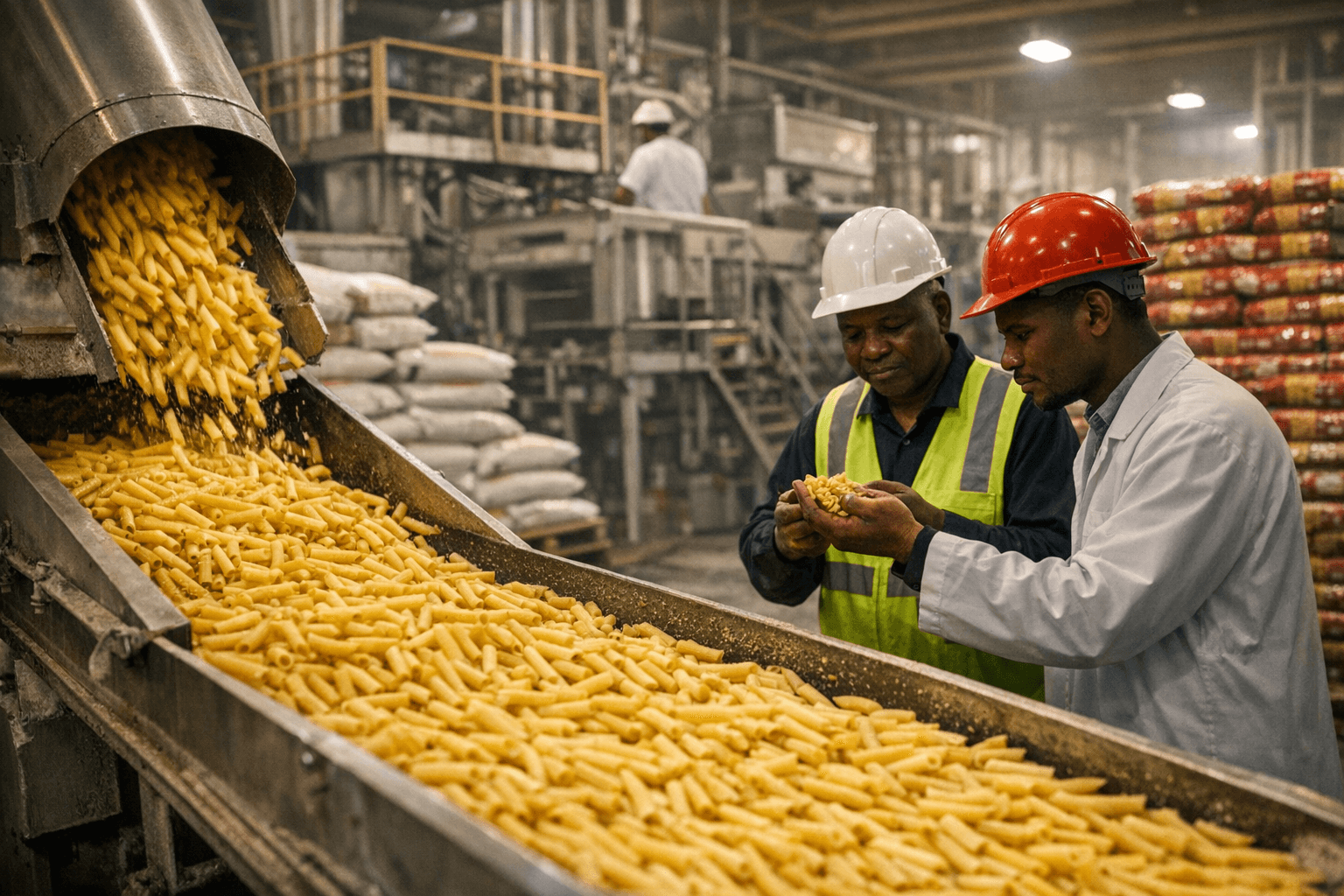
BUA Foods posted N1.77 trillion in audited 2025 revenue, naming pasta alongside sugar, flour, and rice as the explicit demand drivers behind a 16 percent gain from N1.53 trillion the prior year. The company is already mid-execution on a deal with Italy's FAVA to nearly double pasta production capacity to 900,000 metric tonnes per annum.
The results cover the financial year ended December 31, 2025. They were released alongside news from BUA's headquarters in Lagos, where BUA Group founder and chairman Abdul Samad Rabiu hosted Tony Elumelu, chairman of United Bank for Africa, to deepen a financing partnership underpinning manufacturing and industrial expansion. "Our 2025 performance reflects a business that is not only growing, but scaling with discipline," Rabiu said. "We are building capacity, deepening local production, and delivering consistent value to shareholders, all while positioning for the future." Elumelu said BUA Group demonstrates "what is possible when long-term capital meets disciplined execution."
The FAVA partnership commits to adding nine lines of long-cut pasta at 6,000 kilograms per hour each, pushing annual output from 500,000 to 900,000 metric tonnes and positioning BUA as one of Africa's largest pasta producers. That expansion runs in parallel with a separate agreement with Turkish milling equipment company IMAS for four new wheat flour mills at 3,200 tonnes per day, lifting BUA's overall wheat flour milling capacity to 2.5 million tonnes annually. MD Ayodele Abioye has flagged supply-chain optimization as a central priority alongside the physical build-out.
The grain import reality sharpens the context: Nigeria currently brings in 99 percent of the 5.67 million metric tonnes of wheat it consumes each year. BUA's outgrower wheat cultivation scheme in Kano and backward-integration push into sugar in Kwara State point toward narrowing that dependency, which would reduce raw-material costs across all wheat-based products, pasta included.
For home cooks tracking what hits shelves over the next 18 to 24 months, three things are worth watching. New shapes are the most tangible near-term prospect: BUA noted more than 600 pasta shapes are produced globally and flagged the gradual introduction of new varieties to the Nigerian market. Fortified and enriched pasta formulations are a logical extension of BUA's existing enriched flour lines, given Nigeria's regulatory framework around staple food fortification. And as the FAVA long-cut lines come fully online, the spaghetti format that already dominates Nigerian kitchen cabinets should see meaningful availability gains with real downward price pressure.
That format underpins the most naturalized Nigerian pasta preparation: jollof spaghetti. The approach is a deliberate departure from Italian convention. You blend tomatoes, red bell peppers, and scotch bonnet, then fry the puree down in oil with onion until it thickens to something closer to a paste. Stock, curry powder, thyme, and seasoning cubes go in next. The dry spaghetti finishes directly in that sauce with just enough liquid to cook it through, absorbing the smoky, deeply savory base the same way jollof rice does at the bottom of the pot. No separate boiling, no draining, no ladled sauce on top. The result tastes like the inside of a Nigerian pot rather than an Italian bowl, which is exactly the point, and exactly the kind of embedded household demand that shows up in a N1.77 trillion revenue line.
BUA Foods also proposed a N28-per-share dividend alongside the results. When a company paying dividends and simultaneously closing nine-line equipment deals with an Italian pasta manufacturer names pasta as a core revenue driver, the shelf in Lagos is going to look different in 18 months.
This article was produced by Prism’s automated news system from verified source data, official records, and press releases, then run through automated quality and moderation checks before publishing. The system is built and supervised by the people who set the standards it runs under. Read our full AI policy.
Did this article answer your question?