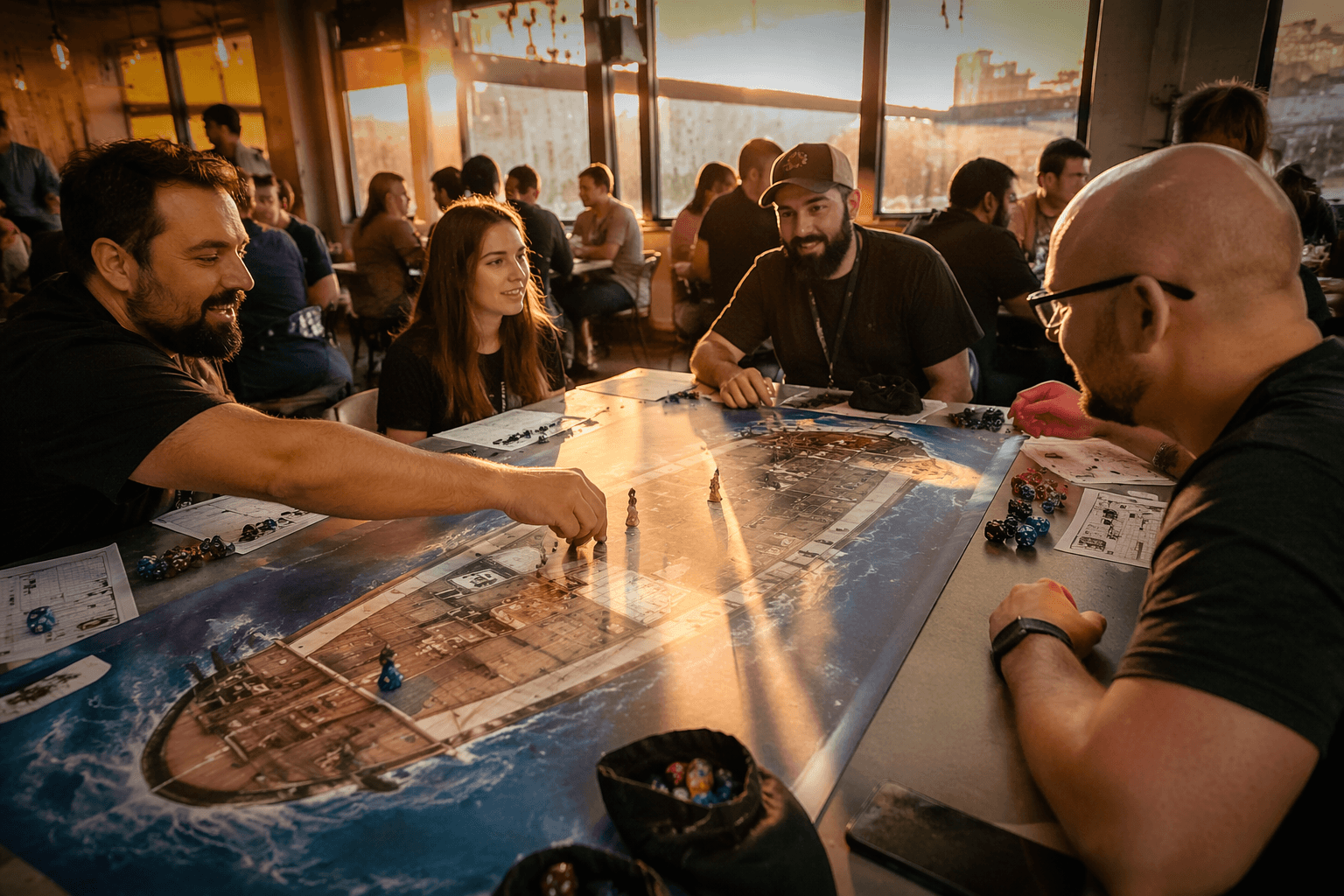
Ten Ready-to-Use Pathfinder Adventure Hooks for Busy GMs
Ten plug-and-play adventure hooks built for Pathfinder Second Edition, each with a premise, NPC, and mechanical twist you can run with one page of prep.

Every GM knows the feeling: it's two hours before session, your planned arc fell apart, and you need something that'll actually hook your table. These ten hooks are built for exactly that moment. Each one comes with a one-sentence premise, a setup, a suggested NPC or monster, and a single mechanical twist that makes the scene feel unmistakably like Pathfinder. Slot them into a one-shot, drop them into a gap in your Adventure Path, or use them as the spark that starts a whole new campaign arc.
The Flooded Archive
An ancient pocket-library rises from a sphinx-guarded swamp, and the locals are willing to pay for a single scroll retrieved from its depths. Simple enough on paper, but the scroll itself is the real problem: it's a map that changes every time it's read. Use illusion and maze mechanics to simulate the shifting layout, turning what looks like a straightforward fetch quest into a navigational puzzle that rewards players who think laterally rather than just charging forward. A sphinx or a clutch of water elementals make for guardians that feel proportional to the prize.
The Broken Oath
A champion's divine connection has been severed, their patron's blessing retracted without explanation. They come to the party not for a fight, but for help performing a restorative ritual. The mechanical twist here is what makes this one sing: re-sealing the oath requires skill checks tied to both social interactions and combat, woven together in a single encounter sequence. A fallen paladin turned revenant works perfectly as the antagonist, someone who failed the same trial and now exists as a cautionary echo of what the champion could become.
The Automaton That Sleeps When Watched
A ruined structure somewhere on the edge of civilization holds a construct unlike anything in a standard bestiary: it only moves when no one is looking at it. An archaeologist hires the party to recover its core, which sounds manageable until the first time the table realizes the thing is right behind them. Run this using alternating rounds of concealment and Perception checks to simulate the "moves when unobserved" behavior. It's a cinematic combat puzzle that plays on player paranoia in the best possible way, and it tends to generate exactly the kind of table tension that people talk about for months afterward.
The Mirrored Heist
A museum piece has been swapped for a perfect duplicate, and the institution, unable to prove the party's innocence, offers them a deal: find the real artifact and the charges disappear. The guild contact or rogue antagonist pulling the strings is a satisfying cat-and-mouse target, but the real curveball is the duplicate itself. It's sentient, and it actively sabotages Perception checks to protect its own existence. That single detail reframes the entire investigation and gives even skill-heavy parties a challenge they can't just roll their way through.
The Fading Festival
A village festival is bleeding magic from its attendees, and the chef-Guildmaster running the event is desperate enough to hire outsiders. The culprit is a fae trickster, but confronting it isn't a straightforward fight: the festival's power wanes each round, creating a timed challenge that forces the party to balance negotiation against urgency. This hook works especially well when players have a mix of social and combat builds, since both skill sets become genuinely necessary rather than one overshadowing the other.
The Last Mirage Dragon
A merchant prince is offering serious coin for intelligence on a mirage dragon that's been haunting the shipping lanes, appearing only within specific terrain conditions. The encounter itself is a large one, but the terrain illusions are what give it its teeth: players must make navigation checks and Will saves to avoid being funneled into traps laid by a creature that is, fundamentally, made of misdirection. This is a hook that rewards parties who read the environment carefully rather than sprinting toward the biggest threat on the board.
The Corrupt Archive
A scriptorium's institutional memory is being eaten, literally. A scholar's memory-ink is being erased by what amounts to an intellectual parasite, and the hiring party needs it stopped before irreplaceable knowledge is lost forever. The mechanical twist is disorienting in a satisfying way: spells and skill checks fail intermittently unless characters perform knowledge-based rituals to stabilize the environment. An ooze or intellectual parasite fits the horror-adjacent tone of this one, and the scriptorium setting gives the whole thing a wonderfully dusty, academic dread.
The Missing March
A military unit went silent on the warfront, and a commander needs scouts, specifically the party, to find out why. What they discover is a mix of human deserters and a summoned outsider, and the central challenge is figuring out which is which. Rather than leaning on combat as the primary resolution tool, this hook makes social inference the load-bearing mechanic: use social checks in place of full combat to determine friend from foe. It's a hook that tends to catch combat-heavy parties off guard and gives roleplayers a genuine moment in the spotlight.
The Nameless Contract
The party finds a cursed contract on a corpse in a tavern. Whoever signed it is bound to obey an unknown patron, and the conditions reveal themselves slowly rather than all at once. A minor fiend or devil-broker lurks behind the document, but the real tension is the choice the party faces in real time: accept a tangible immediate benefit while the long-term cost remains deliberately obscured. Run this hook as a slow burn. Let the contract's full terms emerge over multiple sessions. The ambiguity is the point.
The Echoing Spire
A tower whispers prophecies to everyone who enters, and an oracle needs a lost page retrieved from somewhere inside. The prophetic wraith haunting the spire is the immediate threat, but the mechanical twist is what elevates this hook above a standard dungeon crawl: every prophecy heard inside the spire imposes a lasting mechanical penalty or bonus that persists for the entire session. Some players will receive advantages that reshape their tactics; others will be working around a genuine liability. It creates asymmetry at the table in a way that feels earned rather than arbitrary.
Running These Hooks at Your Table
Getting any of these to the table fast follows a simple pattern: pick a hook, pull a level-appropriate statblock from the Remaster or the Archives of Nethys PRD, decide whether you're running a tight 1-2 hour one-shot or cracking open an extended arc, and give your key NPC a single clear motivation. Keep your prep document to one page: the goal, the obstacle, one social encounter, and one mechanical encounter. That's enough scaffolding to run a session that feels complete.
The hooks that land hardest at the table are the ones where a vivid image meets a single rules-light mechanical twist: a scroll that reshapes itself, a construct that moves in your blind spot, a contract that never shows all its cards. Build around that combination and your players will do most of the creative heavy lifting themselves.
This article was produced by Prism’s automated news system from verified source data, official records, and press releases, then run through automated quality and moderation checks before publishing. The system is built and supervised by the people who set the standards it runs under. Read our full AI policy.
Did this article answer your question?