AJR Images uses Nikon 800mm lens to capture split-second action
Alan Randle’s 800mm surf setup shows that elite reach is only half the trick. The real payoff is anticipation, framing, and timing that still matter on a 100-400mm.
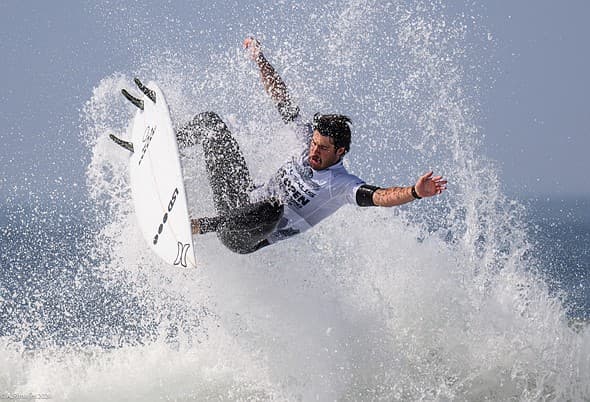
An 800mm lens can make a surfer look close enough to touch, but the real advantage is not reach. Alan Randle, the photographer behind AJR Images, shows how super-telephoto shooting turns split-second action into a discipline of patience, prediction, and restraint.
A long view built on fast subjects
Randle is based in Southern California, originally from the United Kingdom, and has been photographing since the early 1960s. He has spent the last 15 years working more seriously, building a body of work around airshows, surfing, wildlife, and other fast-moving subjects where the camera only gets one clean chance. That background matters because his lens choices are not about collecting expensive gear. They are about matching the right tool to subjects that disappear almost as quickly as they appear.
The surf setting highlighted in the community spotlight is Huntington Beach, home of the US Open of Surfing. The event is described as the world’s largest surf competition and has been hosted there every year since 1959. The first West Coast Surfboard Championships in September 1959 drew 75 entrants across five divisions, which gives the location a deep competitive history as well as a modern one. The 2026 US Open of Surfing is scheduled for July 25 through August 2, 2026, making it a natural stage for a photographer trying to freeze a moment that lasts only a heartbeat.
What the Nikon 800mm actually changes
Randle leans on Nikon super-telephoto glass, including the Z 400mm F2.8 TC, the Z 600mm F4 TC, and especially the Z 800mm f/6.3. Nikon announced the NIKKOR Z 800mm f/6.3 VR S on April 5, 2022, with availability starting in April 2022 and a suggested retail price of $6,499.95. It weighs 2,385 g and measures 385 mm in length, and Nikon says it is about 48% lighter and 16% shorter than its older F-mount 800mm f/5.6.
Those numbers matter because they explain why a lens this extreme is usable in the field instead of just impressive on a spec sheet. Nikon also says the lens is designed for sports, bird, wildlife, and aviation photographers, and that it can be paired with Z teleconverters for 1120mm or 1600mm reach. It is also built to support smooth panning on fast-moving subjects such as planes and birds, which is a clue to how it behaves when the action is unpredictable and the subject is never still for long.
For photographers working with a 100-400mm, or even a crop body, the lesson is not to chase the same focal length. It is to understand what the extra reach buys you: cleaner subject isolation, tighter framing without intrusion, and the ability to stand back while still filling the frame with motion that would otherwise be too small to matter.
Anticipation is the real autofocus choice
The most useful part of Randle’s approach is not the lens itself but the way he describes using it. He studies the movement patterns of surfers and waits for the peak instant. That is the real lesson for anyone shooting action, because the frame is decided before the shutter fires. At 800mm, the margin for error gets brutally small, so success depends on reading body language, wave shape, and the build-up to the move rather than reacting late.
That mindset translates directly to more accessible gear. A 100-400mm on a mirrorless body can still produce excellent action frames if you are waiting for commitment instead of spraying frames at random. A crop sensor body can make a modest zoom feel longer, but it does not replace timing. The subject still has to enter the strongest part of the frame, and the shot still needs to land at the moment when the surfer, bird, or aircraft reaches the point of greatest tension.
The same logic applies to panning. Nikon’s note that the 800mm is engineered for smooth tracking on fast-moving subjects underlines a larger truth: long-lens action is not about freezing everything rigidly. It is about keeping the subject stable enough in the frame that the motion feels controlled, even when the scene itself is chaotic.
Why the bag matters as a system
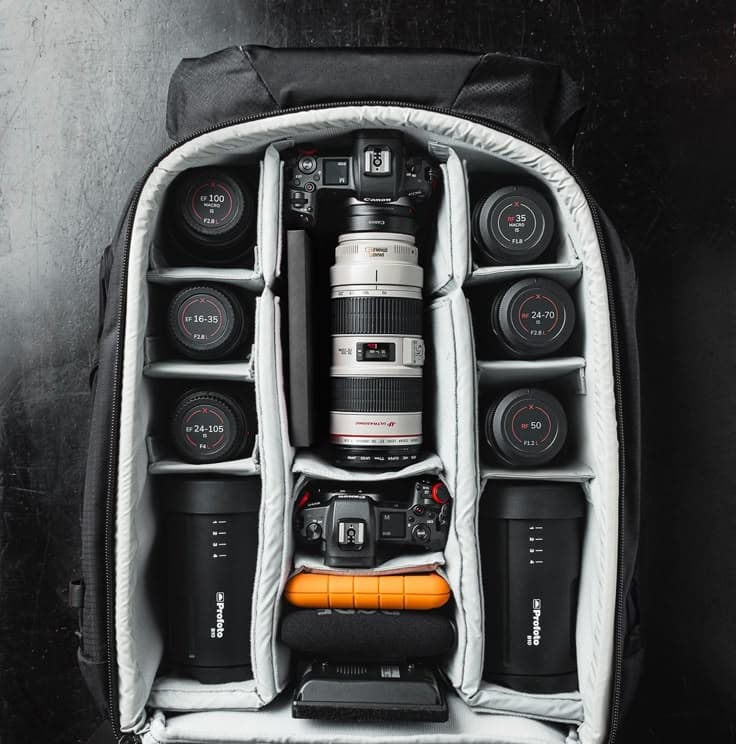
DPReview places Randle in its What’s in your bag? community spotlight series, and that framing is important. His setup is not a random stack of flagship bodies and giant lenses. It is a deliberately matched system built around speed, reach, and reliability. He uses Nikon Z9 bodies for most of the heavy lifting, alongside a Z6III and a 24-120mm F4 for more general work and travel.
The Z9 adds context to the way he shoots. It is Nikon’s 45.7-megapixel flagship mirrorless body, with subject detection for nine subject types, up to 120 fps in reduced-resolution shooting modes, and a blackout-free EVF. That combination is built for keeping a moving subject locked in place while the photographer concentrates on timing and composition. The Z6III, released on June 17, 2024, is Nikon’s compact full-frame option that inherits pro-level performance from the Z9 and Z8, which makes it a practical companion when the assignment shifts away from the heaviest telephoto work.
That mix is the deeper takeaway for readers who shoot with more attainable gear. The bag is not about owning the longest lens in the room. It is about choosing a body and lens combination that fits the way you actually work. If your shooting leans toward surf, birds, aviation, or field sports, the right setup is the one that lets you wait longer, track cleaner, and frame more confidently when the split-second finally arrives.
What to borrow from an 800mm shooter
- Stand where the action repeats, not where it first looks dramatic. Repetition gives you more chances to predict the peak moment.
- Watch for commitment. On surf, that means the takeoff, the turn, or the instant the board and body load up before the maneuver.
- Use longer reach to simplify the frame. A 100-400mm can still isolate the subject if you let the background fall away and avoid clutter.
- Let the action come to the lens. Crop bodies and telephoto zooms reward calm tracking more than frantic reframing.
- Build the shot around the move, not the aftermath. The best frame is usually the one just before the subject finishes the action.
Randle’s AJR Images work makes the case that super-telephoto shooting is really about seeing sooner. Whether the frame is coming from an 800mm f/6.3, a 600mm, or a far more modest zoom, the winning habit is the same: read the motion early, trust the setup, and press the shutter at the instant the scene is about to happen, not after it already has.
This article was produced by Prism’s automated news system from verified source data, official records, and press releases, then run through automated quality and moderation checks before publishing. The system is built and supervised by the people who set the standards it runs under. Read our full AI policy.
Know something we missed? Have a correction or additional information?
Submit a Tip