Artemis II Astronauts Bring Film School Training to Space Mission Photography
Four Artemis II astronauts completed a National Geographic film school before launching to the moon on April 1, 2026, with 28 cameras and a last-minute Nikon Z9 aboard.
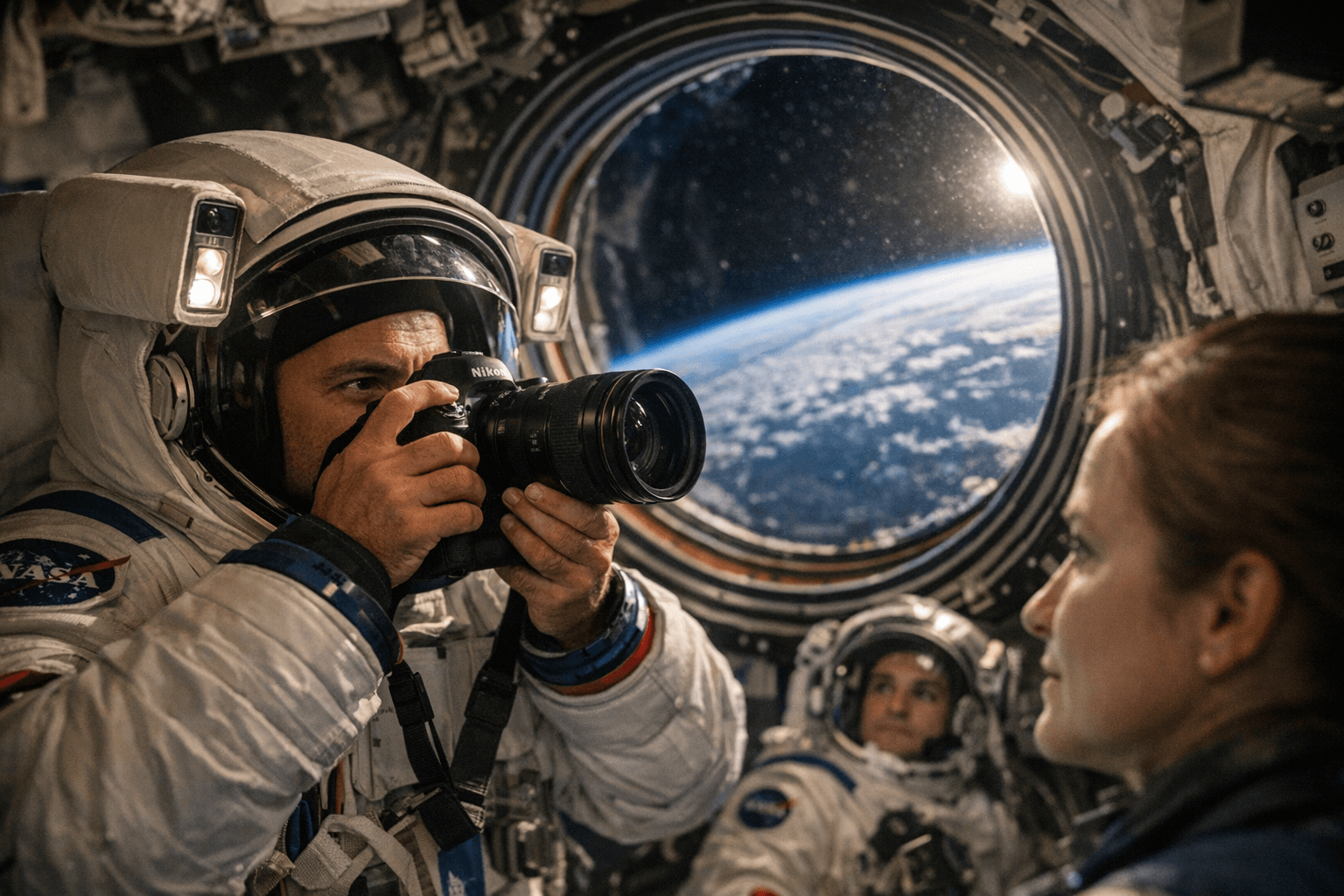
Four astronauts cleared Earth's atmosphere on April 1, 2026, carrying more than 28 cameras, formal film school credentials, and one very last-minute piece of mirrorless gear. The Artemis II mission, the first crewed lunar-trajectory flight since Apollo 17, launched with a photographic arsenal and a storytelling philosophy unlike anything NASA has sent toward the moon before.
The Crew Behind the Cameras
Commander Reid Wiseman, Pilot Victor Glover, Mission Specialist Christina Koch (NASA), and Mission Specialist Jeremy Hansen of the Canadian Space Agency make up the four-person crew aboard Orion. In their more than two years of training together, they've clearly developed a strong camaraderie and shared excitement over the mission. What sets this crew apart visually isn't just the hardware they carry, but the formal media education they received before ever strapping in.
Reid Wiseman, Victor Glover, Christina Koch, and Jeremy Hansen essentially attended a mini "astronaut film school," learning core visual storytelling techniques to better showcase the Artemis mission. That training came directly from National Geographic, whose editorial staff spent roughly a year working with the crew. National Geographic has been covering space exploration since the Mercury and Gemini missions of the 1960s, and photographer Dean Conger was even on the scene to capture the splashdown of Alan Shepard, right after he became the first American in space in 1961. This time, the collaboration is with the astronauts themselves.
What "Astro Film School" Actually Means
The National Geographic training programme, branded internally as "Astro Film School," wasn't a weekend workshop. During the Artemis II mission, the astronauts will act as photographers for the magazine, videographers for social media, and filmmakers for a documentary, on one of the most extraordinary assignments imaginable: flying around the moon and traveling farther in space than any humans have before. That triple role requires distinct skills, and the curriculum covered them: framing for stills, pacing for video sequences, and the narrative logic of documentary filmmaking.
The behind-the-scenes "Astro Film School" footage shows the crew testing National Geographic cameras at NASA's Johnson Space Center in Houston, working inside a replica of the Orion spacecraft to understand the physical constraints they'd face on orbit. Orion is a cramped space of just 330 cubic feet, about the size of two minivans, meaning every shot requires awareness of what's behind you, above you, and literally pressing against your elbow. Understanding narrative composition in that environment is a skill you can't improvise at 240,000 miles from Earth.
The Hardware: Why a 2016 DSLR Is Flying to the Moon
At least 28 cameras are aboard the Orion for the Artemis II mission, including GoPros, DSLRs, and a mirrorless camera, with cameras mounted to the spacecraft's exterior and interior as well as handheld cameras carried by the crew. The primary imaging workhorse is a camera that surprises most photographers when they first hear it: the Nikon D5, a DSLR released in 2016.
Two Nikon D5 bodies will be aboard the Orion spacecraft, equipped with wide-angle and telephoto lenses. The choice wasn't arbitrary. According to NASA's Orion Imagery Working Group planning document, the D5 was selected for qualities that matter specifically beyond Earth's orbit: its high dynamic range handles the extreme contrast between sunlit surfaces and deep shadow, its radiation resistance is well-documented beyond low Earth orbit, and its ISO range extends to an expanded equivalent of 3,280,000. For imaging the lunar surface, where the sun blasts featureless white off regolith while crater interiors sit in absolute black, that dynamic range isn't a luxury; it's a scientific requirement.
The Nikon D5 remains the camera of choice for the Artemis II mission and will be assigned primary photographic duties as a proven, highly-tested camera that the team knows will excel in the high-radiation environment of space. The Z9, by contrast, is aboard for a very different reason.
The Last-Minute Z9 Addition
Although the plan had been for the Artemis II astronauts to bring just Nikon D5 DSLR cameras, last-minute requests by the crew helped get a Nikon Z9 aboard before it launched. The push came directly from Wiseman, who lobbied hard for the mirrorless body to be included. As he explained ahead of the April 1 launch: "That's the camera that they'll be using on Artemis III plus, so we were fighting really hard to get that on the vehicle to test out in a high-radiation environment in deep space." Wiseman described it as a "great piece of gear" and noted the team completed last-minute training with the Z9 before launch.
Being able to put a Nikon Z9 through its paces aboard the Artemis II mission as it navigates space and orbits the Moon should prove extremely helpful for future Artemis missions and provide NASA with essential data as it finalizes the HULC program. The Artemis III mission, which will put humans back on the Moon for the first time since 1972, is scheduled for launch next year. The imaging data Wiseman and crew collect on Z9 sensor performance in deep-space radiation could directly determine which bodies land on the lunar surface.
Storytelling Over Documentation
What the National Geographic partnership signals most loudly is a philosophical shift in how NASA thinks about mission imagery. The training in narrative filmmaking means crew members can make deliberate creative choices: selecting sequences that build emotional momentum, framing shots that place a human face against the curvature of Earth, pacing footage to serve both scientific clarity and public understanding. These aren't accidental outcomes of pointing a camera out a window.
The backup crew members, including Jenni Gibbons of the CSA, also received the National Geographic training, meaning the storytelling competency extends beyond the four primary flyers. NASA's investment in media literacy across the Artemis programme reflects a recognition that the cultural record of a mission matters as much as its scientific log, and that the two are most powerful when the same person captures both.
Why This Matters for Photographers on the Ground
The Artemis II imaging setup is a compressed masterclass in real-world photographic constraint. When 330 cubic feet is your entire studio, every equipment decision is an editorial choice. The Nikon D5's selection over newer hardware underlines a principle working photographers know well: the best camera for a job isn't the newest one; it's the one whose failure modes you understand completely. The last-minute inclusion of the Z9 adds a layer most photographers recognise too: you advocate for the tool you believe in, even when the manifest is already closed.
The broader lesson from the National Geographic film school programme is that technical competence and narrative craft are not separate disciplines. The Artemis II crew isn't carrying cameras as an afterthought to the science. They've been trained to use them with intention, on a mission that will take them farther from Earth than any human has traveled in over fifty years. The images they return with will be shaped by that education in ways that go far beyond any spec sheet.
This article was produced by Prism’s automated news system from verified source data, official records, and press releases, then run through automated quality and moderation checks before publishing. The system is built and supervised by the people who set the standards it runs under. Read our full AI policy.
Did this article answer your question?