Backyard Astrophotographers Stitch 250,000 Photos Into Stunning 174-Megapixel Moon Portrait
Andrew McCarthy and Connor Matherne stacked 250,000 photos into a 174-megapixel Moon portrait; the method is replicable from any backyard with a telescope.
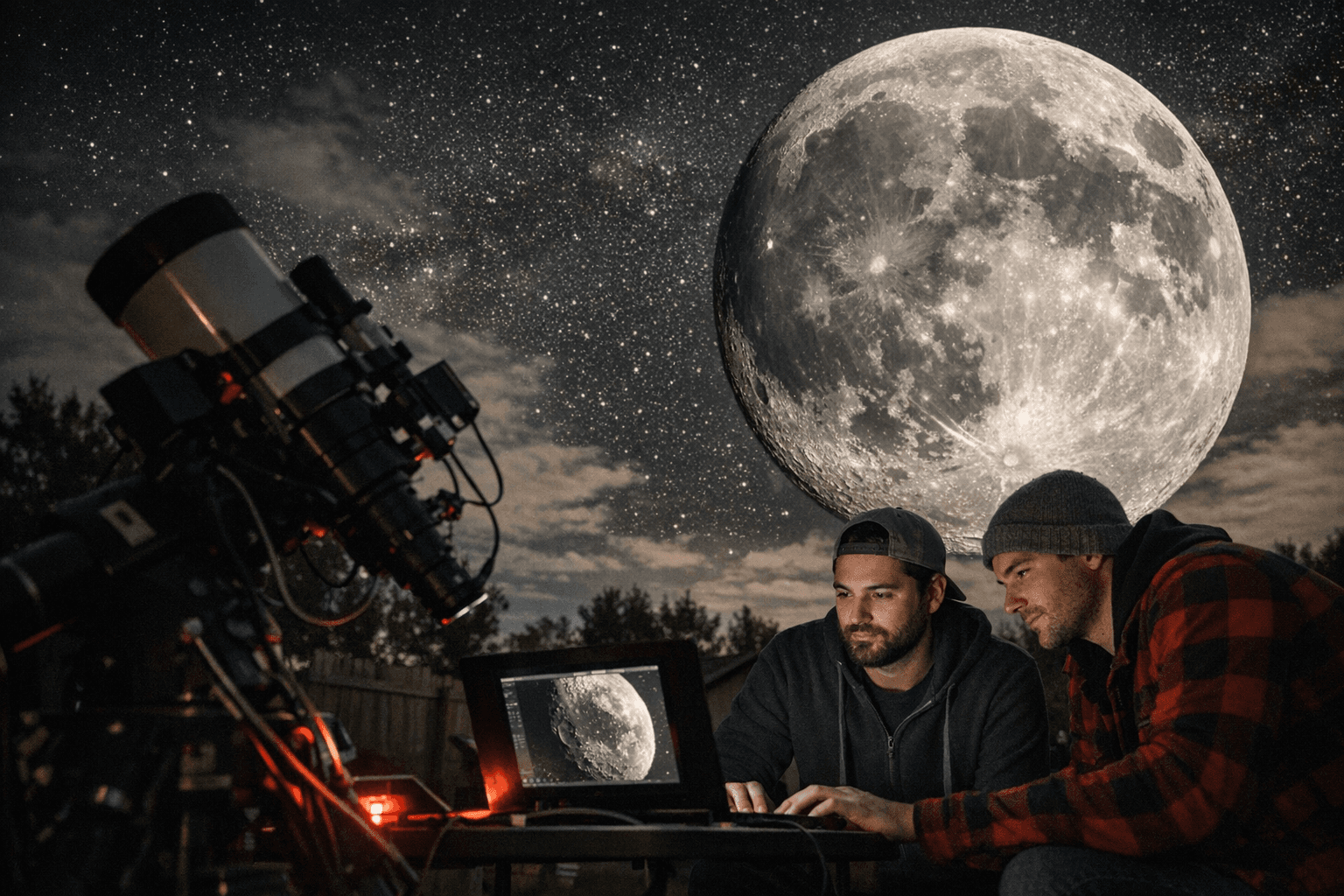
Two hundred and fifty thousand photographs. Nine months of edits exchanged across state lines. The result: a single 174-megapixel portrait of the Moon that reveals colors the naked eye was never meant to see.
Andrew McCarthy, the Arizona-based astrophotographer behind the 2-million-follower Instagram account @cosmic_background, built "The Hunt for Artemis" alongside Connor Matherne, a planetary scientist and Louisiana State University alumnus who graduated in 2017 and 2019. The pair first connected on Reddit and Instagram, and when NASA's Artemis 1 mission was approaching its originally planned August 29, 2022 launch date, they set out to create what McCarthy called "the most ridiculously detailed moon images we could come up with."
The division of labor was geographic and technical. As McCarthy described it: "I captured 200,000 up-close surface detail shots, while Connor captured 50,000 full-color shots of the full lunar disc." McCarthy shot from Arizona using a ZWO ASI 224MC CCD camera, focusing entirely on granular surface detail in a single evening. Matherne handled full-disc color data from Louisiana. Without those 50,000 color frames, McCarthy noted on Reddit, the image "would have been dreary gray."
The color embedded in the final image is scientifically real, not invented. Reddish tones mark regions of the lunar regolith rich in iron and feldspar; bluish zones indicate concentrations of titanium. These subtle differences exist because of oxidation driven by Earth's atmospheric influence, but they sit below the threshold of unaided human vision. McCarthy and Matherne increased the saturation to pull them into view, effectively making the Moon legible as a geological map.
After the shooting was done, the actual work began. Using photo stacking and stitching, the two spent nine months merging, refining, and exchanging edits before the final composite appeared on Reddit around August 20, 2022. Viral coverage followed within days across Space.com, CBS News, and IFLScience.
What makes McCarthy's method worth studying is that the capture side required no exotic facility. A high-frame-rate planetary camera like the ZWO ASI 224MC, paired with a stable mount and a long focal-length telescope, represents the professional entry point. Shooters on a tighter budget can start with a Sony mirrorless body (McCarthy also relies on a Sony a7ii) and free stacking software like AutoStakkert! or Registax, which handle the computational heavy lifting that turns hundreds of shaky frames into one sharp result. The principle scales from 50 stacked frames to 200,000: shoot more than you think you need, stack everything, and discard nothing until the sort.
For the color workflow specifically, McCarthy and Matherne's split-role model is replicable for any two photographers in different cities with coordinated timing. One shooter locks onto fine surface texture at high magnification; a second captures the full disc at lower magnification for color reference. Stacking software aligns the geometry afterward.
"The Hunt for Artemis" first appeared publicly just nine days before NASA's originally planned Artemis 1 lift-off. The rocket ultimately launched November 16, 2022, carrying the uncrewed Orion spacecraft on its first integrated flight with the Space Launch System from Cape Canaveral, Florida. Orion reached a maximum distance of 268,563 miles from Earth before splashing down December 11, 2022. McCarthy later pushed the method further still: in May 2023 he released "GigaMoon," a 1.3-gigapixel lunar image assembled from 280,000 photographs across two telescopes.
You don't need a mission to justify the method. A clear night and a stacking count measured in the hundreds is enough to start.
This article was produced by Prism’s automated news system from verified source data, official records, and press releases, then run through automated quality and moderation checks before publishing. The system is built and supervised by the people who set the standards it runs under. Read our full AI policy.
Did this article answer your question?