BBC photo picks spark debate over 2026's best images so far
BBC Culture’s photo shortlist has photographers arguing over a familiar split: historic importance versus pure image-making. The two most debated picks reward timing and story, but not everyone calls them the year’s strongest frames.
BBC Culture’s latest image roundup has done what the best photo selections always do: it has drawn a line between a picture that matters and a picture that sings. Digital Camera World’s response to the shortlist zeroes in on two images in particular, both undeniably powerful, both easy to defend, and both open to argument on the question that hangs over every year’s “best of” debate.
The shortlist that set off the argument
The BBC Culture roundup, titled “Nine of the most striking images of 2026 so far,” is framed as an expert guide to eye-catching work from the first half of the year. Its range matters, because it does not limit itself to one genre or one newsroom style, but moves across hard-hitting press photography, landscapes, and creative aerial imagery. That breadth is part of why the choices are being watched closely: once a shortlist tries to define the year’s visual pulse, every omission and inclusion becomes part of the conversation.
Maduro and Flores arrive in Manhattan
The first image at the center of the debate shows Nicolás Maduro and Cilia Flores arriving in Manhattan under DEA custody, a Reuters and Zuma Press frame that carries immediate political weight. Digital Camera World notes that Maduro led Venezuela for 13 years, from 2013 to 2026, during a prolonged economic and humanitarian crisis, which gives the image a heavy historical charge before anyone even starts talking about the light, angle, or lens choice. The report also says Maduro and Flores were arrested in a U.S. raid in January and face several charges, making the photograph less a standalone portrait than a document of a political collapse in motion.
What makes the picture difficult to dismiss is also what makes it difficult to crown. It is the kind of frame editors reach for when they want the stakes to be unmistakable, because the subject matter lands instantly and the symbolism is blunt. But once the first reaction passes, the composition has to survive a tougher test: does the picture transcend the event, or does the event do most of the work?
Why the Maduro frame divides photographers
This is where the expert-versus-community split comes into focus. Photo judges often reward images that crystallize a moment with clarity, especially when the subject is historically consequential and the timing is exact. Many photographers, though, reserve “best of the year” language for frames that also bring something less obvious to the table, whether that is visual tension, layered gesture, or a composition that keeps revealing itself.
That tension explains why the Maduro image can feel important without being universally loved. The arrest context is unmistakable, the names are instantly recognizable, and the photograph has documentary force, but some viewers will always ask whether documentary force alone is enough when the competition includes more formally inventive work. In other words, the image earns its place in the conversation, even if it does not settle it.
The Bodo dancers turn a stadium into pattern
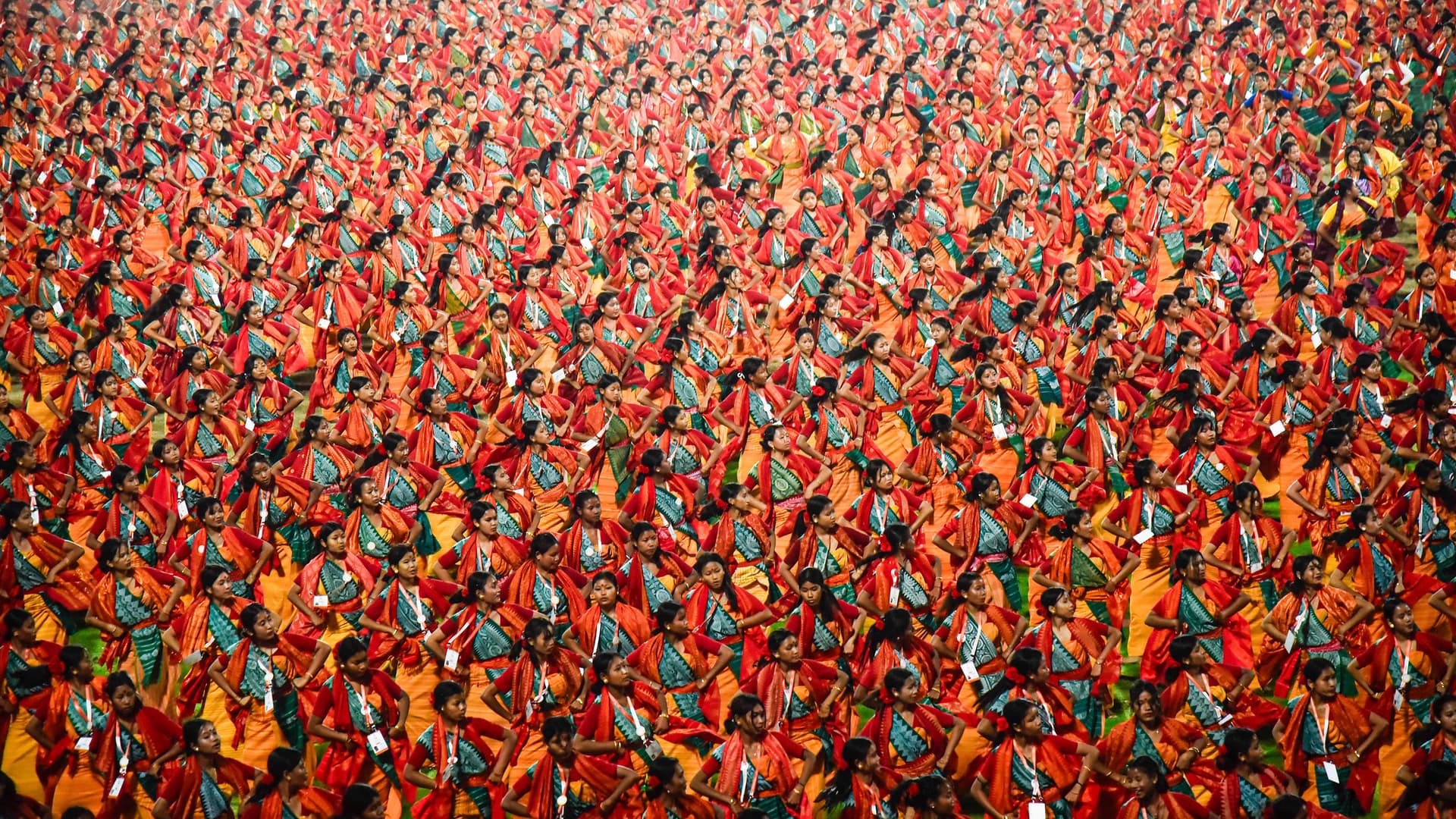
The second image pulls the discussion in a different direction altogether. It shows about 10,000 Bodo dancers at Sarusajai Stadium in Guwahati, India, performing Bagurumba in an overhead view that turns the crowd into a dense field of color and movement. Local coverage says the performance took place on January 17, 2026, and that it was linked to a Guinness World Record attempt for the largest-ever Bagurumba dance performance.
Here the appeal is not political urgency but visual choreography on a massive scale. The image works because it converts numbers into design, with thousands of bodies becoming a single patterned surface rather than a simple wide shot of a crowd. That is exactly the sort of picture that can travel well across photography circles, because it rewards both the immediate glance and the slower look.
Bagurumba, Guinness, and regional pride
The record-attempt angle gives the image a second layer of meaning, one that goes beyond spectacle. If the Guinness World Records context explains why so many people were gathered, the cultural context explains why the frame carries emotional weight, especially for Bodo and Assamese viewers. The image is not just large; it is communal, ceremonial, and tied to heritage.
That is also why the response in Assam was so visible. Cabinet Minister Bimal Borah publicly praised the BBC recognition on X, calling it a breathtaking moment that captured Assam and Bodo heritage. That reaction matters because it shows how photo selection can ripple outward from media criticism into regional pride, turning a photograph into a shared cultural marker.
What these two photos say about timing
Put side by side, the two images make the same argument in different languages. The Maduro frame depends on timing in the newsroom sense, because it captures a politically loaded arrival with maximum relevance and minimum ambiguity. The Bodo dancers image depends on timing in the performance sense, because the overhead perspective freezes a fleeting collective act at the instant when pattern, scale, and motion line up.
That is one of the clearest lessons for photographers looking at why expert shortlists become controversial. “Best” rarely means the most technically flawless image in isolation; it often means the frame that arrived at the right second and carried the story cleanly. When judges praise a picture this way, they are usually valuing the photographer’s instinct as much as the subject in front of the lens.
Storytelling versus pure composition
Still, storytelling and composition do not always pull in the same direction. The Maduro photograph leans hard on narrative gravity, with the custody detail doing much of the emotional lifting. The Bodo image, by contrast, gets a large part of its power from structure, repetition, and a near-abstract overhead arrangement that makes thousands of dancers read like a single design.
That difference is exactly why the BBC’s visual comparison to Piet Mondrian’s “Victory Boogie Woogie” is so telling. The reference signals an image that works not only as reportage but as pattern, balancing the practical reality of a public performance with a painterly sense of order. For photographers, that is the kind of comparison that invites another question: does a picture become stronger because it resembles art, or because it captures a real-world event so well that it starts to feel like art?
Why the debate has spread beyond one roundup
The argument has widened because this is not happening in a vacuum. BBC Culture’s shortlist is being read alongside other major 2026 photo award rounds, including World Press Photo and Sony World Photography Awards coverage, which makes the field feel crowded and fiercely contested. Once multiple institutions are staking claims on the year’s best work, every list becomes part of a larger contest over taste, authority, and what kind of photography deserves attention.
That competitive backdrop also sharpens the framing debate. A press image with undeniable historical weight can sit beside a carefully composed aerial scene, and both can be called striking without being equally persuasive as “the best.” The friction is not a flaw in the shortlist; it is the point, because the strongest annual image debates are never really about one photo alone.
What photographers can take from the shortlist
For working photographers, the useful takeaway is that these picks reward different strengths. One image proves the force of historical urgency, where identity, custody, and consequence all hit at once. The other proves the impact of scale, pattern, and cultural spectacle, where an overhead angle can transform a stadium into a visual map.
That is why the BBC choices have landed so effectively and so divisively at the same time. They show that a year’s best images are often judged on more than sharpness or exposure, and that the real question is whether a photograph delivers timing, storytelling, emotional weight, composition, and originality in one frame. In a crowded year, that balance is exactly what keeps the argument alive.
This article was produced by Prism’s automated news system from verified source data, official records, and press releases, then run through automated quality and moderation checks before publishing. The system is built and supervised by the people who set the standards it runs under. Read our full AI policy.
Did this article answer your question?