Camera Traps on Remote Tasmanian Island Capture Rare Blonde Echidnas and Marsupials
Thirty trail cameras on Truwana/Cape Barren Island generated 500,000 images and caught blonde echidnas on film, with odds of spotting one reportedly at 1 in 10,000.
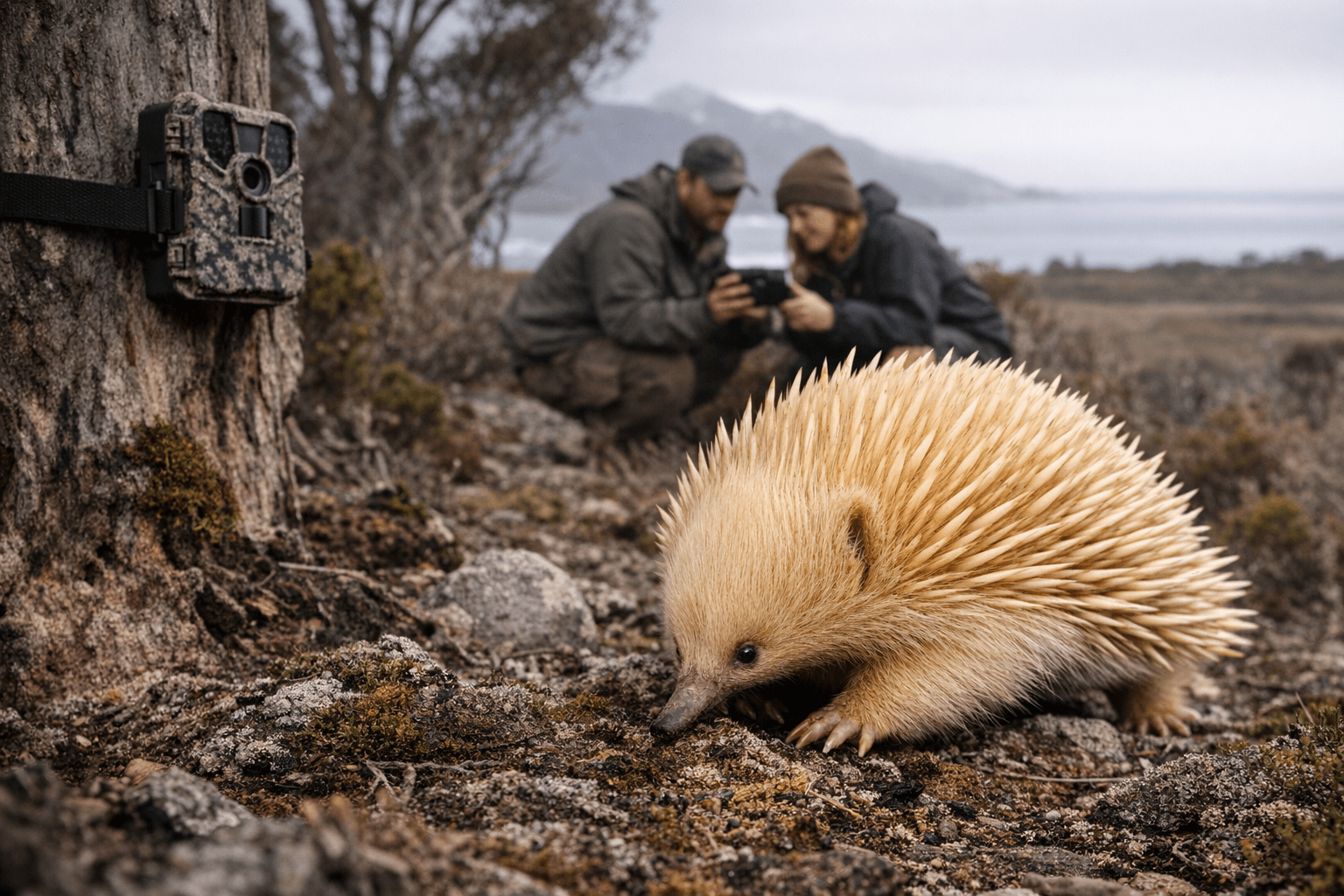
Thirty motion-sensor cameras left running across a remote Bass Strait island for six months have produced one of the more striking wildlife datasets to come out of Tasmania in recent memory: roughly half a million images documenting blonde echidnas, a marsupial with fewer than 5,000 individuals left in the state, a vulnerable migratory shorebird, and a feral cat that explains why rangers are busy with traps of a different kind.
The survey, the first systematic camera-trap deployment on Truwana (also known as Cape Barren Island), ran from November 2024 to May 2025. The Truwana Rangers led the project with backing from WWF-Australia's Eyes on Country program and Dr Elizabeth Znidersic of Charles Sturt University. Rangers positioned the 30 cameras across seven distinct sites covering the island's grasslands, wetlands, and scrub, then retrieved the memory cards and worked through the resulting image haul.
The white-footed dunnart turned up at six of those seven sites, a detection rate that surprised observers familiar with how rarely the tiny nocturnal marsupial shows up in surveys elsewhere. Petapixel reported the species is believed to number fewer than 5,000 individuals across Tasmania, and its presence at nearly every monitored location on Truwana carries real weight for conservation planning. The dunnarts are insectivorous and largely nocturnal, and the night-vision footage captures them moving through grass and scrub in exactly the kind of habitat that feral cats and foxes also frequent.
Those feral cats are not incidental to the story. One was photographed directly by a trail camera, and an active predator-trapping program on the island removes dozens of predators each year. The camera data and the trapping effort are running in parallel, with each informing the other.
The image that has drawn the most attention outside conservation circles shows a pale, almost creamy-furred echidna against the island scrub. These belong to the Tasmanian subspecies, which carries thicker fur than mainland echidnas, and the blonde coloration appears in both normally pigmented and unusually pale individuals on Truwana. IFLScience and Petapixel attribute the lighter color to leucism, a genetic condition that reduces pigmentation without producing the fully white coat or red eyes associated with albinism. DigitalCameraWorld describes the coloration as resulting from albinism. That discrepancy has not been resolved in published reporting, and the Truwana Rangers or Dr Znidersic would be the right sources to clarify whether any genetic assessment has been done on the photographed animals. DigitalCameraWorld separately puts the odds of encountering a blonde echidna in the wild at 1 in 10,000, though no primary study is cited for that figure.
The cameras also confirmed the presence of the Tasmanian subspecies of the long-nosed potoroo, the eastern pygmy possum, and Latham's snipe, a migratory shorebird that breeds in northern Japan and parts of far-eastern Russia before flying to Australia. Latham's snipe is listed as vulnerable under the EPBC Threatened Species list and is infrequently seen due to its preference for dense wetland habitat, making the camera footage a useful confirmation of its activity on Truwana.
From a technical standpoint, the survey is a straightforward demonstration of what a well-placed network of trail cameras can accomplish in a compressed timeframe. Thirty cameras, seven sites, six months, half a million frames, and a species list that wildlife managers on the island had previously struggled to assemble through conventional survey methods. The Truwana Rangers' integration of Indigenous ecological knowledge with the camera-trap methodology is also explicitly part of the project's design, and the collaboration with WWF-Australia's Eyes on Country program positions the findings within a broader network of Bass Strait island monitoring. The data now feeds directly into ongoing predator control decisions on the island.
This article was produced by Prism’s automated news system from verified source data, official records, and press releases, then run through automated quality and moderation checks before publishing. The system is built and supervised by the people who set the standards it runs under. Read our full AI policy.
Know something we missed? Have a correction or additional information?
Submit a Tip