Camera traps track elusive clouded leopard for six years in Borneo
One Sunda clouded leopard kept triggering camera traps for six years in Sabah, giving scientists a rare look at age, range and survival.

A single Sunda clouded leopard kept walking back into frame for more than six years, and that long paper trail of remote images is the real story here. In Sabah, Malaysian Borneo, scientists built a rare, continuous portrait of one of the world’s least-seen cats, using camera traps to follow an animal that human observers would almost never catch in the open.
The work stretched across more than 15 years, from 2007 to 2023, and drew on 13 separate camera-trap surveys. Published in the peer-reviewed journal Biotropica, the study brought together the Leibniz Institute for Zoo and Wildlife Research, the Sabah Forestry Department and Panthera. That kind of timeline is exactly why wildlife photographers should care: it shows that remote imaging is not just a field workaround, but a way to document longevity, movement and survival at a scale a person on foot cannot match.
The most striking record came from a female estimated to be about 8.5 years old at the last recording, a cat described in coverage as the oldest wild leopard ever recorded. Over the full study period, researchers also tracked leopards moving between forest preserves over nearly 40 kilometers, a reminder that a species can look scarce in one patch of forest and still be quietly using a much larger landscape.
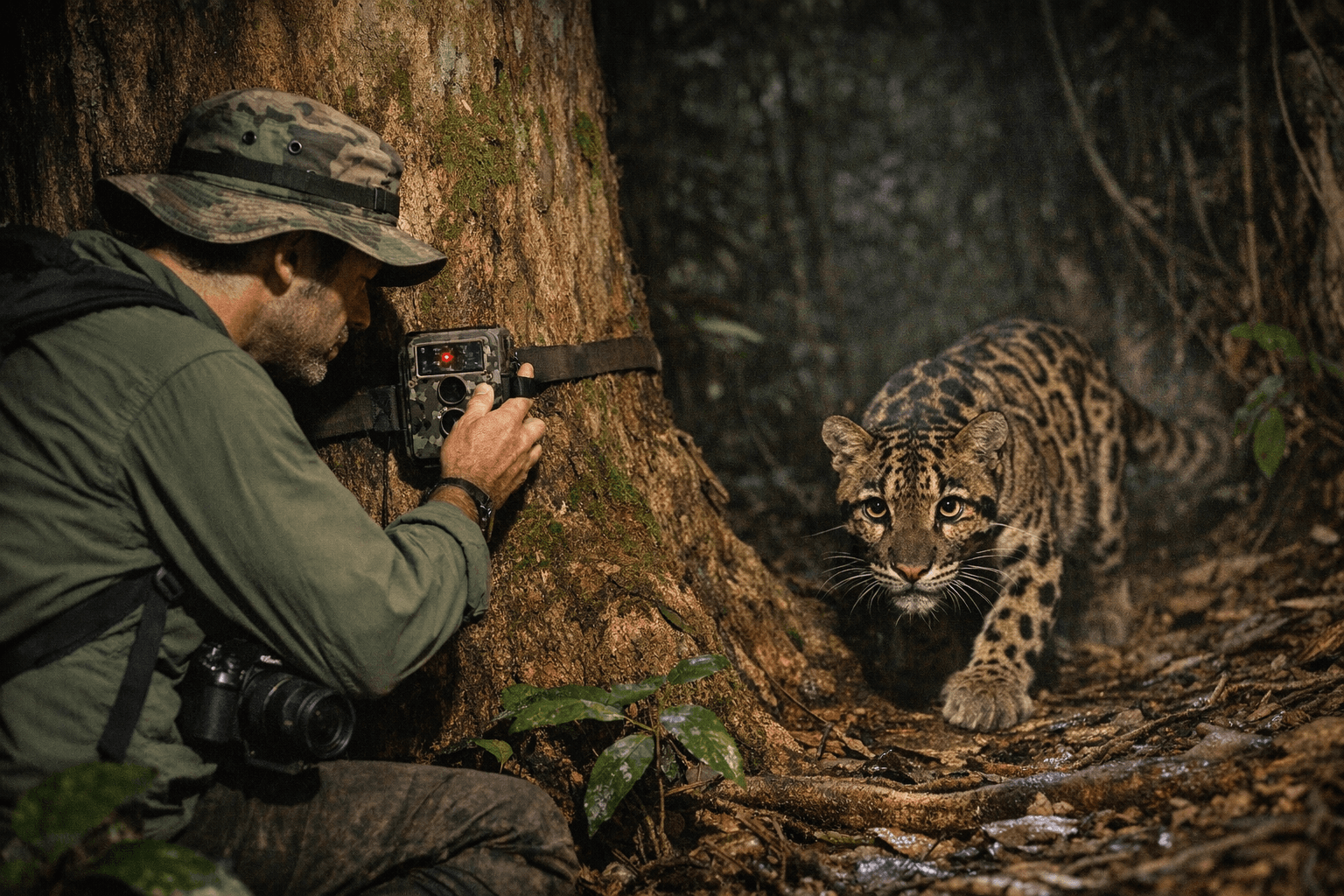
That is where camera traps earn their keep. They can catch animals that avoid roads, trails and people, and they can do it repeatedly, in the same places, over years. For anyone who thinks of wildlife photography only in terms of a telephoto lens, a blind and a lucky sighting, this is the other side of the craft: patient field placement, consistent monitoring and image sets that become ecological evidence. Panthera’s Wai-Ming Wong said long-term, large-scale monitoring helps scientists move beyond snapshots and understand how wild cat populations persist over time.
The study also exposed how easy it is to miss the females. Panthera reported that female Sunda clouded leopards were detected 68% less often than males, and Panthera Malaysia project coordinator Thye Lim Tee warned that undercounting females can distort breeding and population assessments. That matters in Sabah’s Deramakot Core Area, where Panthera’s Malaysia program monitors and protects the Sunda clouded leopard and other wild cats in a mixed-use landscape. Panthera has been studying Borneo’s elusive carnivores since 2005, and this six-year trail of one leopard shows why the work is worth the wait: camera traps can reveal a hidden cat’s life in a way no daylight walk-in encounter ever could.
Know something we missed? Have a correction or additional information?
Submit a Tip