David Schwartz’s Route 66 Photos Become USPS Centennial Stamps
Eight David Schwartz Route 66 photos landed on USPS stamps, turning a decades-long project into something millions will handle in everyday mail.
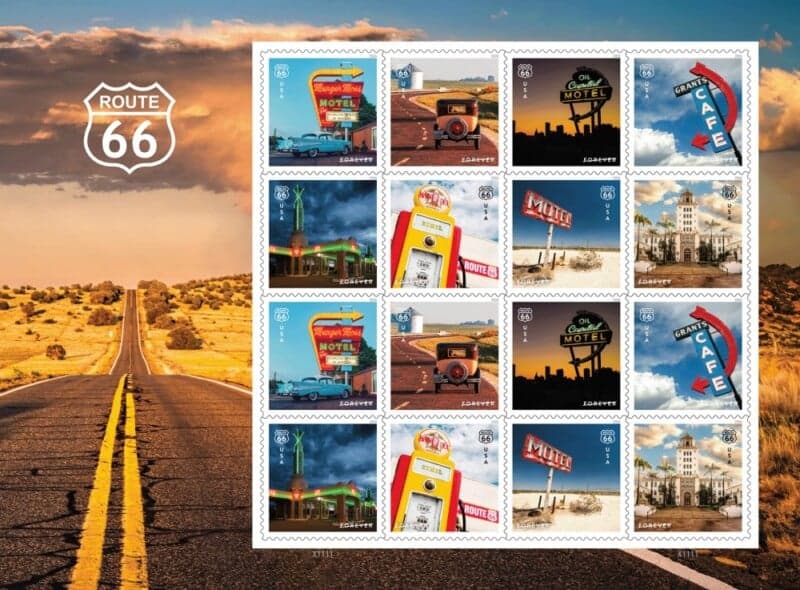
Eight of David Schwartz’s Route 66 photographs have moved out of the archive and into everyday American circulation, where they will be peeled, canceled, and stuck on envelopes instead of framed on a wall. For photographers, that is the real headline: a long-running documentary project about one road has become postage, a tiny format with a national audience.
The U.S. Postal Service issued the Route 66 stamps on May 5, 2026, during the National Postal Forum in Phoenix. The pane includes 16 stamps and eight distinct designs, each repeated twice, and all of them are Forever stamps, which always match the current First-Class Mail 1-ounce price. Greg Breeding designed the stamps and the pane using existing Schwartz photographs, while the pane’s selvage carries an additional Schwartz image from near Crookton, Arizona, on one of the longest continuous drivable stretches of Route 66 in the state.

That Arizona selvage image matters because this project is not just about nostalgia. USPS said it captures the sense of possibility tied to the open road, and that idea tracks with the way Schwartz has worked the highway. He has driven Route 66 more than 40 times and spent more than 20 years photographing its motels, diners, gas stations, and roadside landmarks. That persistence is what made him a natural fit for a project built around eight states, from Illinois through Missouri, Kansas, Oklahoma, Texas, New Mexico, Arizona, and California.
Breeding said the assignment initially felt daunting, but Schwartz’s deep knowledge of the subject and his editorial style made the process far smoother. That is the part photographers should pay attention to. Stamp art has to read fast and read small. It cannot rely on subtle detail alone. It needs a clean silhouette, a strong color block, and a scene that still makes sense when reduced to postage size. Route 66 gives the Postal Service that structure: vintage cars, historic motels, neon signs, gas stations, and the kind of roadside iconography that survives compression.
The stamps also land inside a bigger preservation story. The National Park Service says Route 66 began in 1926, stretched about 2,400 miles from Chicago to Los Angeles, and symbolized mobility, freedom, and the pursuit of the American Dream. Its historical significance runs from 1926 to 1985, and more than 250 Route 66-related buildings, bridges, road alignments, and other sites are listed on the National Register of Historic Places. Route 66 became especially important during the Dust Bowl and Great Depression, when hundreds of thousands moved west for work.
At the Phoenix ceremony, Rod Reid, chairman of the United States Route 66 Centennial Commission, called the stamp issuance an open invitation to experience Route 66. Schwartz put it more plainly: Route 66 is “living history” that people can still step into and become part of. That is what gives this stamp set its weight. It is not just a tribute. It is mass-produced legacy, with Schwartz’s eye carrying Route 66 into mailboxes everywhere.
This article was produced by Prism’s automated news system from verified source data, official records, and press releases, then run through automated quality and moderation checks before publishing. The system is built and supervised by the people who set the standards it runs under. Read our full AI policy.
Did this article answer your question?