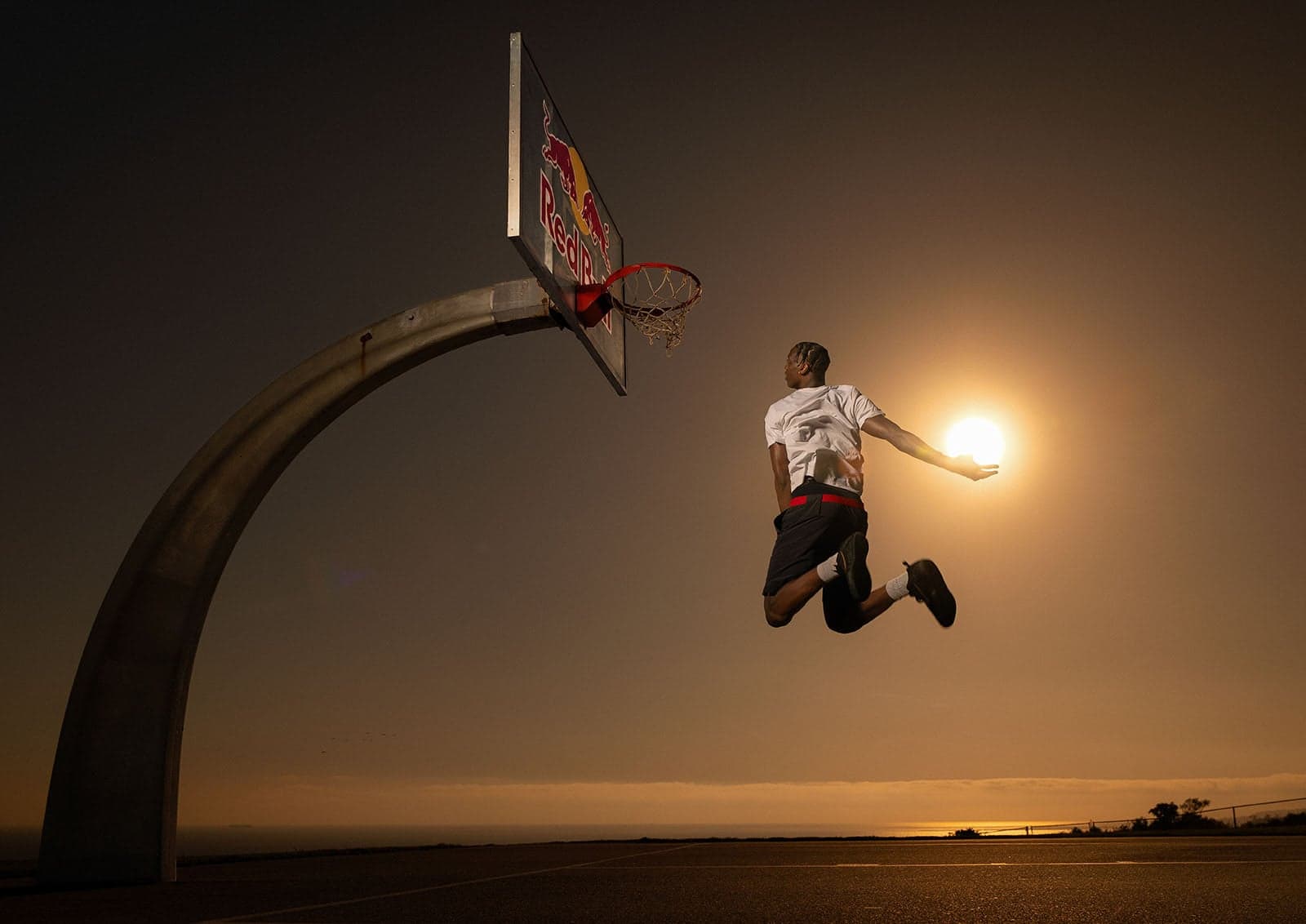
Dustin Snipes recreates his iconic sun-dunking photo with AJ Dybantsa
Dustin Snipes turned a surreal dunk into repeatable geometry, using the same San Pedro court, a variable ND filter, and minute-by-minute sun timing with AJ Dybantsa.
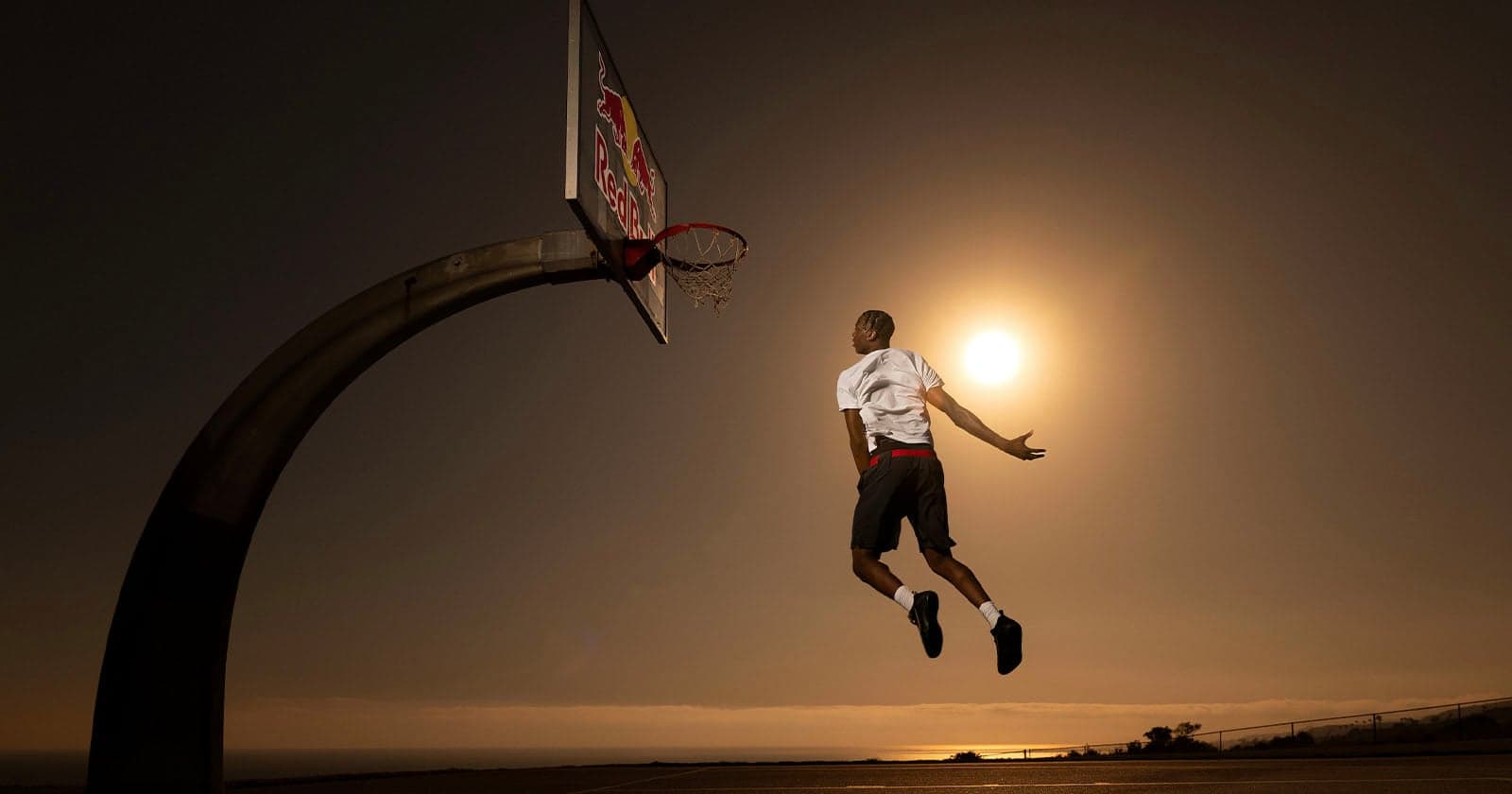
Dustin Snipes made the sun itself look like a basketball again, and the trick was less magic than disciplined setup. He recreated his iconic dunk image with AJ Dybantsa at Angels Gate Park in San Pedro, California, using the same court he had chosen for Anthony Davis in 2015 because the horizon stayed clean all the way to the Pacific. The process is a practical blueprint for any photographer trying to build one-shot concepts around light, timing, and a moving subject.
Why the same court mattered
The location shows this image was engineered, not stumbled into. Snipes went back to the exact same San Pedro basketball court he used a decade earlier because the site gives him an unobstructed horizon line, which makes solar alignment possible in the first place. When the sun is the headline element in the frame, even a slight change in horizon shape can break the illusion.
Angels Gate Park worked for the AJ Dybantsa remake for the same reason. The shoot took place on June 17, 2026, in late-afternoon light as the sun dropped toward the Pacific, and that low angle gave Snipes the kind of narrow window he needed. Red Bull listed Dybantsa as a 2.06-meter, 6-foot-9 wing and projected first pick in the 2026 NBA Draft, but the structure of the picture stayed the same: a controlled horizon, a specific court, and a subject placed into a preplanned sun path.
Build the frame around solar timing
The sun moves roughly its own diameter every two minutes. That means the window for this shot is not just short, it is constantly sliding. Snipes had to choreograph the sequence minute by minute, and the final frames came from timing, precision, patience, and repeated attempts, not from AI or visual effects.
Before the athlete ever jumps, the shot already exists as a timing exercise. You need to know where the sun will sit against the court, how much space you have before it drifts, and which exact moment gives you the cleanest overlap between the ball, the body, and the bright disk behind them. In a setup like this, the subject is not the only moving part. The light is moving too, and it is moving on a deadline.
Control the light, then protect focus
For the 2026 remake, Snipes used a 6-9 stop variable ND filter, which let him hold highly specific exposure values while keeping the sun under control. Settings included 1/250 at f/4 on the Canon EOS R5 Mark II and 1/400 on the Canon EOS R1, depending on the body and configuration. Those numbers show how little wiggle room this type of image allows once the sun is in the frame.
The dense ND filter solved one problem and created another. Autofocus became unreliable, so Snipes dropped to manual focus first, then ramped the filter back to maximum density once focus was locked. The filter was not just an exposure tool; it was part of the timing system. If focus is not nailed before the filter goes dark, the whole setup can collapse in the seconds it takes the sun to slip out of position.
Snipes also described the work as something between photography and applied science, and the older Anthony Davis shoot shows why. In 2015, he tested around ISO 31 at 1/1600 and f/11, then even pushed to 1/8000 at f/22 before settling into a more workable formula around ISO 31, 1/250 at f/6.3 with an 8-stop ND filter. He kept testing as the light changed.
What the 2015 original set in motion
The Anthony Davis version established the template that the Dybantsa remake followed. That shoot used a minute-by-minute shot list to keep pace with the changing sun position, and Snipes added more than 10,000 watts of Broncolor packs to light Davis once the sky had gone dark enough to need help. Red Bull turned the original image into downloadable wallpaper.
The stunt depended on a lighting plan, a shot list, and an overbuilt technical setup, not luck or a lucky sunset. If the sun was the foreground element, the Broncolor packs were the insurance policy behind it, giving Davis enough separation to keep the image readable after the sky dimmed.
What to steal from the process
- Previsualize the horizon before you schedule the athlete. The court in San Pedro worked because the line to the Pacific was clean enough to make the sun readable.
- Treat the sun as a moving subject. If it shifts by its own diameter every two minutes, your frame needs a minute-by-minute plan.
- Set focus before the ND filter gets heavy. Dense filtration can make autofocus unreliable, so manual focus becomes part of the workflow.
- Build exposure tests into the day. Snipes’ 2015 experiments, from ISO 31 at 1/1600 and f/11 to ISO 31 at 1/250 and f/6.3, show how quickly the right settings can change once the light changes.
- Have an exit point. If the timing slips, the shot is gone, and the smartest move can be to reset rather than force it.
Born on January 29, 2007, in Boston, Massachusetts, Dybantsa was framed by Red Bull as a BYU player and rising basketball superstar ahead of the 2026 draft.
This article was produced by Prism’s automated news system from verified source data, official records, and press releases, then run through automated quality and moderation checks before publishing. The system is built and supervised by the people who set the standards it runs under. Read our full AI policy.
Did this article answer your question?