ESA and JWST release NIRCam and MIRI dataset of NGC 5134
ESA and the JWST teams released a new NIRCam + MIRI dataset and Picture of the Month pan of spiral galaxy NGC 5134, with downloadable Ultra HD assets and a 30 s video (potm2602a).
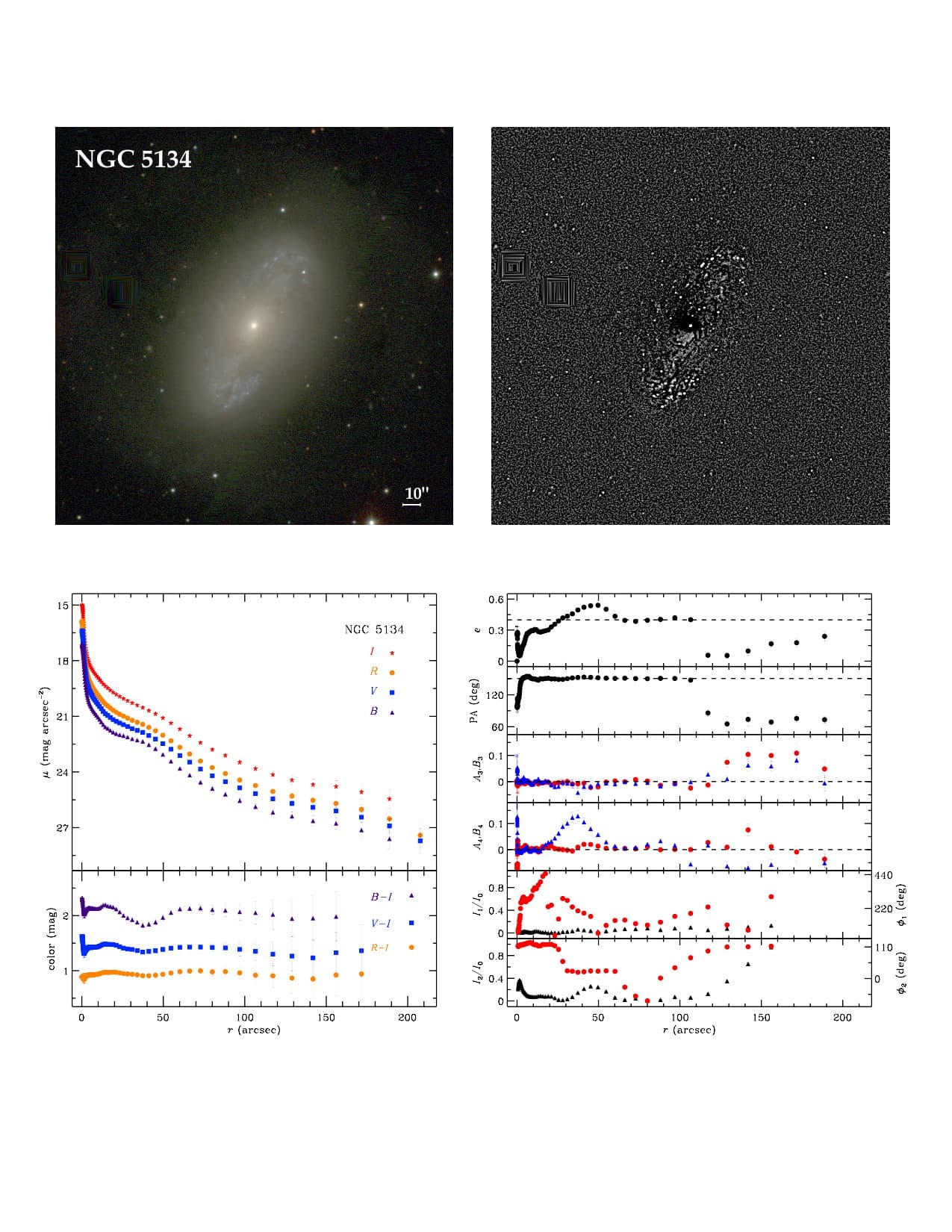
ESA and the James Webb Space Telescope teams published a coordinated NIRCam and MIRI dataset for spiral galaxy NGC 5134, releasing the image as Picture of the Month on 20 February 2026 (PotM Id potm2602a) with a 30 s pan video at 25 fps and downloadable Ultra HD, HD, QHD, Mobile and broadcaster packages. The release is credited to ESA/Webb, NASA & CSA with image processing attribution to A. Leroy and additional ESA credit to N. Bartmann.
The dataset pairs NIRCam near-infrared imaging of stars and star clusters with MIRI mid-infrared maps of warm dust and polycyclic aromatic hydrocarbons, a combination intended to turn scenic imagery into diagnostic data. As DIYPhotography summarized, "This coordinated use of NIRCam and MIRI therefore transforms a visual image into a physical map. It links radiation, dust heating, and stellar distribution in a single coherent dataset." UniverseMagazine notes that NIRCam highlights the galaxy's star clusters while MIRI "saturates the gas clouds" with emission from warm dust.
ESA and press materials describe NGC 5134 as located in the constellation Virgo and give a distance of 65 million light-years in the PotM caption text and accompanying press write-ups. The ESA PotM web text states: "Two powerful instruments of the NASA/ESA/CSA James Webb Space Telescope joined forces to create this scenic galaxy view. This spiral galaxy is named NGC 5134, and it’s located 65 million light-years away in the constellation Virgo." Asset metadata lists the PotM video music as Stellardrone - "Twilight" and the web production credits as Enciso Systems accelerated by CDN77.
Catalog data for NGC 5134 show a wider range of values than the 65 Mly press figure. Wikipedia lists precise coordinates RA (J2000) 13h 25m 18.5378s and Dec −21° 08′ 03.086″, redshift z = 0.005864 ± 0.00000700, and heliocentric radial velocity 1,758 ± 2 km/s. A velocity corrected to the cosmic microwave background of 2,061 ± 21 km/s corresponds to a Hubble distance of 99.2 ± 7.0 million light-years (30.40 ± 2.15 Mpc), while a compilation of 20 non-redshift distance measurements gives a mean of 28.53 ± 3.93 Mly (8.746 ± 1.206 Mpc). The PotM and press materials do not specify which distance estimator was used to state 65 Mly.
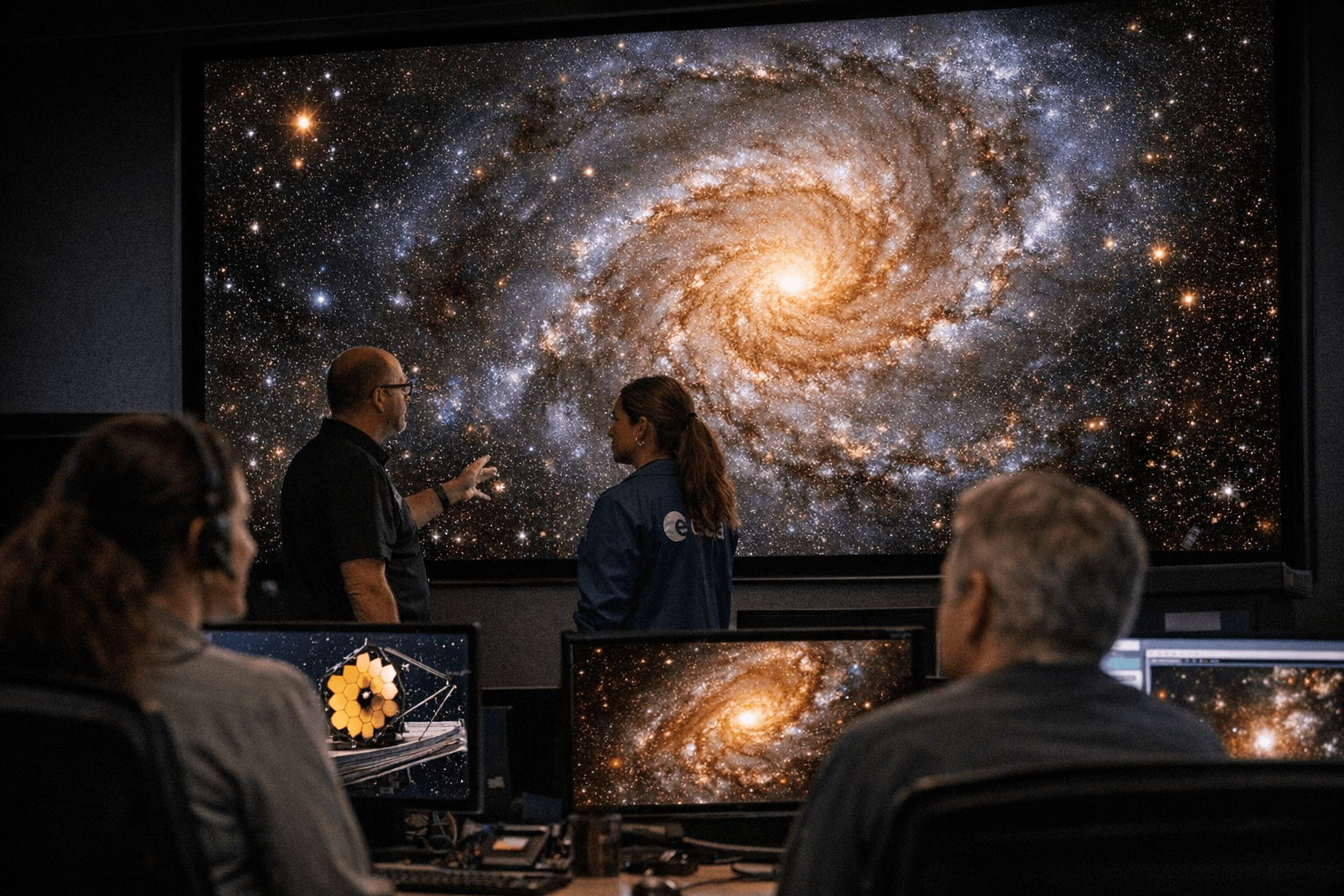
The release frames NGC 5134 as a laboratory for the stellar lifecycle and interstellar medium. UniverseMagazine used a time hook to note, "This is a gigantic figure by human standards, we see the galaxy as it was at the time of the extinction of the dinosaurs." Sources describe star formation beginning in cold molecular clouds, massive stars ending in supernovae that eject material hundreds of light years, and lower-mass stars returning gas more gently as red giants, all processes that JWST’s infrared bands can map across the galaxy’s disk. UniverseMagazine also provides plain-language context for mid-infrared emission: "Dust particles consist of complex organic molecules called polycyclic aromatic hydrocarbons. They form flat ring-shaped structures, very similar to honeycombs in beehives. On Earth, they are found in smoke from fires, car exhaust fumes, or, say, burnt toast."
Ancillary catalog notes in the release materials and Wikipedia include NGC 5134’s membership in the NGC 5084 group (LGG 345) alongside NGC 5084, NGC 5087, ESO 576-50 and ESO 576-40, discovery by William Herschel on 10 March 1785, and a catalog entry noting a possible active galactic nucleus. Practical takeaway for educators and astrophotographers: high-resolution JWST assets with full credit lines (Image/data credit: ESA/Webb, NASA & CSA; image processing/annotation credit: A. Leroy; additional ESA credit: N. Bartmann) and the 30 s PotM clip (potm2602a) are available for download, and the combined NIRCam+MIRI dataset is explicitly intended to be used as a physical map linking radiation, dust heating and stellar distribution for studies of nearby star-forming galaxies.
Know something we missed? Have a correction or additional information?
Submit a Tip