Photographer Captures Likely First-Ever Underwater Images of Rare Ross Seal
Justin Hofman spent 15 Antarctic seasons and saw a Ross seal exactly twice. The second time, underwater, he had a macro lens rigged for krill, no strobes, and made history.
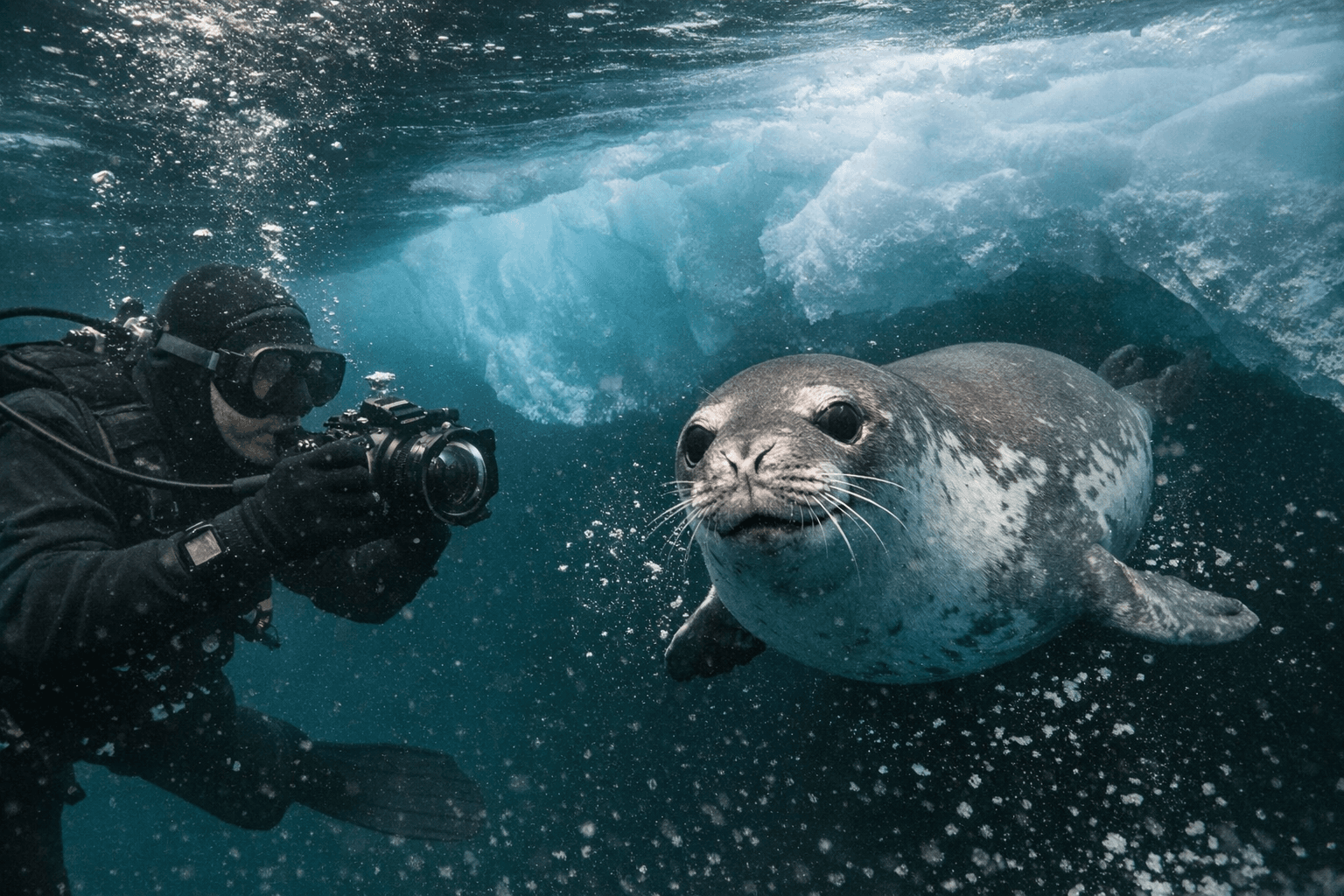
The camera rig that produced what are almost certainly the first underwater photographs of a Ross seal was, by the photographer's own admission, "the absolute worst thing you could use to photograph big animals." Justin Hofman had configured his housing with a 90mm macro lens for krill when, working from the National Geographic Resolution deep in Antarctic pack ice during the 2025-2026 season, a Ross seal materialized in front of him.
Hofman, who works as an undersea specialist with Lindblad Expeditions, had spent 15 seasons in Antarctica and seen a Ross seal exactly once before, on the ice. "This animal lives so deep within the Antarctic pack ice that its life history is not very well understood, and it is not seen very often," he said. Nobody, to his knowledge, had photographed one underwater. "I didn't think about it in the way that someone thinks about a goal or a target subject," he said. "I never thought that it was an actual possibility."
What put Hofman in position was a year of record-breaking sea ice loss. 2025 recorded one of the lowest levels ever for Antarctic sea ice formation, which allowed the National Geographic Resolution to venture much further south much earlier than ever before. "On a 'normal' year, the Ross seal's habitat is inaccessible because of the thickness and extent of the sea ice," Hofman said. Ross seals breed and molt in areas south of 60 degrees south latitude, territory that expedition ships rarely reach. Hofman acknowledged the darker dimension of his good fortune: "The only reason that I was able to get these photos is because of climate change impacts on sea ice."
The wrong-lens problem quietly worked in his favor. Hofman would normally reach for a wide-angle zoom on a dome port to work close and give the viewer a sense of immersion. The 90mm macro forced him to stay well back, and the early-season water clarity made that viable. Because the plankton bloom had not yet occurred, the water was "incredibly clear," which let him maintain enough distance that the seal's behavior stayed natural. More critically, he often uses strobes for underwater work, but with the water so clear, there was enough ambient light to expose the images without them, avoiding any disturbance to the animal. He locked in manual exposure to handle the shifting light filtering through pack ice, fired continuous high burst, and used an external monitor to drop the housing deeper and hold precise compositions.
One image shows the seal's signature large eyes staring directly into the camera. Others display the animal's distinctive dark stripes as it moves through the water. Videographer and fellow passenger Ayla Townsend also captured moving footage of the encounter.
The "first-ever" claim is genuinely hard to refute. It was only Hofman's second sighting of a Ross seal, and he knew the species had never been photographed in its habitat underwater before. Ross seals are the smallest and rarest members of the Antarctic true seal family, solitary by nature and almost never encountered in water. The scientific photographic record is thin enough that a prior underwater image would almost certainly be known to a researcher with Hofman's 15 seasons of polar field time. Hofman is no stranger to high-profile wildlife documentation either: his photograph of a seahorse gripping a cotton bud in Indonesian waters was a finalist in the 2017 Natural History Museum Wildlife Photographer of the Year competition.
For underwater photographers working in polar environments, the technical playbook here is specific and instructive: ambient light over strobes when visibility permits, manual exposure to counter flickering light beneath ice, continuous burst to capitalize on fleeting windows, and enough working distance to let the animal set the terms of the encounter. The ethical calculus is equally precise: staying back is not just a conservation courtesy, it is the reason the photographs exist at all.
Know something we missed? Have a correction or additional information?
Submit a Tip

