How Harold "Doc" Edgerton's 1957 Milk Drop Coronet Changed Photography Forever
A single milk drop, frozen by a flash lasting one-millionth of a second, became one of Time's most influential images ever taken.
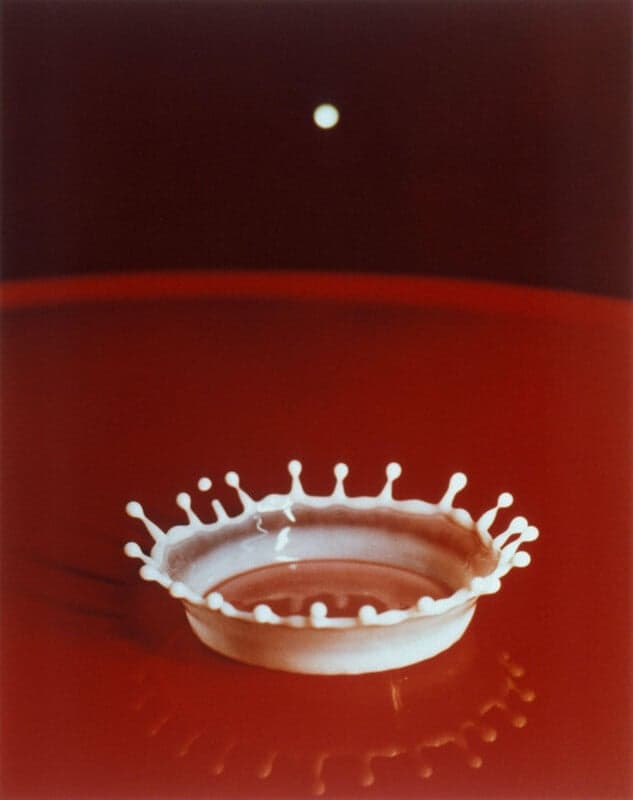
A xenon flash lasting roughly one-millionth of a second. That's the whole secret behind one of the most recognizable photographs ever made. On January 10, 1957, Harold "Doc" Edgerton pointed his camera at a falling drop of milk and, through a chain of precisely engineered triggers and pulses, captured the Milk Drop Coronet: a perfectly symmetrical crown of liquid suspended in mid-air, so clean and geometric it looks like it was drawn rather than photographed. Time magazine later included it in its list of Most Influential Images of All Time, and the photography world has never quite stopped studying how Edgerton pulled it off.
The shutter speed that wasn't fast enough
The first thing most photographers fixate on when they learn about Milk Drop Coronet is the shutter speed: 1/10,000th of a second. That's genuinely fast by any mechanical standard, fast enough to freeze most high-speed subjects you'd encounter. But for a milk drop in mid-splash, it wasn't the real story. The xenon flashtubes Edgerton used illuminated for far less than that, about a millionth of a second. As Kim Vandiver of MIT's Edgerton Center explained on Science Friday, "The light itself essentially acts as a shutter." The mechanical shutter was essentially irrelevant to the final image's sharpness. What mattered was how briefly the flash lit the scene, and a duration of roughly one microsecond is short enough to freeze motion that no mechanical shutter on earth can touch.
This distinction matters practically for anyone working in high-speed photography today. Flash duration, not shutter speed, is the limiting factor when you're trying to freeze fast fluid motion. Edgerton understood this in the 1950s, and that understanding is baked into every serious strobist technique used now.
How the trigger system actually worked
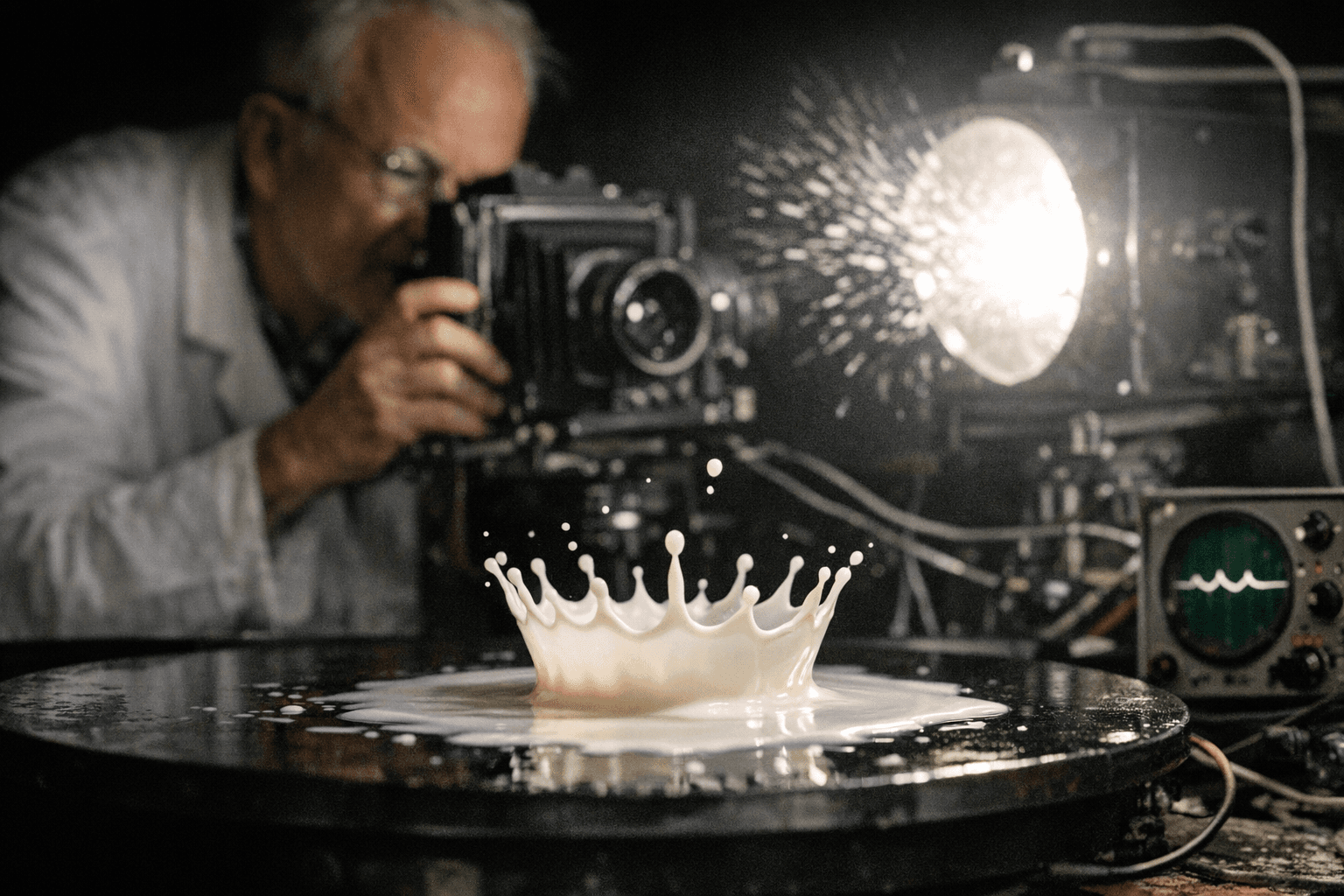
The technical ingenuity of Milk Drop Coronet goes well beyond the flash itself. Getting the exposure to fire at precisely the right microsecond required a trigger system that Edgerton built around the falling drop's own physics. The light was positioned in front of the drip, and the whole sequence was set in motion by the milk drop itself. He aligned a beam of light with a detector, so that as the droplet fell, it momentarily interrupted the beam, casting a shadow on the detector and generating a voltage pulse. That pulse traveled through an electrical circuit and triggered the flash after a controllable delay.
That controllable delay is the key phrase. By adjusting how long the circuit waited before firing the flash, Edgerton could choose exactly which moment in the drop's splash sequence he captured. Fire too early and you get an undeveloped crown; too late and the structure collapses back into the liquid. The Milk Drop Coronet represents the precise millisecond where the crown shape is fully formed and geometrically perfect. Getting there required not just clever engineering but iterative experimentation across hundreds of attempts.
Years of trial and error before the crown
This wasn't a happy accident. Milk Drop Coronet quite literally crowned years of trial and error, and there were hundreds of photos left on the darkroom floor before Edgerton captured the frame that would define his legacy. The version most people recognize, taken on January 10, 1957, was the culmination of work Edgerton had been doing on fluid dynamics and high-speed imaging for nearly two decades by that point.
In fact, he had been photographing milk splashes as far back as 1939, when he published a book titled "Flash! Seeing the Unseen by Ultra High-Speed Photograph." That volume already contained a black-and-white photograph of a milk splash forming a coronal shape, so the subject was one Edgerton returned to repeatedly, refining his technique each time. The 1957 image, shot in color with dye-transfer printing, was the fully realized version of something he'd been chasing for nearly 20 years.
Edgerton understood the physics, not just the gear
What separated Edgerton from someone simply pointing a fast flash at a liquid was that he genuinely understood what he was photographing at a molecular level. In the 1939 book, he laid out the fluid dynamics in plain language that holds up today:
"First, the behavior of liquids is affected by surface tension. The surface layers of any liquid act like a stretched skin or membrane (a drumhead, for example) which is always trying to contract and diminish its area."
"Second, a spout or column of liquid, beyond a certain length in relation to its diameter, is unstable and tends to break down into a series of equidistant drops. As these drops are formed, they are joined together by narrow necks of liquid which in turn break up into smaller drops."
That second paragraph is exactly what you're seeing in the coronet shape: the upward spouts around the crown's rim each represent one of those unstable columns about to break into a secondary droplet. Edgerton wasn't just freezing a pretty shape; he was illustrating a physical phenomenon. The photograph works simultaneously as art and as scientific documentation, which is a rare combination that explains much of its staying power.
The print is as important as the negative
One aspect of Milk Drop Coronet that doesn't get nearly enough attention is how the image was produced as a physical object. Most existing prints are dye-transfer, a process championed by photographers including William Eggleston and widely considered the superior method for producing color photographs. Dye-transfer prints have exceptional saturation, tonal depth, and longevity compared to chromogenic alternatives, which is part of why surviving prints of the coronet still look as vivid as they do.
The dye-transfer prints matter more than they might otherwise, because the original negative was reportedly destroyed. If that reported claim holds up under archival scrutiny, it means those dye-transfer prints aren't just high-quality reproductions; they're the primary surviving physical record of the image. The deep whites, the precise rendering of each droplet at the crown's edge, the delicate shadow structure at the base: all of that exists now only because someone committed to the dye-transfer process at the time the prints were made.
Why Milk Drop Coronet still matters
The photograph's inclusion on Time magazine's list of Most Influential Images of All Time places it in conversation with images that shaped how people see the world. Edgerton's contribution was specifically to make visible what had always been invisible: motion faster than human perception, physics happening at timescales the naked eye simply cannot register.
His broader body of work, which included work like the "Mrs. Webster with hummingbirds" photograph, extended that same principle across subjects from athletes to nuclear tests. But Milk Drop Coronet remains the image that crystallizes his method most purely, partly because the subject is so ordinary. Milk. A kitchen counter. A drop falling from a modest height. The fact that something so mundane could contain such perfect geometric complexity, and that a camera and a one-microsecond flash could reveal it, is the argument Edgerton made for the entire discipline of high-speed photography.
Every photographer working with high-speed strobes today, every researcher using flash photography to study fluid dynamics, every commercial shooter freezing water splashes for beverage ads, is working in the tradition that Edgerton established through those hundreds of failed frames and one extraordinary morning in January 1957.
This article was produced by Prism’s automated news system from verified source data, official records, and press releases, then run through automated quality and moderation checks before publishing. The system is built and supervised by the people who set the standards it runs under. Read our full AI policy.
Did this article answer your question?