How One Photographer Captured Stunning Overhead Portraits Without a Drone
A 2012 DSLR, no drone, and a farm in KwaZulu-Natal: here's exactly how Coenraad Torlage pulled off a Sony Award-winning overhead portrait.
A new perspective is a difficult thing to achieve in the modern age of photography. Drone photography, action cameras, and a new breed of lightweight pro lenses have made it possible to capture unique compositions with ease, making it more challenging than ever to produce truly original images. For South African photographer Coenraad Torlage, that pressure became the engine behind one of the most talked-about overhead portraits in recent competition photography. His solution? A 2012 DSLR, a farm, and the refusal to let a missing drone be the reason a shot didn't happen.
His idea was clear: shooting from above. But having no drone made it difficult to achieve an aerial perspective. What followed is one of the cleaner examples of constraint-driven creativity you'll find in working photography, and the technique Torlage used is entirely reproducible with gear you almost certainly already own.
The Shot and Its Stakes
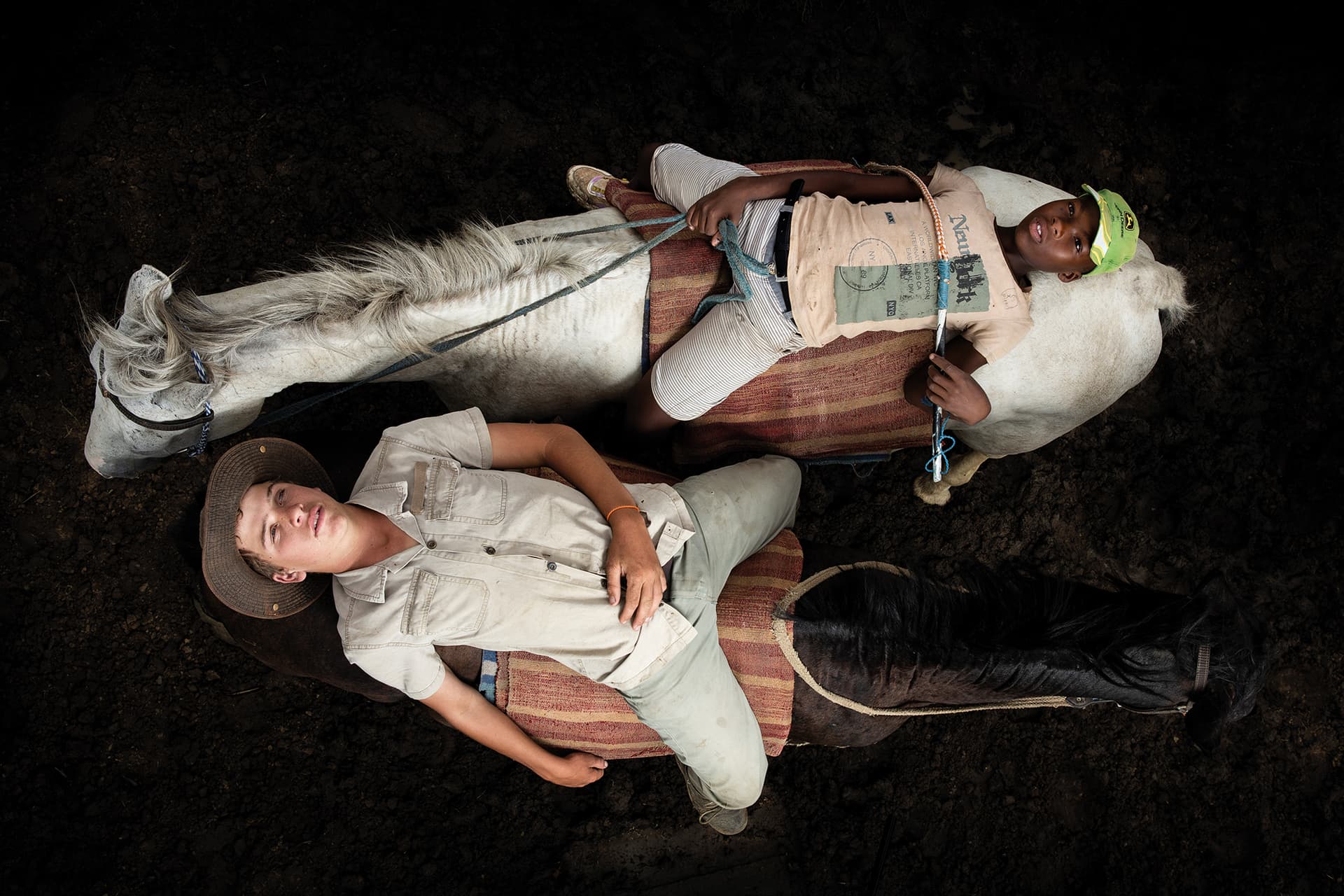
Torlage shot this image as part of his winning Young Farmers series, made for the final round of the Sony World Photography Awards Student Competition 2021. He explains that the photograph was taken on a farm in Elandslaagte in the province of KwaZulu-Natal in South Africa, showing HW and Olwethu after a long day herding cattle on horseback. Torlage, who grew up on a farm himself, set out to photograph the next generation of farmers as they face challenges concerning severe droughts, safety, and debates around land ownership, alongside their contributions towards a fairer and more equitable future of sustainability and food security.
The image won him Student Photographer of the Year 2021, earning €30,000 worth of Sony photography equipment for his institution, the Stellenbosch Academy of Design and Photography. By using a mix of natural and artificial light, Coenraad captured a timeless portrait of the two boys, with a strong narrative theme. None of it required a drone registration, a pilot licence, or a no-fly zone waiver.
Why Drone-Free Overhead Work Matters Right Now
Aerial perspectives have been democratized by consumer drones, but access is never guaranteed. Restricted airspace, proximity to populated areas, weather conditions, or simply arriving on location without a licensed pilot in your team can all ground a drone before a single frame is shot. Knowing how to replicate that elevated vantage with conventional gear is not a niche skill; it is a form of location insurance that separates photographers who deliver from those who go home empty-handed.
The approach Torlage took is worth breaking down step by step, because each decision compounds the next.
The Step-by-Step Setup
Step 1: Find Your Elevation Support
On a working farm like Elandslaagte, the environment itself offers structural height: hay bales, fence posts, loading platforms, and stable rooftops all provide stable footing that no drone regulation can restrict. In urban or small-space shoots, the same principle applies: staircases, fire escapes, mezzanine levels, or a purpose-brought A-frame ladder all function as your "drone." The rule is simple: any stable platform that places your camera eye above shoulder height of a standing adult begins to deliver overhead compression. For shots requiring extreme verticals over a flat subject, a collaborator holding a fully extended monopod with the camera attached and triggered remotely via your phone or a cable release can add a further 2 to 3 metres of effective elevation without any structural support at all.
Step 2: Secure the Camera and Think About Tethering
Height introduces risk, both to your gear and to anyone below. Before climbing or extending a rig, attach a camera safety strap or tether to your body or the support structure. If you are mounting a body to a monopod that a second person is holding overhead, a wrist tether on the assistant is not optional. Ball heads with locking levers are safer than friction-only heads at elevated angles, because the camera's weight naturally pulls it nose-down over time.
- Use a tether cord rated for at least twice your camera body weight
- Lock all tripod or monopod leg joints before raising
- Confirm the live view or remote shutter is working before you commit to the height
- Brief any assistant on the signal to lower the rig before you adjust framing
Step 3: Lens Choice and Focal Length
Torlage worked with a 2012 DSLR, which means a relatively standard sensor and a choice of legacy glass that is still entirely capable of publication-quality output. For overhead portrait work, a mid-telephoto focal length (roughly 50mm to 85mm on a full-frame body, or its crop-sensor equivalent) does two important things: it compresses the scene so the ground plane behind the subjects reads as a cohesive backdrop rather than a chaotic spread of detail, and it keeps a working distance that allows you to light the subjects from the side without the light stand entering the frame. Avoid ultra-wide lenses for this kind of work. From directly overhead, a wide lens will stretch the outermost edges of the frame and distort the subjects' proportions in a way that reads as a technical error rather than a stylistic choice.
Step 4: Shutter Speed and Exposure
From elevation, small subject movements are amplified. A subject who shifts their weight or glances up at the camera creates a noticeably blurred frame at shutter speeds below 1/250s. Torlage's farm setting also meant horses and cattle in frame, compounding the need for speed. Set your shutter to at least 1/250s for static portrait subjects and 1/500s or faster if any movement is expected. Open the aperture to compensate, keeping depth of field shallow enough to separate the subjects from the ground, but not so shallow that the top of a hat and the face at a slightly different plane both fall out of focus simultaneously.
Step 5: Lighting From Above Without Going Flat
Directly overhead natural light is the enemy of portrait photography. It creates harsh shadows under brow ridges and chins that flatten faces and remove the dimensional quality that makes a portrait compelling. The mix of natural and artificial light Torlage used is the practical answer: position a single off-camera flash or a large reflector at roughly a 45-degree angle to the subjects, low enough that its angle of incidence gives the faces fill light rather than a secondary overhead source. A silver reflector bounced with available sunlight costs nothing and is the minimum viable tool for this fix.
Step 6: Framing From Above
Overhead shots rewrite the spatial grammar of a portrait. Leading lines that would normally recede into a background now radiate outward from the subjects or run diagonally across the frame. The subject's relationship to negative space changes: a figure on a dirt path shot from above is surrounded by the texture of the ground, which becomes as compositionally active as any studio backdrop. In Torlage's image, the ground plane of a KwaZulu-Natal farm becomes a graphic field that anchors the two subjects as figures in a wider story. Place your subjects deliberately within this space; do not assume a centred composition is the strongest one. A subject positioned in the lower third of an overhead frame, with the eye travelling upward through surrounding negative space, often reads with more weight than a centred arrangement.
Post-Processing: Perspective Correction and Subject Isolation
Even a carefully positioned elevated camera introduces some perspective keystoning if the angle is not precisely perpendicular to the ground plane. In Lightroom or Camera Raw, the Geometry panel's Vertical correction slider fixes this in seconds. For subject isolation, a slight luminosity mask that darkens the ground plane relative to the subjects pushes the eye toward the faces without heavy-handed vignetting. Avoid over-sharpening the background texture; the ground detail is atmosphere, not the subject.
Adapting the Setup in Small Spaces
Not every overhead shot happens on a farm with bales of hay to climb. In a studio or small interior, the same principles scale down directly:
- A 2-metre A-frame ladder provides sufficient elevation for a flat-lay-style portrait on a studio floor
- A ceiling grid or truss system, where available, offers fixed rigging points for a boom arm
- A monopod extended to full height and held by an assistant gives a usable high angle in corridors, doorways, or locations where a ladder cannot stand safely
- A camera with a flip-out screen or smartphone remote view eliminates the need to look through the viewfinder, making ladder or monopod-held shots practical rather than theoretical
The Troubleshooting Box
*Problem: Camera won't stay aimed straight down from a monopod.* Fix: Tighten the ball head more aggressively and check that the mounting plate is centred, not offset to one side.
*Problem: Flash sync fails at high shutter speeds.* Fix: Drop to your camera's maximum sync speed (typically 1/200s or 1/250s) or switch the flash to high-speed sync mode if available.
*Problem: Ground texture is too distracting and competes with the subjects.* Fix: Slightly de-focus the background in post with a radial mask, or choose a shooting position that places the subjects over a more uniform section of ground.
*Problem: Subject looks distorted or oddly proportioned.* Fix: You're likely too close with a wide-angle lens. Step back, switch to a longer focal length, and re-frame.
Torlage's image of HW and Olwethu is now part of the permanent record of the 2021 Sony World Photography Awards, shot not with a licensed drone and a remote pilot certificate, but with a decade-old DSLR and the willingness to climb. The perspective that reads as technically ambitious on the page was achieved by solving one location-specific problem at a time. That is the actual skill set: not the gear list, but the sequential thinking that turns a missing piece of equipment into a more intentional image.
This article was produced by Prism’s automated news system from verified source data, official records, and press releases, then run through automated quality and moderation checks before publishing. The system is built and supervised by the people who set the standards it runs under. Read our full AI policy.
Did this article answer your question?