How to photograph mountain gorillas in Uganda’s dim forest
Bwindi’s gorillas are a lesson in restraint: meter for black fur in deep shade, then move your feet for the angle.
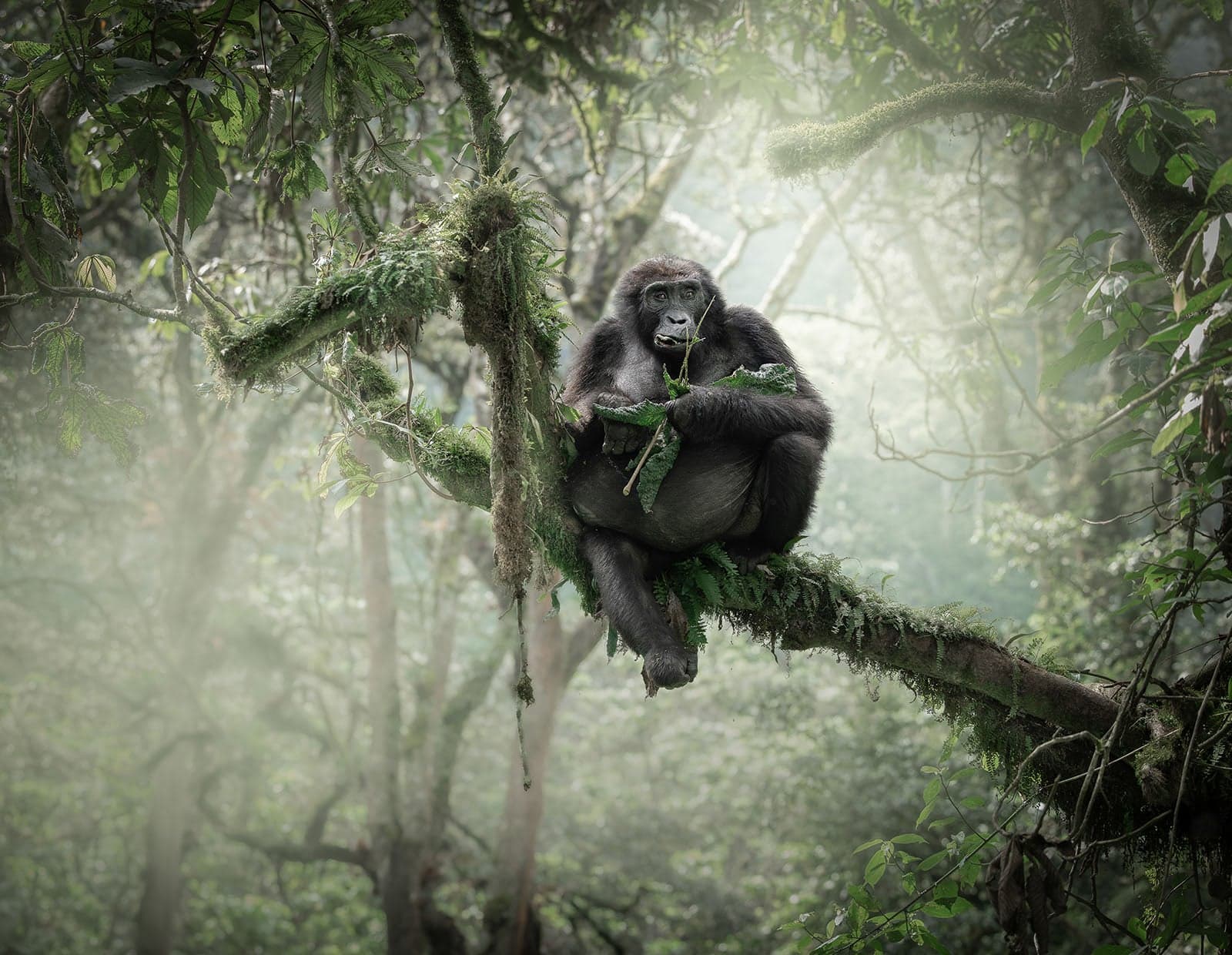
The forest gives you seconds, not a studio
Photographing mountain gorillas in Uganda’s Bwindi Impenetrable National Park is less about chasing a perfect portrait and more about surviving the conditions long enough to make a clean frame. The park holds roughly half of the world’s mountain gorilla population, but the habitat is doing everything it can to hide them: steep ground, thick vegetation, mist, and a canopy that turns daylight into a patchwork of deep shade. Once the encounter starts, there is little room to reposition, and even less time to treat the moment like a controlled wildlife shoot.
That is what makes this assignment such a useful field lesson. The real problem is not whether the subject is beautiful. It is whether you can expose the black fur correctly, keep motion sharp in low light, and avoid composing a frame that collapses into leaves, branches, and dark trunks. The photographers behind this kind of work are solving the same issues you face with any difficult outdoor subject, from birds in a wet forest to mammals in a canyon at dusk.
Meter for the forest you have, not the forest you want
The first trap in Bwindi is exposure. The forest canopy creates deep shade, and the gorillas’ black coats can fool a meter into delivering a file that looks safe on the rear LCD but is actually too dark. In a dim environment, the screen is a comfort blanket, not a reliable judge. The better habit is to watch the histogram and expose for usable detail in the fur, rather than trusting a display that often flatters the scene.
That means resisting the instinct to underexpose and plan to fix everything later. In these conditions, the shadow recovery you want on a computer often comes at the cost of texture, and fur is unforgiving when it is buried in noise or flattened by underexposure. The practical move is to give the sensor enough light up front, then protect the highlights as best you can while keeping the subject readable.
Read the histogram, not the rear screen
In a forest this dark, the histogram becomes your working compass. The rear LCD may make a frame look acceptable because your eyes are adjusting to the gloom, but the graph tells you whether the file has actual tonal information in the blacks and midtones. With gorillas, that matters because the subject itself is already dark, and the background usually is too.
- Check the histogram after the first few frames, not just the preview image.
- Make sure the subject’s fur has separation from the surrounding shade.
- Adjust exposure before the encounter is over, because there may not be a second chance.
A clean workflow here is simple:
That discipline helps anywhere the scene is deceptive, especially under trees, in dawn fog, or in any habitat where the background is darker than the animal.
Keep shutter speed alive by pushing ISO
The Fernleys’ advice cuts against a common reflex: do not starve the exposure just to keep ISO low. In a place where the light is limited and the subject can move at any moment, shutter speed is the thing that protects the image from becoming mush. The point is not to chase technically pristine files at the expense of sharpness. The point is to preserve motion and detail in the fur while the gorilla is still in view.
That tradeoff matters because wildlife is not a still life. Even when a gorilla appears calm, small movements in the head, hands, or body can ruin a shot if the shutter is too slow. A higher ISO, used deliberately, is the price of freezing the moment. For photographers used to overthinking noise, Bwindi is a reminder that a sharp, slightly noisier file is usually better than a clean blur.
Composition starts with your boots
One of the most practical details from the forest is also one of the easiest to overlook: the best angle can require real physical work. The Fernleys describe climbing a steep slope to reach an eye-level viewpoint, and that tells you a lot about fieldcraft in dense habitat. In a place with unstable footing and tangled vegetation, composition is not only about lens choice. It is about where your body can safely go.
Eye level changes everything. It turns a documentarian’s look-down snapshot into something more intimate and balanced, especially when the subject is a large mammal set against a chaotic background. In a steep forest, getting that perspective may mean pausing, breathing, and choosing your footing carefully before raising the camera. The reward is a frame that feels less like a quick grab and more like a meeting between equals.
Move first, then shoot
When the path allows it, repositioning yourself before the encounter becomes the difference between a cluttered file and a usable one. Dense foliage can chop the frame into distracting layers, and subject distance can make the scene feel smaller and flatter than it really is. A slight shift in height or angle can clear branches from the face, separate the animal from the background, and give the subject room to breathe.
That approach applies far beyond gorillas. In any difficult outdoor subject, your feet are part of the camera system. If the habitat is messy, the answer is often to change your position, not just your focal length.
Respect the rules, because they shape the pictures
Gorilla photography in Bwindi is not a casual safari experience, and that is not a side note. Photographers are on foot, moving through rugged terrain under strict rules that require respect for the guides, trackers, and the gorillas themselves. Those constraints are not obstacles to creativity, they are the conditions that define the shoot.
Limited time with the animals changes how you work. You cannot spend ten minutes hunting for a different backdrop or asking the subject to hold still. You have to read behavior quickly, stay aware of the group’s movement, and make the first workable frame count. That kind of discipline is useful everywhere in wildlife photography, because the best field pictures usually come from anticipation, not improvisation.
The bigger lesson for any hard subject
Bwindi’s mountain gorillas are a reminder that great wildlife photography is rarely about adding more gear to the bag. It is about understanding light, reading behavior, and making clear decisions when the habitat is fighting back. Low light, dark fur, cluttered backgrounds, limited mobility, and strict ethical boundaries create a test that strips away vanity and leaves only technique.
If you can photograph a gorilla in that kind of forest, you can handle almost any difficult outdoor subject. The trick is the same every time: protect shutter speed, trust the histogram, work for the angle, and let the field dictate the shot instead of pretending the field is a studio. That is how the mist stops being a problem and becomes part of the picture.
This article was produced by Prism’s automated news system from verified source data, official records, and press releases, then run through automated quality and moderation checks before publishing. The system is built and supervised by the people who set the standards it runs under. Read our full AI policy.
Know something we missed? Have a correction or additional information?
Submit a Tip