Hubble captures the glittering Chandelier Cluster in Sagittarius
Hubble’s new view of NGC 6723 turns Sagittarius into a glittering chandelier, while the data still sharpen cluster history.
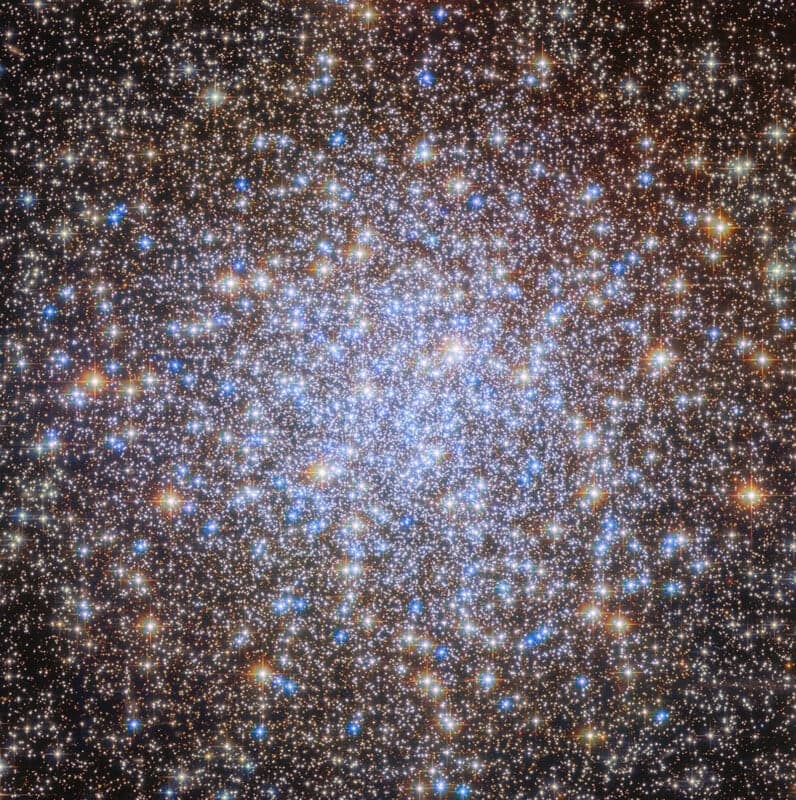
NASA and ESA released Hubble’s image of NGC 6723 on June 26, 2026, and the globular cluster earns its Chandelier Cluster nickname at a glance. Packed so tightly that the frame shimmers with individual points of light, the system sits in Sagittarius near the border with Corona Australis, about 27,000 to 28,400 light-years from Earth.
The image works because Hubble shows scale as much as sparkle. NASA describes globular clusters as collections of tens of thousands to millions of stars held together by gravity, and says the Milky Way contains more than 150 of them, with some still likely hidden by dust or crowded star fields. NGC 6723 was discovered by James Dunlop in 1826 in New South Wales, Australia, yet even now its crowded core still benefits from the telescope’s ability to separate what the eye cannot.

That visual punch is only part of the story. NASA says globular clusters like NGC 6723 do not fit the old idea that every star formed in a single brief burst. Hubble’s globular-cluster work helped overturn that assumption, and in this case ultraviolet imaging showed that NGC 6723 went through two closely spaced episodes of star formation. The result is a cluster that looks simple in a wide frame but carries a more complicated history once the data are pulled apart.
Hubble first observed NGC 6723 as part of observing programme 10775, led by A. Sarajedini, which surveyed 65 Milky Way globular clusters in visible and near-infrared light. ESA says that dataset has already been used to study globular-cluster ages and mass segregation, the process in which heavier stars drift toward the center while lighter stars move outward. That is the kind of use photographers recognize immediately: the picture is the hook, but the way the frame is built determines how much can be read from it.
For photographers, especially anyone drawn to astrophotography or scientific imaging, NGC 6723 is a clean example of why Hubble still matters. The color, structure, and deep exposure turn a dense star field into something that feels like a finished print, yet the same image still carries evidence about how the cluster formed and changed. Hubble’s chandelier may be beautiful first, but it remains useful because the beauty is built from data that still have work to do.
This article was produced by Prism’s automated news system from verified source data, official records, and press releases, then run through automated quality and moderation checks before publishing. The system is built and supervised by the people who set the standards it runs under. Read our full AI policy.
Did this article answer your question?