John Lazzaro photographs America’s forgotten sanatoriums in Sanatorium
John Lazzaro spent five years turning abandoned TB hospitals into a map of American medical memory, using architecture, access, and sequence to make the past feel present.

A long game of recovery
John Lazzaro’s *Sanatorium* is not just a book of eerie ruins. It is a five-year documentary project built from repeat visits, difficult access, and a clear visual method for rescuing a disappearing part of American history. Lazzaro photographed more than 25 former tuberculosis hospitals across 17 states, then shaped those images into a 121-page, 11-by-10-inch book that treats the buildings as evidence, not scenery.
That distinction matters. In Lazzaro’s hands, these places are not generic abandonments, but structures that once stood at the center of the country’s response to tuberculosis, one of the deadliest public-health crises in American history. The result is a body of work that feels as useful to photographers as it is to historians: consistent, patient, and built to outlast the moment that inspired it.
Why the sanatorium still matters
To understand the weight of the project, you have to understand the scale of the disease. By the beginning of the 19th century, tuberculosis had already killed one in seven of all people who had ever lived, according to PBS. Long before antibiotics changed the story, many patients sought relief in sanatoriums, where rest, clean air, and climate were thought to offer the best chance at recovery.
The modern arc of that history is often traced in the United States to Edward Livingstone Trudeau’s Adirondack Cottage Sanitarium in Saranac Lake, built in 1885. A museum source describes Trudeau’s 1884 Adirondack Cottage Sanatorium as the first rest home for tuberculosis patients in the United States, which places the Adirondacks at the center of the country’s sanatorium era. Lazzaro’s project returns to that legacy with a photographer’s eye and a preservationist’s instinct.
The historical frame also reaches beyond the buildings themselves. Robert Koch announced the discovery of Mycobacterium tuberculosis on March 24, 1882, and World TB Day was later established in 1982 to commemorate that breakthrough. That timeline gives Lazzaro’s images more than nostalgic appeal: they sit inside a larger story of medical discovery, failed cures, architectural response, and social isolation.
Inside Lazzaro’s method
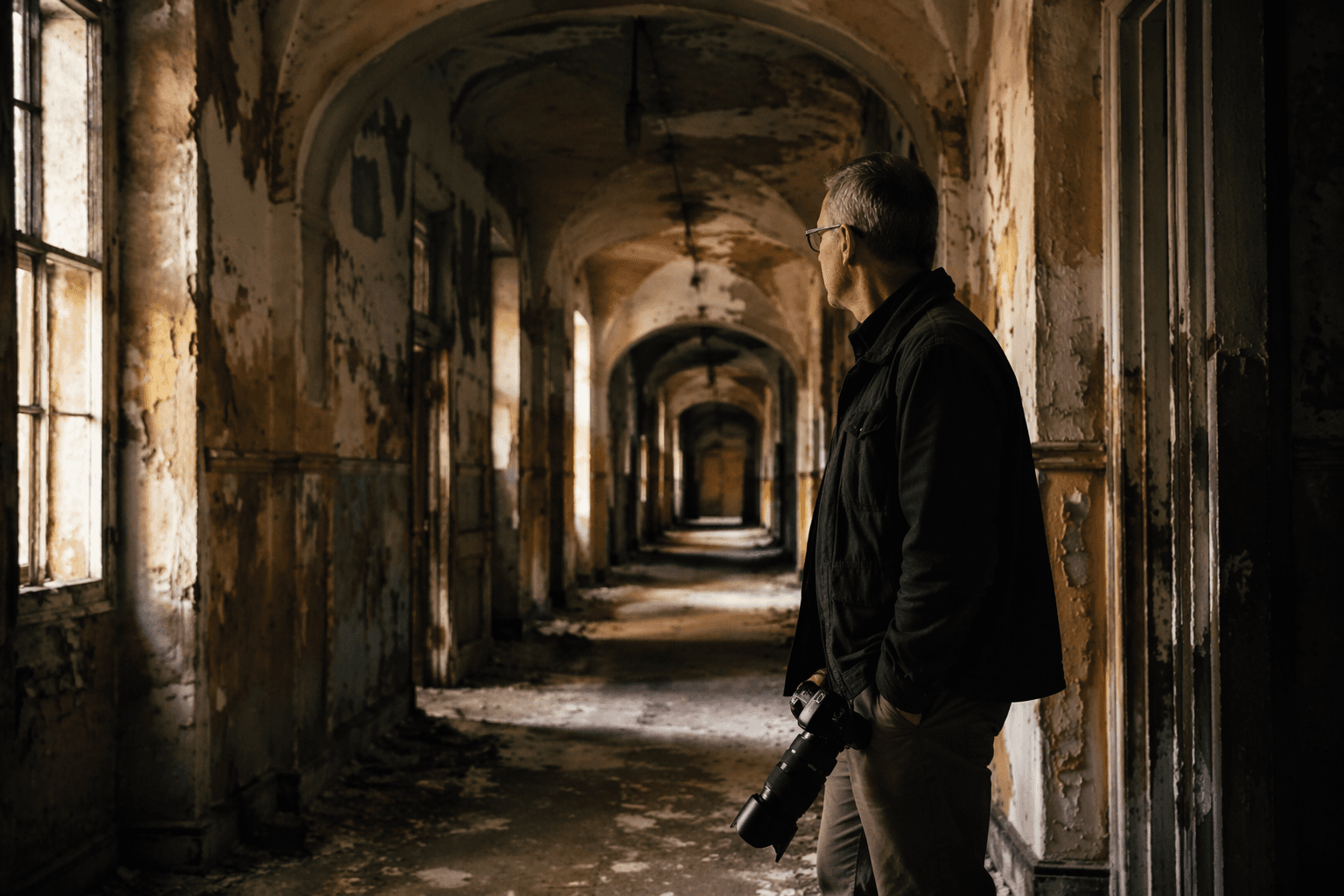
What makes *Sanatorium* compelling to photographers is not only the subject matter, but the way Lazzaro approached it. Fstoppers notes that he worked with a Canon EOS 5D Mark IV and a Canon TS-E 24mm f/3.5L II tilt-shift lens, a combination that makes immediate sense for interior and architectural work. The tilt-shift perspective helps hold verticals straight and preserve the formal geometry of rooms, corridors, and facades, which is essential when the architecture itself is part of the story.
That control changes the reading of the images. Instead of leaning into distortion or decay for drama, the photographs emphasize structure, proportion, and the bones of the buildings. The sanatoriums become visual records of planning and ideology, not just relics with peeling paint.
Access was part of the method too. Fstoppers reports that Lazzaro sometimes had to go far beyond a normal walk-through, including taking a kayak to reach at least one location inaccessible by land. That kind of effort tells you a lot about the project: it was not assembled from quick visits, but from persistence, route-finding, and a willingness to earn the frame.
From ruin study to documentary archive
The strongest reading of *Sanatorium* is that it turns architecture into an archive. Lazzaro says the book is the first to document the contemporary vestiges of former tuberculosis hospitals in the United States, and the sites named in the project show the range of that archive: Adirondack Cottage Sanitarium in Saranac Lake, Seaside Sanatorium in Waterford, Connecticut, Molly Stark Sanatorium in Ohio, and Sea View Hospital in Staten Island.
Sea View matters on its own terms. Lazzaro’s book page identifies it as the site of pioneering antibiotic research for the cure for tuberculosis, which adds another layer to the project’s historical map. These are not just forgotten buildings; they are places where treatment, experimentation, and public health policy once collided.
That is what separates the work from simple ruin photography. The images are linked by subject, but also by sequence, geography, and historical tension. A project like this succeeds because the photographer keeps returning, keeps gathering, and eventually arranges the material so the whole body of work speaks with more authority than any single frame.
What hobbyist photographers can take from it
The lesson here is practical, and it extends well beyond architectural photography. Lazzaro shows how a personal obsession can become a disciplined documentary project when it is supported by repetition and clear visual rules. The photographs do not depend on one spectacular location; they gain force from accumulation, from the consistency of the approach, and from the willingness to build a story over years.
A few takeaways stand out:
- Pick a subject that can sustain repeat visits, not just one great shoot.
- Build a visual system that fits the subject, in this case a tilt-shift lens and a framing style that respects architecture.
- Treat access as part of the project, not a side note.
- Sequence the images so the body of work feels like an argument, not a scrapbook.
- Use personal fascination to find a public story with historical weight.
That is why the project resonates so strongly in the COVID era as well. Fstoppers notes that Lazzaro’s interest in isolation and public health took on new meaning during lockdowns, which gave the work contemporary relevance without flattening its older history. The parallels are there, but the photographs never reduce sanatoriums to a simple metaphor. They remain what they are: places where medical hope, social separation, and design philosophy were once built into the walls.
A project moving into the public eye
The book’s reach has already expanded into exhibitions and institutional programming. Historic Saranac Lake is showing photographs from the project in a special exhibit and describes the work as documenting the contemporary remnants of over 25 former tuberculosis hospitals across the United States, including Trudeau Sanatorium. The Firefly Artists in Northport, New York, has also announced a show and reception around *Sanatorium: Inside the Architectural Cure for Tuberculosis*, framing it as a five-year photographic journey across 17 states.
Lazzaro’s own biography at Foto Foto Gallery places him on Long Island and describes him as a photographer and documentary filmmaker focused on social-awareness subjects. That helps explain why the project lands the way it does. It is not nostalgia dressed up as decay, and it is not a single-issue book announcement. It is the kind of sustained, access-heavy, historically grounded work that turns a niche obsession into a meaningful visual record.
The sanatoriums may have fallen silent, but Lazzaro’s long-term approach gives them a new kind of presence. In *Sanatorium*, the strongest image is not the one that looks most dramatic at first glance, but the one that proves years of return visits can still recover a lost chapter of American life.
This article was produced by Prism’s automated news system from verified source data, official records, and press releases, then run through automated quality and moderation checks before publishing. The system is built and supervised by the people who set the standards it runs under. Read our full AI policy.
Did this article answer your question?