Michael Shainblum embraces fog and shifting weather in New Zealand photos
Shainblum’s New Zealand work turns fog and rain into the subject, not the obstacle. In Fiordland, he shows how patience and lens changes can make shifting weather the whole image.
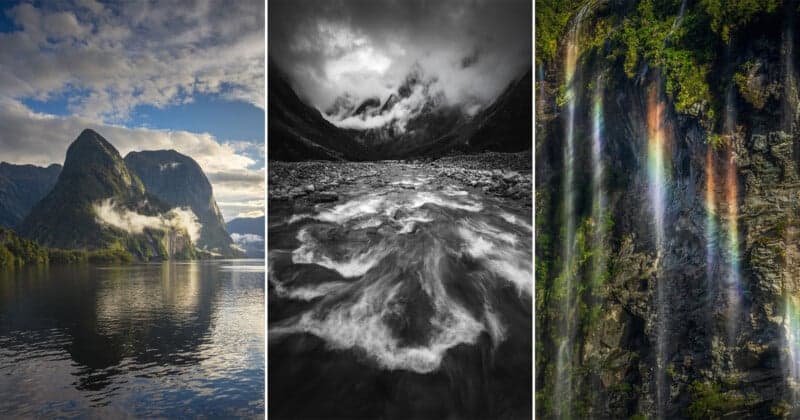
Michael Shainblum’s New Zealand project starts where many landscape shooters would pack up: in fog, rain, wind, and visibility that changes fast enough to wreck a neat plan. In Fiordland National Park, Milford Sound, and Doubtful Sound, he treats that instability as the point of the image rather than the thing standing in the way. The lesson is practical as much as it is poetic: if the weather keeps rewriting the scene, the photographer has to keep rewriting the frame.
Why the weather is the subject
Shainblum’s approach pushes back against the polished, postcard version of New Zealand that landscape photography can so easily fall into. Instead of forcing each location into a fixed composition, he works with the atmosphere as it appears, disappears, and returns. That makes the project feel alive in a way that tightly preplanned shooting rarely does, because the scene is not being preserved unchanged. It is being negotiated in real time.
That matters in places like Fiordland, where the weather is not a backdrop but a moving part of the landscape. Fog can cut off entire mountains in seconds, rain can compress the distance into flat tonal layers, and wind can strip away any sense that the frame is stable. When those conditions are treated as active ingredients, the photograph becomes less about perfect visibility and more about interpretation.
A flexible eye beats a fixed shot list
Shainblum has said that he does not think of photography as a fixed style so much as an extension of personality and imagination, and that idea shows up clearly in the way he worked the New Zealand coast. When the weather opened a scene, he moved wide. When it closed down, he shifted to tighter telephoto fragments that isolated shapes, light, and atmosphere. The camera choice followed the land, not the other way around.
That is the field habit worth stealing. A wide view gives you the scale of Milford Sound or Doubtful Sound, but a telephoto can turn an incomplete view into a graphic study of cliff edges, water texture, or a sliver of light between weather fronts. The point is not to lock yourself into one focal length and wait for the world to cooperate. It is to keep changing your interpretation as the landscape changes in front of you.
- Wide lenses work when the scene gives you enough structure to hold scale and mood together.
- Telephoto frames become powerful when fog erases context and leaves only fragments worth isolating.
- A changing sky often rewards quick decisions over perfect composition.
Milford Sound and the moving frame
Water is doing a lot of the visual work in these images, especially at Milford Sound. Boat wake, tides, and wind keep rewriting the surface, which means the foreground is never entirely static. That movement gives the composition a second layer of uncertainty, one that can either muddy the frame or make it feel more immediate depending on how quickly the photographer responds.
This is where atmosphere stops being decoration and starts becoming structure. A flat, reflective patch of water can act like a temporary base for the image, while wake lines can draw the eye into the scene and then pull it back out again. If the land is half-hidden by mist, the water often becomes the anchor that keeps the photograph from dissolving into abstraction.

Read the scene, then reread it
The strongest habit in Shainblum’s New Zealand work is not gear-related at all. It is the willingness to keep re-reading the scene as the weather changes. A view that looks unusable at one moment may become the best frame five minutes later, not because the light improved in a conventional sense, but because the fog shifted into a cleaner shape or the rain added tonal separation between layers.
That kind of response takes patience, but it also takes restraint. It means not pressing the shutter just because a location is famous, and not assuming the first clear view is the best one. In a place like Fiordland, the better image may be the one that appears only after the obvious scene has disappeared.
Use uncertainty as a compositional tool
The practical takeaway from this project is that atmospheric weather does not need to be treated as a delay. It can create drama, depth, and surprise that would be much harder to fake later in post-processing. Fog can hide the obvious and force you to notice shape. Rain can flatten the distance into tonal bands. Wind can keep the surface of the water from settling into something too predictable.
That is why this work feels different from formulaic landscape photography. The photograph is not built from a guaranteed destination and a tidy checklist of foreground, midground, and background. It is built from adaptation, from watching what the weather removes, then deciding what remains worth keeping.
What this project asks from a landscape photographer
Shainblum’s New Zealand images are a reminder that some of the best landscape work comes from staying in the field after the neat version has vanished. The scene does not need to be pristine to be photographable. It needs to be watched closely enough that its changes become part of the picture.
That is the real throughline in Fiordland, Milford Sound, and Doubtful Sound: fog, rain, wind, and water are not interruptions to the photograph, they are the photograph unfolding. The mountain may disappear, the frame may narrow, and the foreground may shift again, but the picture keeps moving with it, which is exactly why it lingers.
This article was produced by Prism’s automated news system from verified source data, official records, and press releases, then run through automated quality and moderation checks before publishing. The system is built and supervised by the people who set the standards it runs under. Read our full AI policy.
Did this article answer your question?