Misleading Camera Angle of World Leader Sparks Social Media Debate on Photography Ethics
A misleading camera angle at a Qatar press conference made Sheikh Mohammed bin Abdulrahman Al Thani appear to wear a giant cone, racking up 322K views on X and reigniting debate about photographic perspective and ethics.
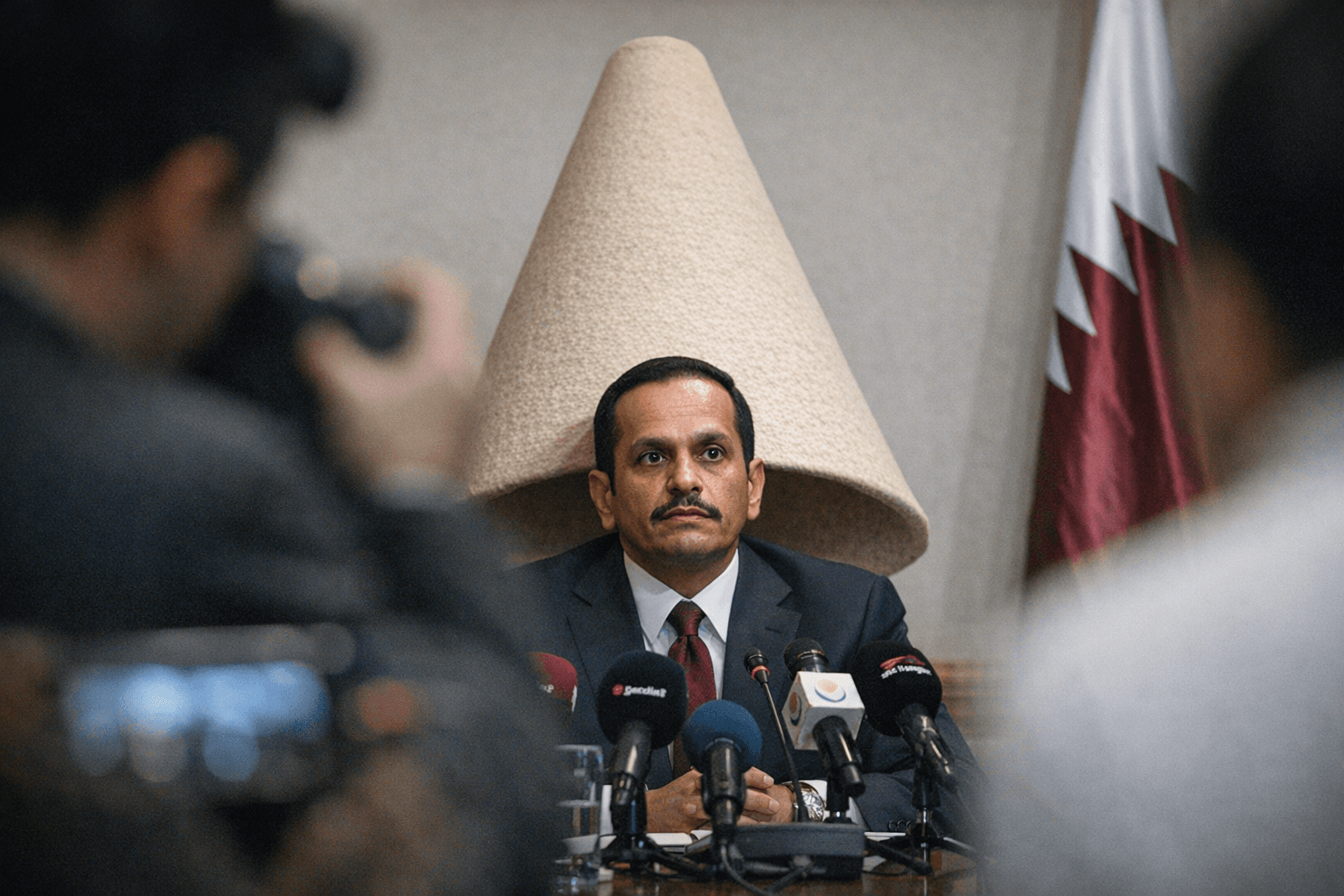
A video posted by the Clash Report account on X showing Qatar's prime minister, Sheikh Mohammed bin Abdulrahman bin Jassim Al Thani, speaking at a press conference in Doha sent social media into a collective double-take — not for what he said, but for what the camera inadvertently made him look like.
Sheikh Mohammed was standing at a podium alongside Turkish Foreign Minister Hakan Fidan, calling for an immediate end to the war on Iran, when an unfortunately aligned flag behind him and a particularly unforgiving camera position combined to create a deeply misleading image. The angle was highlighted in various posts on X, including one by user Mukhtar (@I_amMukhtar) that garnered over 322,000 views after being shared on March 19.
User @poordart shared two still images from the clip pointing out the eyebrow-raising framing, captioning the post simply "A wizard." Others piled on: @Schultz_001 blamed the flag placement ("they placed the flag in such a terrible spot"), while @QGordon18 drew a comparison to the Coneheads film, sharing a GIF of the characters alongside the images. Most succinctly, one user wrote, "I had to do a hard double take."
User @RobProvince had perhaps the most enthusiastic take: "Whoever the camera guy is... double what he's getting paid."
The incident is a textbook illustration of something photographers understand instinctively but general audiences rarely consider: a camera is not a neutral witness. Angle and perspective can easily and unconsciously sow misinformation and spark outrage, and eventually lead to a total mistrust of photography itself. In this case, there was no manipulation, no Photoshop, no intent to deceive. Just a flag, a podium, and a camera locked in from the wrong position.
Most debates about ethics in photojournalism focus on what might be termed "photographic truth," whether a particular image accurately represents the subject or whether it misleads the viewer. This situation adds a wrinkle to that conversation: what happens when the misleading image is entirely unedited?
Research published in the Journal of Leadership & Organizational Studies makes the stakes of camera angle even clearer. The perception of a male leader is influenced by camera angle along the vertical axis; when leaders are viewed from above, they are perceived as less charismatic and less prototypical of their position, accompanied by a measurable loss of approval. A poorly placed flag achieving the optical illusion of a conical headpiece arguably takes that effect to an extreme no researcher could have anticipated.
The integrity of press photography is based on the audience's confidence that the image represents reality as it took place; any element that alters this reality can mislead viewers, distort narratives, and ultimately damage credibility. The Doha footage did none of that deliberately, yet it went viral precisely because the human eye is wired to seek pattern and meaning in an image before it seeks context.
Authentic photographs can be dismissed as fake, while images that fit a preferred narrative are accepted as real — and that friction becomes especially charged when the subject is a sitting head of government. Sheikh Mohammed's remarks about ending a war were substantive. The angle that framed them was not. The fact that the framing nearly eclipsed the message is, for photographers, the real story.
Know something we missed? Have a correction or additional information?
Submit a Tip

