NASA's Latest Spacewalk Delivers Stunning Photos From Beyond Earth's Atmosphere
Astronauts Jessica Meir and Chris Williams spent 7 hours outside the ISS — the resulting photos are a masterclass in shooting under impossible constraints.
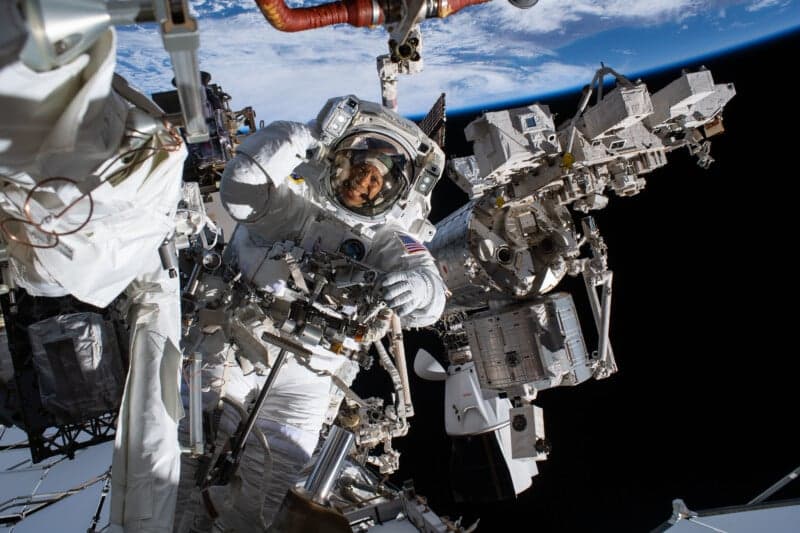
When Jessica Meir floated outside the International Space Station on March 18 and pointed a camera at Chris Williams working against the blinding white hull of the ISS, she produced one of the year's most technically instructive photographs: a human figure dwarfed by solar arrays, Earth's curvature arcing beneath, lit by a sun with zero atmosphere to soften it. No fill card, no diffusion, no second chance.
The images from U.S. EVA 94, the 278th spacewalk in support of ISS maintenance and upgrades, have been circulating among photographers since the gallery surfaced. The seven-hour, two-minute excursion, which concluded at 3:54 p.m. EDT, had a specific engineering goal: Meir and Williams built and installed a modification kit on the station's 2A power channel, prep work for two future roll-out solar arrays. It was Meir's fourth spacewalk and Williams' first. But the images they brought back deserve as much attention as the hardware work itself.
What makes the gallery remarkable is the credit lines. Several frames are credited NASA/Jessica Meir, meaning Williams shot them. Others read NASA/Chris Williams, meaning Meir was behind the camera. These astronauts were photographing each other mid-operation, in pressurized gloves that reduce tactile sensitivity, tethered to a structure moving at 17,500 mph. The Nikon and Canon-class cameras NASA flies on EVA are adapted for exactly this, but no firmware update compensates for a composition window measured in seconds between task steps.
The exposure problem in these images is one photographers studying them should sit with. The ISS surface is a reflective white. Astronaut suits are reflective white. Earth, when it appears in frame, rolls through shadow and sunlit ocean simultaneously. This is a scene that will destroy an auto-exposure reading. The images that work have clearly been dialed in with deliberate highlight control, preserving suit detail without crushing the shadow where the station structure recedes into orbital dark. That balance is the whole game.
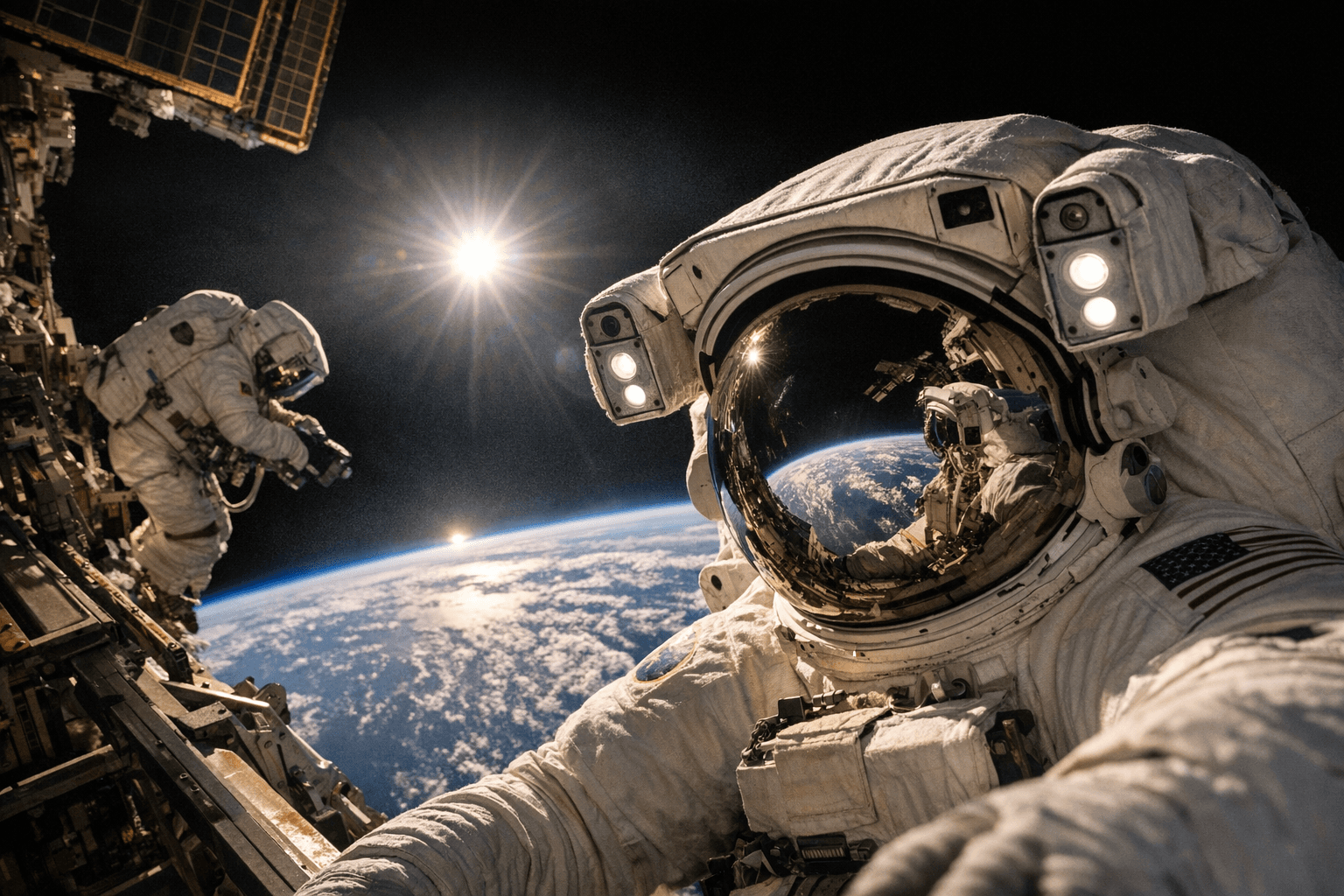
Three exercises translate this directly to your own shooting. First, go out at solar noon on a cloudless day and photograph a subject against a bright concrete or white-painted wall. Your meter will underexpose the subject. Dial in positive exposure compensation and learn where your highlights clip. That is the EVA problem in miniature. Second, find a scene with metallic or glass reflective surfaces, a car hood, a shop window, anything with a specular highlight problem, and work it without a polarizer. Force yourself to find an angle where the composition still holds. Third, shoot a single subject or scene as a three-frame sequence: one wide establishing shot that shows context and scale, one medium that anchors the human element, one tight detail that tells the technical story. That is exactly the sequencing structure in the EVA gallery, and it is the structure that makes the images work as documentation rather than snapshots.
The scale cues in Meir and Williams' images carry particular weight. When a solar array extends beyond the frame edge and a helmeted astronaut fills maybe a third of the composition, the station stops being abstract infrastructure and starts being a place humans work. That storytelling instinct, leading wide to establish, then closing in on the person, is available to any shooter on any assignment. NASA's extreme-environment constraints just make it unusually visible.
Know something we missed? Have a correction or additional information?
Submit a Tip

