Owain Scullion braves Aoraki Mt Cook for award-winning Milky Way shot
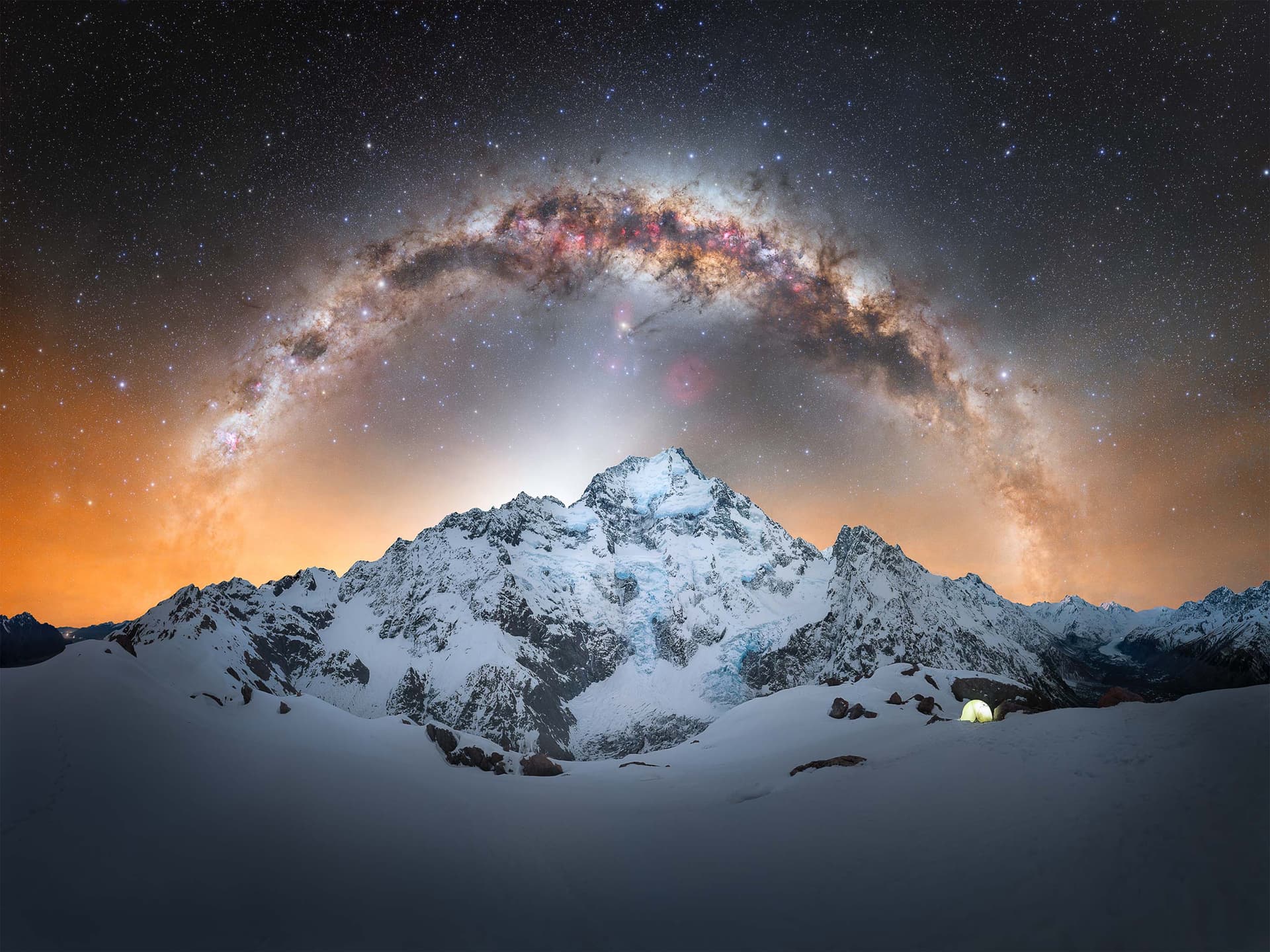
Scullion turned a brutal winter climb above Aoraki Mt Cook into a Milky Way frame that won a place in Capture the Atlas' 2026 collection.
The shot was earned on the mountain
Owain Scullion’s award-winning Milky Way image did not come from a lucky pull-off or a quick tripod setup. It came from a winter push through steep rocky terrain, snow-covered slopes, washouts, unstable snow shaped by solar radiation, and the added strain of camping at altitude. That is the kind of effort that changes how a nightscape is made: the camera work matters, but the route to the frame matters just as much.
Scullion called the project “one of the most demanding challenges I had set for myself,” and that description fits the picture’s appeal. The final image, a carefully planned landscape-astrophotography frame of the Milky Way arch above Aoraki / Mount Cook, was selected for Capture the Atlas’ 2026 Milky Way Photographer of the Year collection, an annual global selection that rewards more than sharp stars and clean processing. It rewards commitment.
Why Aoraki makes the frame harder, and better
Aoraki / Mount Cook sits at the center of Aoraki/Mount Cook National Park and remains one of New Zealand’s most photographed mountain landscapes, which makes it an obvious dream location and a punishing one. The mountain is the country’s tallest at 3,724 metres, and its scale is part of the draw: the terrain gives astrophotography a dramatic anchor that smaller peaks cannot match.
It also brings real risk. The Department of Conservation says avalanches can occur in the park in any season, and the Mueller Hut Route is described as crossing complex avalanche terrain. In winter, that route requires mountaineering experience plus an ice axe, crampons and avalanche rescue equipment. For photographers, that is the first field lesson here: if the foreground is part of the composition, the foreground is part of the expedition.
Te Ara adds the deeper historical context that makes the place feel even more consequential. The first attempt on Aoraki/Mt Cook was made in 1882, and the first successful climb came in 1894 by Tom Fyfe, George Graham and Jack Clarke. That legacy matters because it reminds you that this mountain has always asked for patience, preparation and nerve. Scullion was working in that same tradition, just with a mirrorless camera and a star tracker instead of alpinist first-ascent ambitions.
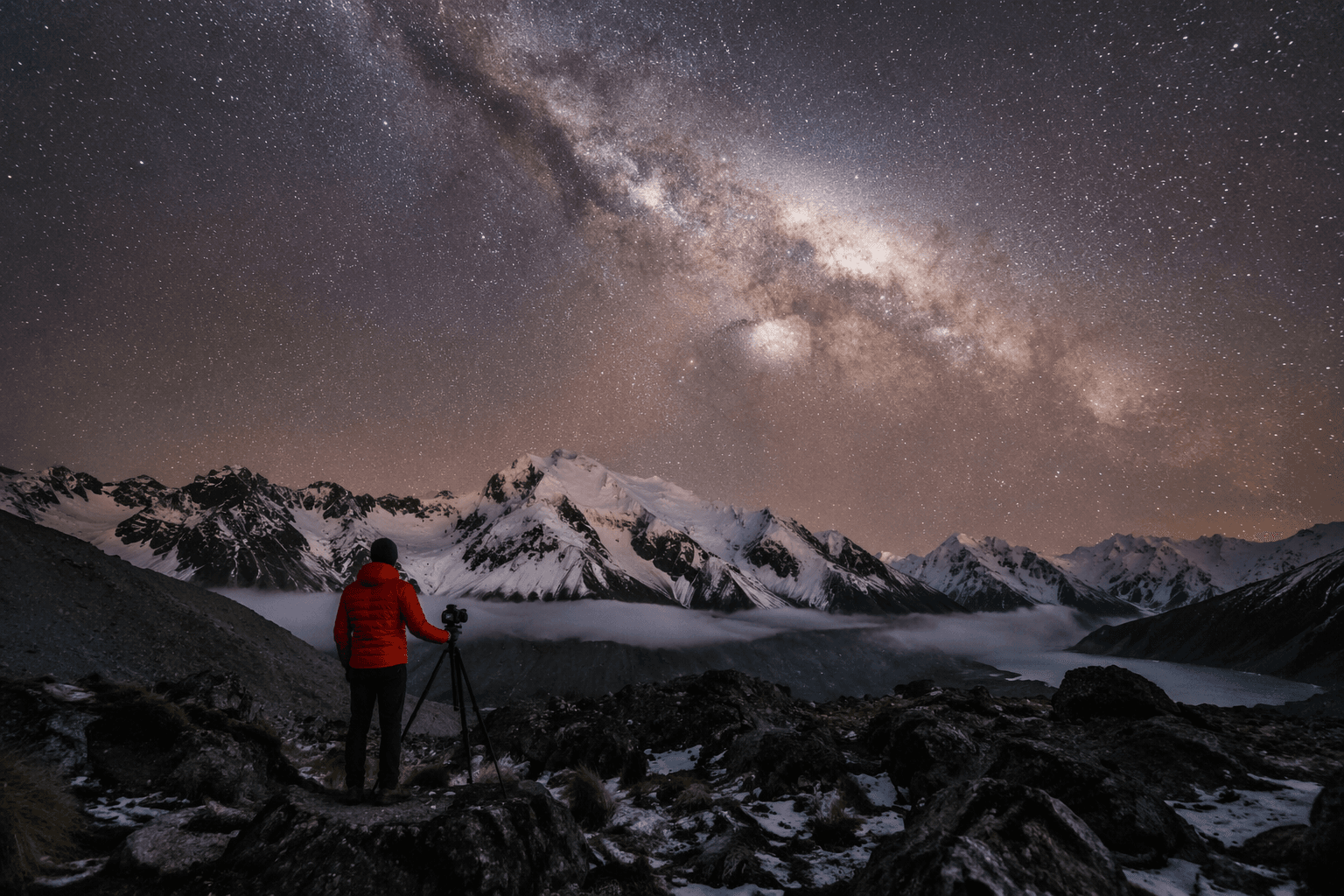
How the image was built in the field
The strength of Scullion’s photograph is that it reads as a single, elegant scene, but it was assembled in pieces under difficult conditions. The sky exposure was made at 60 seconds, f/1.4, ISO 800, while the foreground was handled separately at 60 seconds, f/2.0, ISO 1600. That split approach is a practical reminder that clean nightscape work often means treating sky and land as different problems.
For the capture, Scullion used an astro-modified Fujifilm X-T30 and an MSM Nomad star tracker. The image also involved a Fujifilm XF 23mm f/2.8 R WR, a Viltrox 27mm f/1.2 Pro, a Kase star glow filter and a Nantong H-alpha filter. The gear list is important not because it reads like a shopping list, but because it shows how a compact mirrorless system can still deliver gallery-level results when the operator understands the terrain, the timing and the light.
The star tracker in particular tells you something about the strategy. A tracked sky lets you hold detail in the Milky Way arch while keeping the composition wide enough to let Aoraki dominate the foreground. That is the kind of decision that separates a record shot from a finished image: you are not just pointing at the sky, you are designing a frame around a landscape that has already made the climb difficult.
The pressure points that matter to landscape and astro shooters
Scullion’s ordeal reads like a field guide because each obstacle maps to a repeatable lesson. The steep rock, the snow, the washouts and the unstable surface all underline a basic truth: scouting is part of photography, not a prelude to it. On a mountain like Aoraki, route-finding affects where you can stand, how long you can stay there and whether the composition you imagined is even possible.
- Build the shot around access, not just viewpoint. If the safest line only allows a narrow window, the composition has to respect that.
- Expect winter conditions to change the entire plan. Snow affected by solar radiation can be unstable, which means timing and footwork can matter as much as lens choice.
- Treat camping as part of the creative process. Winter camping at altitude is not background logistics; it is what makes a pre-dawn or late-night frame possible.
- Separate sky and foreground when the scene demands it. Scullion’s matched but distinct exposure choices show how to protect detail in both halves of the image.
- Carry compact, capable gear you can actually move with. The X-T30-based setup is a useful model for anyone who wants serious nightscape results without hauling a heavier full-frame rig into exposed terrain.
The other lesson is psychological: the best astro work often arrives only after you decide the shot is worth the effort. Scullion’s image was not just about technical polish, and it was not a publicity image pasted onto a mountain backdrop. It was the result of a global contest frame earned through endurance, route planning and a willingness to keep going when the mountain made every step count.
That is why the photograph lands. The Milky Way arch is beautiful, but the story behind it is what gives it weight. At Aoraki, where avalanches can happen in any season and the ground itself demands mountaineering judgment, the picture becomes proof that the most memorable nightscapes are often the ones that begin long before dark, with a steep climb, a winter camp and the decision to commit to the shot.
This article was produced by Prism’s automated news system from verified source data, official records, and press releases, then run through automated quality and moderation checks before publishing. The system is built and supervised by the people who set the standards it runs under. Read our full AI policy.
Did this article answer your question?