Photographer Ann Hermes documents vanishing local newsrooms across America
Ann Hermes turns emptying newsrooms into a record of civic loss, from a shuttered Alameda paper to the last press rooms still standing. Her project asks what towns lose when no one is left to witness them.
A disappearing civic map, one newsroom at a time
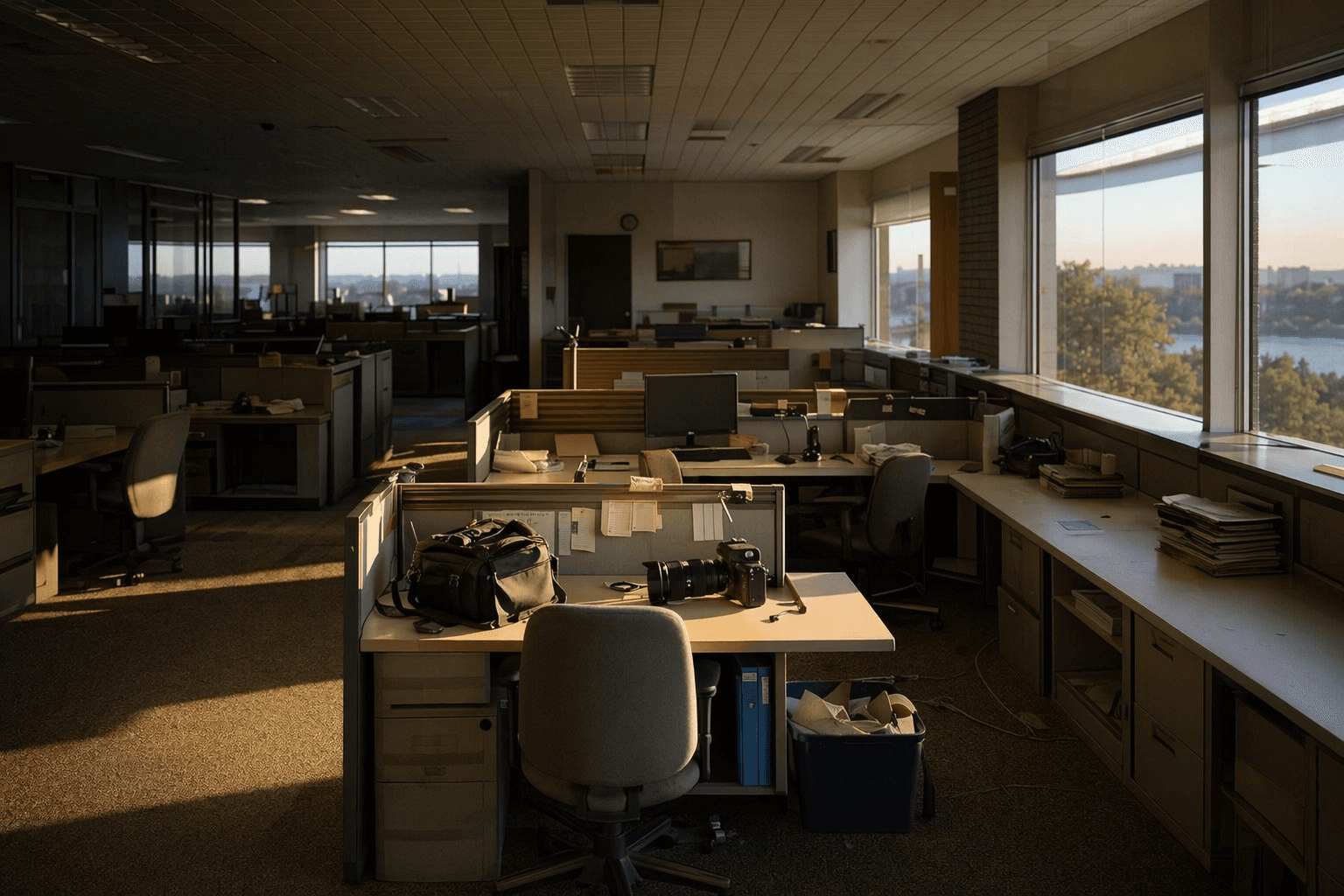
Ann Hermes has spent years photographing places most people only notice when they are gone. From Brooklyn, she has brought her camera into more than 50 local newspapers across the United States, building a body of work that reads less like nostalgia and more like evidence. One of the newspapers she photographed in Alameda, California, has already shut down, which makes the project feel even sharper: these are not just workspaces, they are fragile public institutions that can vanish faster than communities expect.
The power of Hermes’s work is not simply that it documents newspaper rooms. It documents what happens when the institutions that once anchored towns, counties, and small cities start to disappear. Her images, featured in an Associated Press story by media writer David Bauder and amplified by AP White House reporter Seung Min Kim, land hardest because they show the human scale of the collapse, not just the business side of it.
How Hermes arrived at this project
Hermes started thinking about the series around 2016, after hearing critics wave journalists off as elitists. What she found inside local newsrooms told a very different story. These were often cramped, improvised places, staffed by working people in shabby surroundings, the opposite of the polished media caricatures that dominate public debate. That contrast became the engine of the project.
Her own reporting background gave the work unusual intimacy. Hermes worked at the Christian Science Monitor and started her career at the Northwest Arkansas Times in Fayetteville and The Eagle-Tribune on the outskirts of Boston. That history matters because it shows she is not approaching newsrooms from outside. She knows the rhythm of deadline rooms, the clutter, the paper stacks, and the sense that a building can hold a community’s memory long after the circulation numbers start to fall.
She also says she loves these spaces and the people in them. That affection keeps the photographs from becoming elegies alone. They are affectionate, but never sentimental, and they make a practical argument about visibility: if local journalism is being hollowed out, then its physical spaces deserve to be recorded while they still function.
What the pictures actually capture
Hermes has largely avoided metro papers, in part because of corporate resistance, and instead focused on smaller local and regional newsrooms where the signs of strain are often easier to see. Her project includes not only traditional print newspapers but also a few online newsrooms, which broadens the picture beyond old newsprint. The result is a cross-section of journalism in transition, not a single format frozen in time.
The names in the series matter because they locate the crisis in real places. In Vermont, she photographed Tom Haley at the Rutland Herald. In Illinois, she captured the Belleville News-Democrat, a paper founded in 1858 and purchased by McClatchy in 2006. In Alaska, she photographed the Juneau Empire, whose printing press shut down in 2023 after 36 years. These details are not decorative. They show how continuity is being interrupted, whether by ownership changes, equipment shutdowns, or the slow erosion of the business itself.
Hermes has also turned her lens on other transitional institutions, including the last Morse code station operating in North America and department store photo booths. That thread runs through the whole project. She is drawn to systems that once felt ordinary and public, then became endangered or obsolete. In that sense, the newsroom series is part of a larger archive of disappearing shared life.
The numbers behind the decline
The backdrop for Hermes’s photographs is brutal. A 2024 Medill report found 127 newspaper closings in the prior year. It also said more than 1,500 counties, with a combined 55 million residents, had no or only one source of local news. Its watch list of counties at risk of becoming news deserts grew to 279.
The 2025 Medill update made the pattern even harder to ignore. Since 2005, the United States has lost nearly 3,500 newspapers and more than 270,000 newspaper jobs. The report counted 213 counties with no news outlets and 1,524 counties with only one. That is the kind of shrinkage that changes daily life, because it alters who watches school boards, city halls, courts, zoning meetings, and local elections.
PEN America has argued that local watchdog journalism is essential to democracy and has called for stronger support from philanthropic, private, and public sectors. Its 2019 report also urged a congressional commission on public support for local news. In other words, the crisis Hermes photographs is not just cultural. It is structural, democratic, and still unfolding.
Why this work matters to photographers
For photographers, Hermes’s series is a reminder that documentary work can do more than preserve a moment. It can preserve the condition of a public sphere as it erodes. A newsroom photograph is rarely just a room shot when the room itself represents civic memory, labor, and local accountability.
The images are strongest when they show details that ordinary readers might overlook, the worn desks, the improvised setups, the press equipment, the staff still making deadlines against shrinking odds. Those are the textures that make the story sharable, because they translate a huge abstract crisis into something concrete: a place, a face, a machine, a paper that may not survive the next budget cut or ownership shift.
Hermes’s project is still growing, and she says she is nowhere near done. That may be the most telling fact of all. As more local outlets close, merge, or reduce to a fraction of what they were, her photographs become a record of what communities lose when no one is left to witness them, and of what photography can still save when the public square begins to empty out.
This article was produced by Prism’s automated news system from verified source data, official records, and press releases, then run through automated quality and moderation checks before publishing. The system is built and supervised by the people who set the standards it runs under. Read our full AI policy.
Did this article answer your question?