Why Abstract Photography Sharpens Core Skills for Better Images
Abstract photography is a brutal little workout for your eye. It teaches light, exposure, and composition faster because the subject can’t save you.
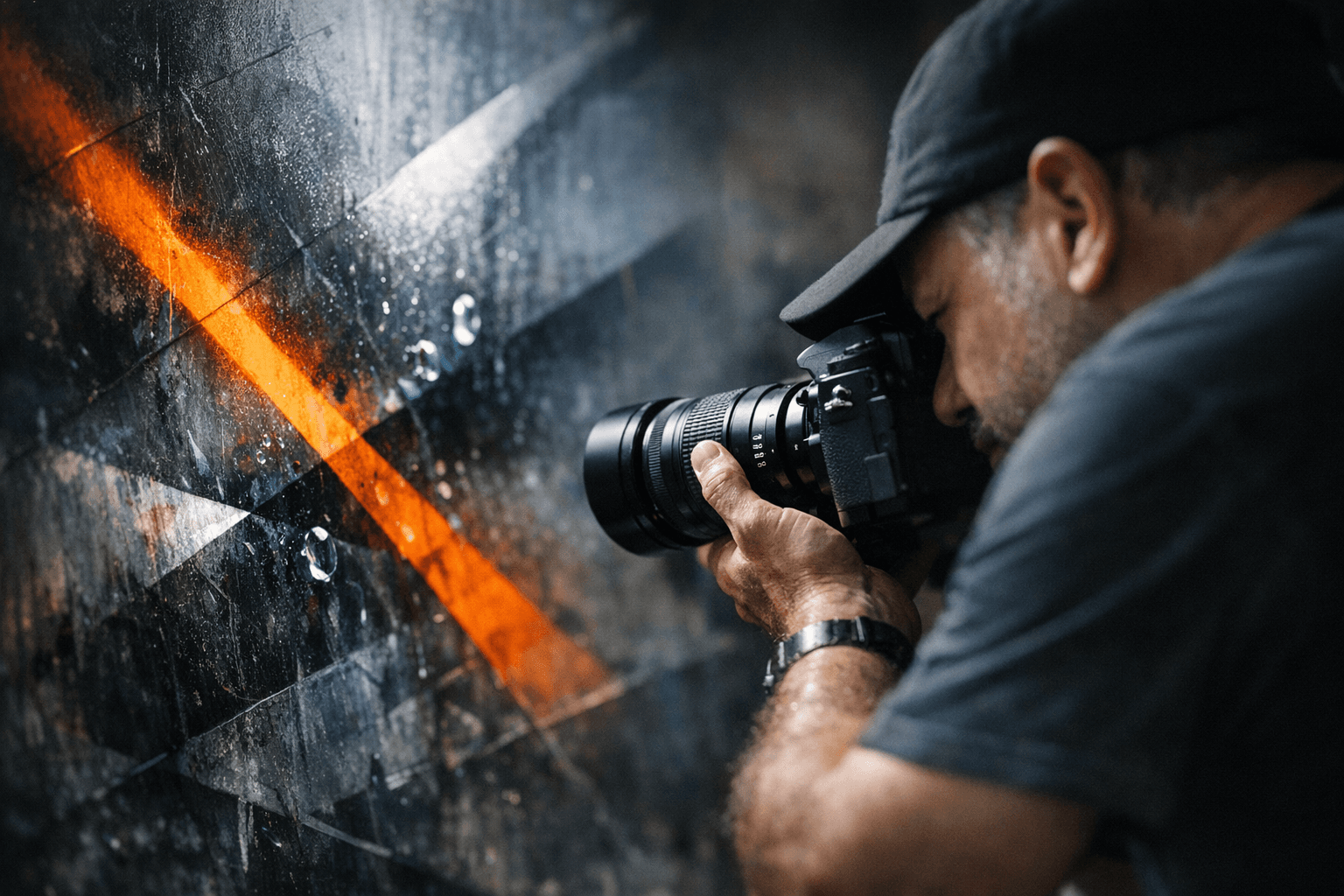
Why abstract photography works as a skills reset
Abstract photography has a funny reputation. A lot of people treat it like a side quest, something you try when you’re bored with “real” photos. That’s exactly why it works so well. When there’s no obvious subject to lean on, you have to pay attention to the things that actually make a photograph hold together: light, form, texture, pattern, color, and composition.
That shift matters because it changes how you look through the camera. Instead of asking, “What is this?” you start asking, “What is the frame doing?” That is a much tougher question, and a much better one if you want to get sharper at the basics. Abstract work strips away the pressure to produce a recognizable subject, which forces you to see structure first and story second.
Seeing light instead of just finding subjects
The first skill abstract photography improves is the one too many shooters rush past: seeing light. If you are not depending on a face, mountain, or product label to carry the image, the quality of the light becomes the image. A bright patch on a wall, a hard edge of shadow across a table, or a soft gradient over glass suddenly matters more than the thing casting it.
That is valuable because light is the one constant that links every genre. Portraiture, street photography, landscapes, and product shooting all live or die by how you read it. Abstract shooting makes you slow down and notice direction, contrast, and falloff, which is exactly the habit that separates a competent photo from one that feels deliberate.
Controlling exposure when the frame is built from tones
Abstract scenes are also a sharp way to train exposure control. When the subject is ambiguous, tonal balance does a lot of the heavy lifting. You start noticing whether the frame is too hot, too flat, too crushed, or just right, and you become more intentional about preserving the parts of the image that matter.
That kind of judgment carries over fast. In a portrait, it helps you protect skin tones and keep backgrounds from blowing out. In a landscape, it helps you balance a bright sky against darker foreground detail. In product work, it keeps reflective surfaces from turning into ugly distractions. Abstract photography makes exposure less about “getting it right” in the generic sense and more about making a visual decision on purpose.
Composing with shape, edge, and negative space
This is where abstract photography gets genuinely useful. Once the viewer is not supposed to immediately identify the subject, you have to be much more careful about edge placement, negative space, tonal balance, and the way shapes interact inside the frame. That forces you to compose with intent instead of relying on recognition.
You begin to notice how a curved line can lead the eye, how a hard edge can split the frame, or how a pocket of empty space can make a shape feel cleaner and stronger. Those instincts transfer directly to other kinds of photography. A portrait background suddenly stops being background noise and starts becoming part of the composition. A street scene becomes less about the obvious subject and more about how geometry and movement sit together.
Texture, pattern, and color do the storytelling
Abstract work also teaches you to trust texture, pattern, and color. In a normal shoot, those elements often sit in the background while the subject carries the meaning. In an abstract frame, they become the whole point. That’s a powerful shift, because it trains you to look for visual relationships instead of just objects.
The best part is that you do not need a dramatic location to practice this. An everyday environment can become a rich source of material if you stop trying to describe it literally and start interpreting it visually. That is why abstract photography is such a good reset for creative rut. It makes ordinary places feel usable again.
A same-day exercise with ordinary objects
You do not need special gear or a location scout to try this. Set up near a window, grab a few household objects, and give yourself one hour to make images that never show the whole subject clearly. The point is not to hide everything for the sake of it. The point is to use light, shape, and texture to build a frame that stands on its own.
1. Pick three ordinary objects with different surfaces, such as a mug, a fork, and a folded shirt, or a lamp, a glass, and a book.
2. Put them near natural light and move them until you get strong shadows, bright edges, or overlapping shapes.
3. Shoot close and crop aggressively so the frame is driven by line, tone, and texture rather than object recognition.
4. Make a second pass and focus only on negative space, adjusting your angle until the empty areas help the shapes breathe instead of crowding them.
5. Compare the frames and ask which one feels strongest even before you identify what the objects are.
That exercise sounds simple, but it exposes weak composition instantly. If the frame falls apart without a clear subject, you can see exactly where your eye has been relying on convenience instead of structure.
Why this helps beginners and experienced shooters differently
For beginners, abstract photography is a clean way to learn how composition actually works. There is less pressure to perform, less temptation to lean on a “good subject,” and more room to notice the mechanics of a photo. That makes the learning curve easier to read because every mistake is visible in the frame.
For experienced photographers, it does something else: it restores curiosity. After a while, it is easy to start repeating the same safe pictures and forget how much you can do with light and form alone. Abstract shooting cuts through that rut fast. It reminds you that the camera is not just a recorder of subjects, it is a tool for visual interpretation.
The practical payoff in the rest of your work
The best argument for abstract photography is not that it produces gallery-friendly images, though it can. It is that it trains the same instincts you use everywhere else. Better light reading, better exposure decisions, cleaner edge placement, smarter use of negative space, and a stronger sense of tonal balance all show up in your other work once you start practicing them in abstract scenes.
That is why the genre is more than a stylistic detour. It is a direct workout for the part of your brain that organizes a frame. Learn to make something visually interesting without depending on a clear subject, and you usually become much better at seeing the structure of every scene in front of you.
This article was produced by Prism’s automated news system from verified source data, official records, and press releases, then run through automated quality and moderation checks before publishing. The system is built and supervised by the people who set the standards it runs under. Read our full AI policy.
Did this article answer your question?