Pro pickleball stars earn millions through contracts, sponsors, prize money
Anna Leigh Waters and Ben Johns are in a different money class than most of pro pickleball, and the gap explains why coaching, camps, and retreats matter.

The top of the pay scale
The money market hit a genuine inflection point heading into 2026, and pro pickleball’s headline names now sit in a different financial universe from most of the tour. Zane Navratil’s breakdown puts Anna Leigh Waters near $4 million a year after taxes and Ben Johns close to $3 million, while a strong A-tier player may gross about $1.35 million and keep roughly $750,000 after taxes and expenses.
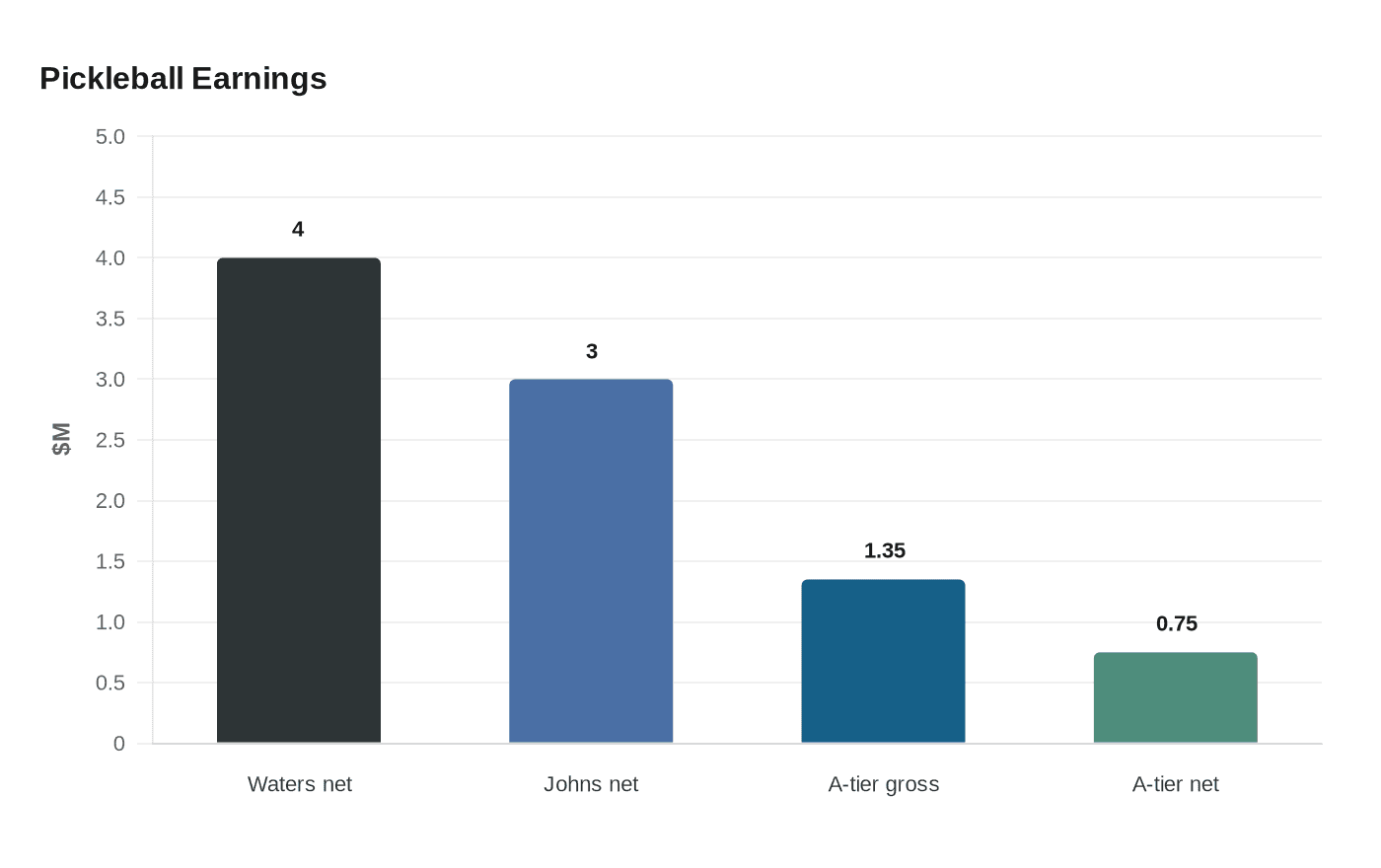
That spread is the real story. Pro pickleball is not paying like a traditional team sport with simple salaries and clean payroll lines. It is paying through a layered mix of league contracts, sponsorships, prize money, appearance fees, teaching income, and other commercial opportunities, and the size of the paycheck depends as much on marketability and brand leverage as on results.
What actually goes into a pro pickleball paycheck
At the very top, the sport’s economics are built around a few stars who can command the biggest sponsorships and the most valuable contract terms. Waters and Johns are the clearest examples. Waters’ profile on the PPA Tour lists her as the world No. 1 women’s singles, doubles, and mixed player, with 181 gold medals and 39 triple crowns, and says she turned pro in 2019 and lives in Boynton Beach, Florida. JOOLA publicly identifies Johns as its world No. 1 pickleball player, which shows how much of their earning power is tied to brand status as much as bracket results.
For the next tier down, the money is still strong but much more complicated. Navratil’s analysis says the highly marketable A-tier can bring in about $1.35 million in gross income, but that number shrinks quickly once taxes and expenses come out. In that range, income is usually diversified across several streams:
- paddle contracts
- clothing and shoe deals
- prize money
- clinics and corporate events
- appearance fees
- teaching and travel-based instruction
That is why two pros with similar results can end up living very different financial lives. One may have a signature paddle deal and steady sponsor support, while another is piecing together a season through teaching, camps, and event fees.
Why the gap between hype and earnings stays so wide
Pickleball’s participation boom has been real and fast. USA Pickleball said the sport grew to 13.6 million U.S. players in 2023 and expanded 51.8% from 2022 to 2023, while later reporting showed 18,258 known court locations nationwide in its 2025 growth report. It also reported 144 sanctioned tournaments in 2025, a sign that the competitive calendar keeps getting bigger even as the pro money stays concentrated at the top.
That mismatch matters because popularity does not automatically turn into broad player wealth. Forbes reported in September 2024 that Waters was expected to make more than $3 million that year, which already put her in rare territory, and it helps explain why the sport’s biggest names attract so much attention from equipment brands and tours. The market is growing fast, but the upside is still being captured by a small group of stars with the strongest commercial pull.
The broader implication is that pro pickleball has matured quickly on the surface while still behaving like a young, uneven industry underneath. The number of players, courts, and sanctioned events has surged, but the pay structure still rewards scarcity. That is one reason fans keep asking how the economics work, and why the answer keeps circling back to the same names.
How the tours are trying to formalize the money
The United Pickleball Association made that pressure visible in June 2025 when it said it planned to deliver up to $31 million in total player earnings starting in 2026. The package included $11 million in guaranteed money, $15 million in PPA Tour and Major League Pickleball prize money, and $5 million in international prize money opportunities. On paper, that is a real expansion of the pro pipeline.
But the structure also shows how the business is changing. The UPA said some guaranteed salaries would be split across 2026, 2027, and 2028, which shifts part of the model away from simple up-front security and toward longer-term incentives. A June 2025 contract update also said players who signed during the 2023 tour wars were eligible for higher prize money pots and a Gold Contract, while later signees were placed on a Standard Contract.
That distinction says a lot about where the sport is right now. The earliest players to bet on the new tour structure were rewarded with better upside, while newer entrants face a more constrained path. The economics are still evolving in real time, and the rules of the game are being rewritten even as the sport keeps adding fans.
Why coaching, camps, and retreats are part of the business model
For the players outside the very top tier, the retreat and teaching world is not a side note. It is one of the ways pro pickleball becomes sustainable. Retreat operators and clinic businesses are actively selling pro coaching, social play, and travel-based instruction in destinations such as Spain, Italy, Malaysia, Indonesia, Antigua, and Guatemala, which turns player reputation into a real revenue stream beyond tournament checks.
That matters because the middle class of pro pickleball is still being built. A player who is not Anna Leigh Waters or Ben Johns may still have a valuable brand, but that value is often unlocked through lessons, camps, corporate events, and destination experiences rather than through prize money alone. The result is an ecosystem where the sport’s aspirational layer, especially coaching holidays and luxury retreats, depends on pros who can teach as well as they can win.
Waters’ changing paddle relationship also shows how quickly these off-court deals can move. Reporting in January 2026 said her seven-year partnership with Paddletek ended and that she later signed with Franklin Sports, a reminder that the sponsor market remains fluid even for the biggest names. For players, that kind of shift can change the entire income picture in one deal cycle.
The bottom line is simple: pickleball’s public hype is real, but its pay structure is still top-heavy. The sport is large enough to support stars, tours, and a growing retreat economy, yet concentrated enough that a handful of names capture most of the upside. Until that changes, the business will keep running on a mix of elite contracts, sponsor power, and the teaching culture that has long kept the broader pickleball world moving.
This article was produced by Prism’s automated news system from verified source data, official records, and press releases, then run through automated quality and moderation checks before publishing. The system is built and supervised by the people who set the standards it runs under. Read our full AI policy.
Did this article answer your question?