Butterfly explains long pips, short pips, and spin control for players
Butterfly’s pips primer turns a niche rubber choice into a simple question: do you want more spin, more disruption, or more control over the rally?
Pips are not a secret language, they are a ball-behavior choice
Butterfly’s Logan Rietz episode does something a lot of equipment talk misses: it makes pips feel playable. Instead of treating long pips, short pips, and inverted rubber like separate worlds, the lesson keeps returning to the same point: the rubber matters because of how the ball comes back off the racket.
That is why the topic lands for everyday players. Table tennis is one of those sports where you can feel the difference on the very next touch, and pips change that feeling fast. Butterfly places the episode in a busy April 2026 stream of training and tournament coverage, which gives the message extra weight: this is not fringe trivia, it is part of how serious players think about the game.
The three main rubbers, in plain club-room language
The usual rubber families are inverted, short pips, long pips, and antispin. Inverted is the familiar baseline for most players, the style most people think of when they picture modern attacking table tennis. Short pips and long pips are the two categories that tend to intimidate newcomers, mostly because they are often discussed as specialty choices instead of everyday tools.
Long pips
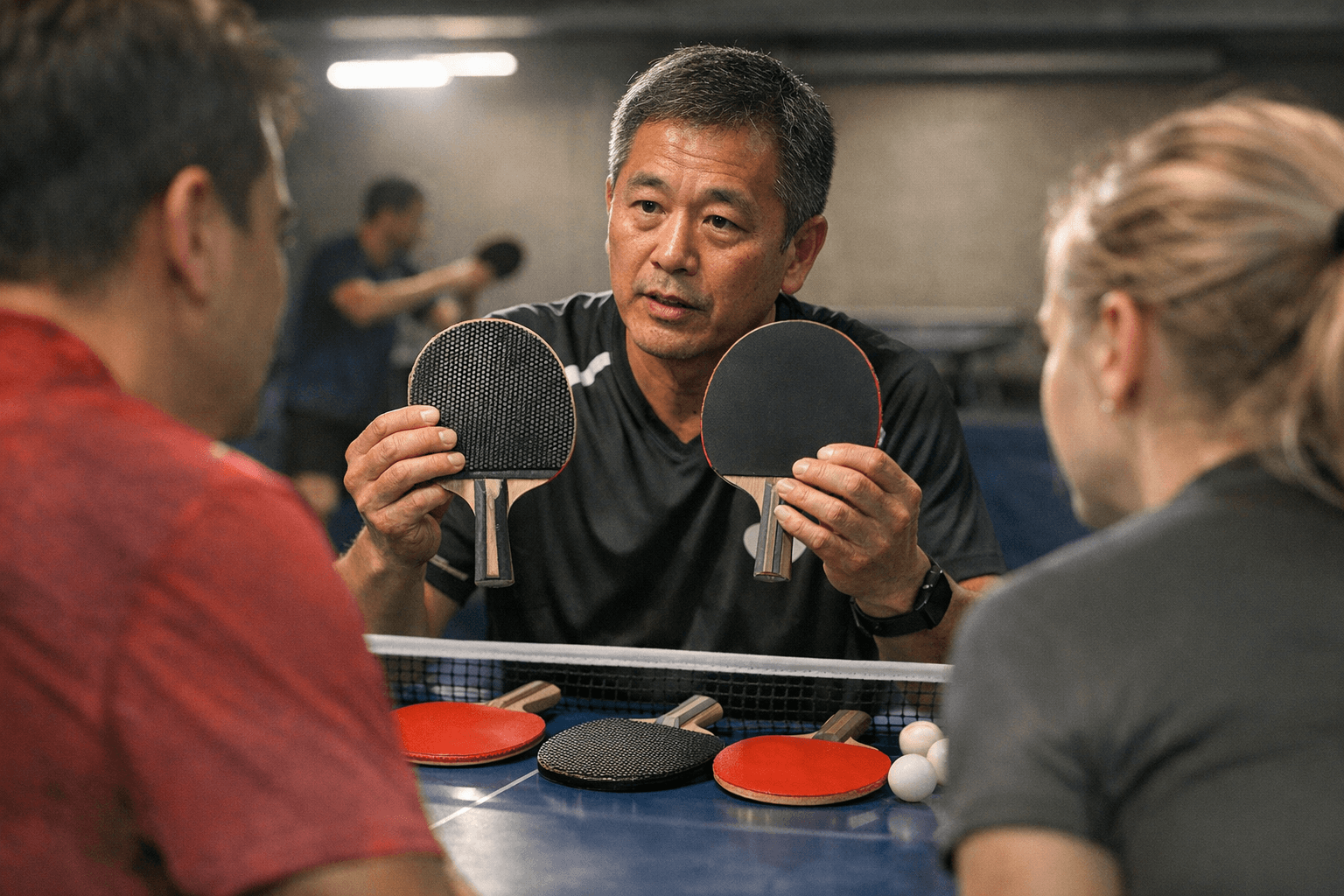
Long pips are the rubber most players hear about when they think of disruption. The spikes are long enough that they change how incoming spin comes back, which is why long pips are often treated as a defensive or variation-heavy option. The important part is not that they create magic, but that they can make spin response less straightforward and give the player a different kind of control over the rally.
That does not mean long pips are random. One of the biggest misconceptions around them is that they are unpredictable by nature, when the better way to think about them is that they are predictable in a different way. If you know how the rubber behaves, the returns can be very manageable, and that is exactly why so many defenders trust them.
Short pips
Short pips sit closer to the middle of the spectrum. They are still pips, but they do not behave like long pips, and they are not the same as inverted rubber. Players often use short pips when they want a crisper, flatter contact, less dependence on heavy spin production, and a style that keeps the ball direct.
For a club player deciding between the two, this is the cleanest distinction to remember: long pips are usually about changing spin and upsetting rhythm, while short pips are more about a direct, compact contact. They solve different problems, and they reward different habits.
Inverted rubber
Inverted remains the default for a reason. It is the most familiar path for building heavy topspin, serving with variety, and playing the looping game that dominates modern table tennis. Butterfly’s pips primer uses inverted as the comparison point because so many players understand their game only through that lens.
That comparison matters when you are trying to decide whether to switch. If your current style depends on generating your own spin and leaning into topspin exchanges, inverted may still be the natural fit. If you want the rubber to do more of the work on spin reversal, disruption, or awkward returns, pips become worth a serious look.
Who should actually try pips
The best candidates are not just old-school defenders. The Butterfly episode frames pips as useful for players who want to improve defensive strategy and understand spin variation, which opens the door much wider than the old stereotype. If you like blocking, changing pace, taking the spin off the ball, or forcing opponents into uncomfortable reads, pips deserve a trial.
Think about your own patterns at the table:
- You win points by absorbing pace and redirecting the ball, not by out-looping everyone
- You like to control the opponent’s spin game instead of matching it
- You want more variation on the return without rebuilding every stroke
- You are curious about a defensive or disruptive identity, rather than a pure power identity
If those descriptions sound familiar, pips may be a tool rather than a gimmick. The episode’s practical message is that the rubber should match the way you want the ball to behave, not the way the crowd expects you to play.
The biggest myths that keep players from experimenting
The first myth is that pips are only for specialists. That idea lingers because long pips have long been associated with defense and disruption, but that does not make them off-limits to regular league players. They are simply a different answer to the same question every player faces: how do I make the ball come back in a way that helps my game?
The second myth is that long pips are too weird to control. Butterfly’s framing pushes back on that by stressing spin response and predictability. Once you understand what the rubber does to incoming spin, the ball stops feeling mysterious and starts feeling like a pattern you can learn.
The third myth is that pips are somehow informal or outside the rules. They are not. The International Table Tennis Federation is the sport’s world governing body, founded in 1926, with 227 member associations and roughly 120 international tournaments sanctioned each year. Equipment is a formal part of the sport, and the United States Association of Table Tennis requires a racket to have one black side and one side in an approved color. The gear choice is built into the rules, not floating outside them.
Should you switch? A simple decision test
The cleanest way to decide is to ask what you want your points to feel like. If you want rallies to stay familiar, spin-heavy, and built around your own topspin production, inverted may still be the easier road. If you want to disrupt rhythm, simplify some exchanges, or build a defense-first identity, pips may fit better.
- More spin variation on blocks and returns
- A defensive or disruptive profile
- Greater comfort against heavy incoming spin
- A rubber that changes the opponent’s timing as much as your own
Long pips make the most sense when you want:
- A direct, flatter contact
- Faster transition into active strokes
- Less dependence on big spin generation
- A style that stays aggressive without feeling overbuilt
Short pips make more sense when you want:
That is the real value of Butterfly’s lesson. It does not sell pips as a trick rubber or a curiosity. It presents them as an equipment decision with tactical consequences, and for a player standing at the edge of a racket change, that is the difference between guessing and choosing.
Know something we missed? Have a correction or additional information?
Submit a Tip