Hana Goda Makes History as First African Woman in World Cup Quarterfinals
Egypt's 18-year-old Hana Goda became the first African woman to reach a World Cup singles quarterfinal, then pushed world No. 1 Sun Yingsha to a deciding game.
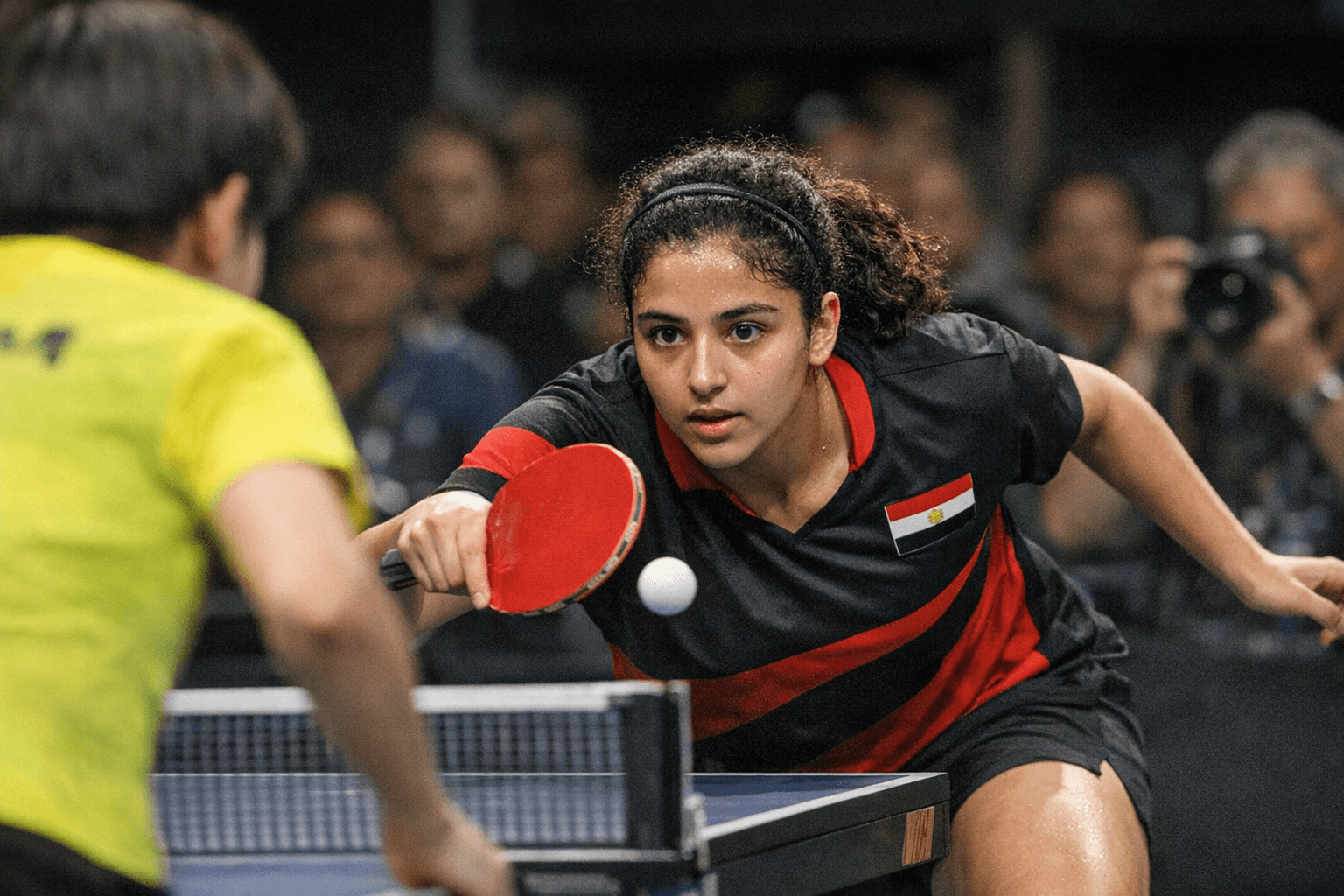
The geography of elite women's table tennis has been predictable for decades: Chinese players at the top, Europeans and East Asians in the mix, everyone else competing for table scraps. What happened at Galaxy Arena in Macao on April 3 was a direct challenge to that map.
Hana Goda, an 18-year-old from Cairo ranked 26th in the world, defeated France's Yuan Jia Nan 4-3 in the Round of 16 at the ITTF Men's and Women's World Cup Macao 2026, becoming the first African woman in history to reach a singles World Cup quarterfinal. The match ran one hour and twelve minutes. One game alone stretched to 30 points. The final game scores were 9-11, 11-9, 11-5, 14-16, 8-11, 11-8, 13-11, the kind of line score that tells you nobody led comfortably for long.
When the decisive point landed, Goda collapsed flat on her back on the court, weeping. "I don't even know how I feel right now. It's crazy, it's emotional, I just can't believe it," she said.
The breakthrough comes 12 years after Nigeria's Quadri Aruna became the first African player to reach a World Cup quarterfinal at all, a feat he achieved in Düsseldorf in 2014 and for which he was named ITTF World Player of the Year. Goda's run arrived in the women's draw, where no African had gone this deep in singles before. The milestone is not a footnote; it is the entire story.
To understand what reaching that stage required, start with the infrastructure gap. Egypt is not a traditional table tennis powerhouse stocked with top-50 sparring partners on demand. Goda navigated that reality from almost the beginning. Because she was too short to reach the table as a young child, her coach sawed off the table legs so she could train. By age 10, she was already traveling to China for training camps, a deliberate investment in sparring quality that most African juniors never access. At 14 years and 7 months, she became the youngest player ever to win the ITTF Africa Cup women's singles title. By 15, she was the youngest senior African champion on record. She competed at the 2024 Paris Olympics and arrived in Macao with Red Bull and equipment brand STIGA in her corner, sponsorships that funded the international circuit exposure that sharpens a player into a genuine threat.
The quarterfinal itself confirmed the level. After eliminating Yuan Jia Nan, Goda pushed world No. 1 and two-time World Cup champion Sun Yingsha to the absolute limit in a seven-game thriller, falling 4-3. Pushing the best player on the planet to a deciding game, as a first-time World Cup quarterfinalist, is not a consolation; it is a credential.
The ITTF hailed the achievement as "a landmark moment for African table tennis, and a result that will inspire a generation of players across the continent for years to come." The practical meaning of that statement lives in funding rooms and federation boardrooms: when a teenager from Cairo reaches the last eight at the World Cup in the ITTF's centenary year, the argument for investing in African women's programs no longer requires a vision statement. It has a scoreline.
Aruna was 25 when he made his run in 2014. Goda is 18. The trajectory is accelerating.
Know something we missed? Have a correction or additional information?
Submit a Tip