Hwa Chong Pair Powers Through Injury to Reclaim B Division Title
A Hwa Chong Institution doubles pair played through a bloodied knee to help their school reclaim the NSG B Division table tennis title.
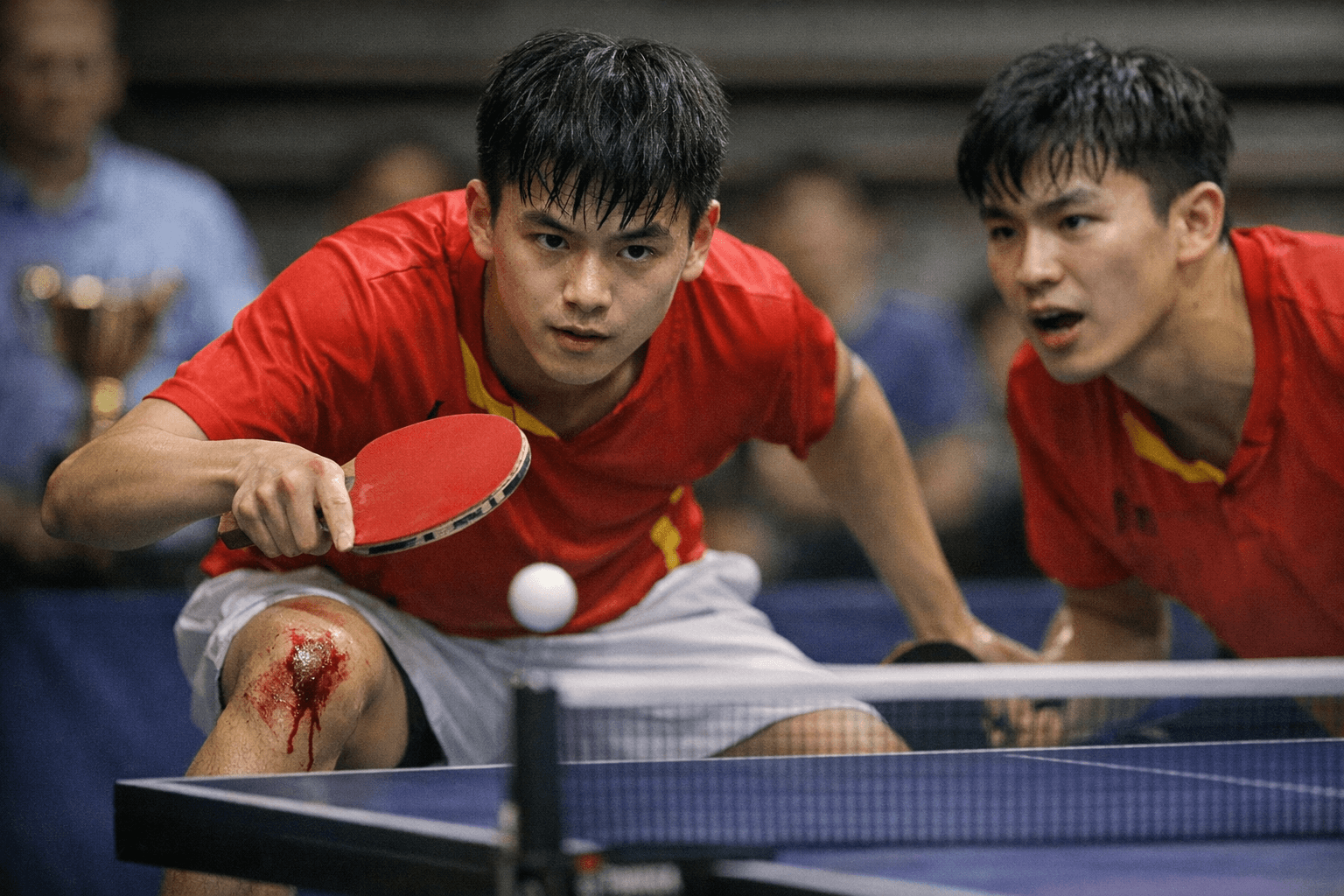
Table tennis badly needs players who refuse to fold under pressure, and two competitors from Hwa Chong Institution gave the Singapore schools circuit exactly that kind of moment on Thursday, grinding through a bloodied knee injury to help their school reclaim the National School Games B Division title.
The injury, sustained during play, forced the pair to make one of the sport's most under-discussed decisions: stay on, or step off. The answer tells you almost everything about what separates junior competitors from those who understand how matches are actually won and lost. A bloodied knee is not a structural failure. It is painful, visually alarming, and psychologically disruptive, which is precisely why the HCI pair's choice to continue mattered beyond the scoreboard.
Knowing when playing through is smart rather than reckless comes down to one distinction: is the injury limiting movement in a way that creates compounding risk, or is it simply uncomfortable? A surface laceration with no joint instability passes that test. A rolling ankle or a locked knee does not, because every lateral push compounds the damage and distorts the mechanics of every stroke that follows.
For a pair managing a compromised leg mid-match, the immediate adjustment is footwork economy. Wide-angle covering steps get replaced with shorter pivots from a central position. The affected player anchors slightly deeper, narrowing their court coverage zone and relying on their partner to shade toward the wider angles. This is not retreat; it is load redistribution, and when executed cleanly it is nearly invisible to an opponent who has to keep reading the table rather than the players.
Serve selection shifts too. Long, heavy topspin serves that demand explosive first-step recovery from the server become liabilities. Short, low serves into the body or wide to the forehand court put the pressure of movement squarely on the receiver, buying the serving pair a more stationary third-ball opportunity. A controlled third ball to the opponent's crossover point, where backhand and forehand jurisdiction blur, punishes any hesitation without requiring the HCI pair to generate explosive footwork themselves.
In terms of tactical roles, the pair would have relied on whoever had the healthier movement to dominate the middle ball: the single most contested and most decisive zone in competitive doubles. The middle ball, arriving between partners, triggers the coordination problem that breaks amateur pairs. Deciding in advance, based on the server rotation and the incoming ball height, which player owns the middle removes the hesitation that gifts opponents cheap points.
Timeout usage in that kind of scenario is equally instructive. A timeout called not at a score crisis but at the first sign of physical distress, giving a brief standing recovery and a chance to reset tactical assignments, is a tool that most young players treat as a last resort when it is in fact a precision instrument.
Hwa Chong's B Division crown had slipped away in recent seasons, and reclaiming it under those conditions carries a different weight than a clean run. The pair demonstrated something practical rather than symbolic: that structured decision-making, both medical and tactical, holds up when the match demands it.
Know something we missed? Have a correction or additional information?
Submit a Tip