Rockford Hosts 250-Plus Student Athletes at Collegiate Table Tennis Championships
Harvard, Cal, and 50-plus colleges sent 250+ players to Rockford's NCTTA Championships, where the coed team format is quietly rewriting what collegiate table tennis looks like.
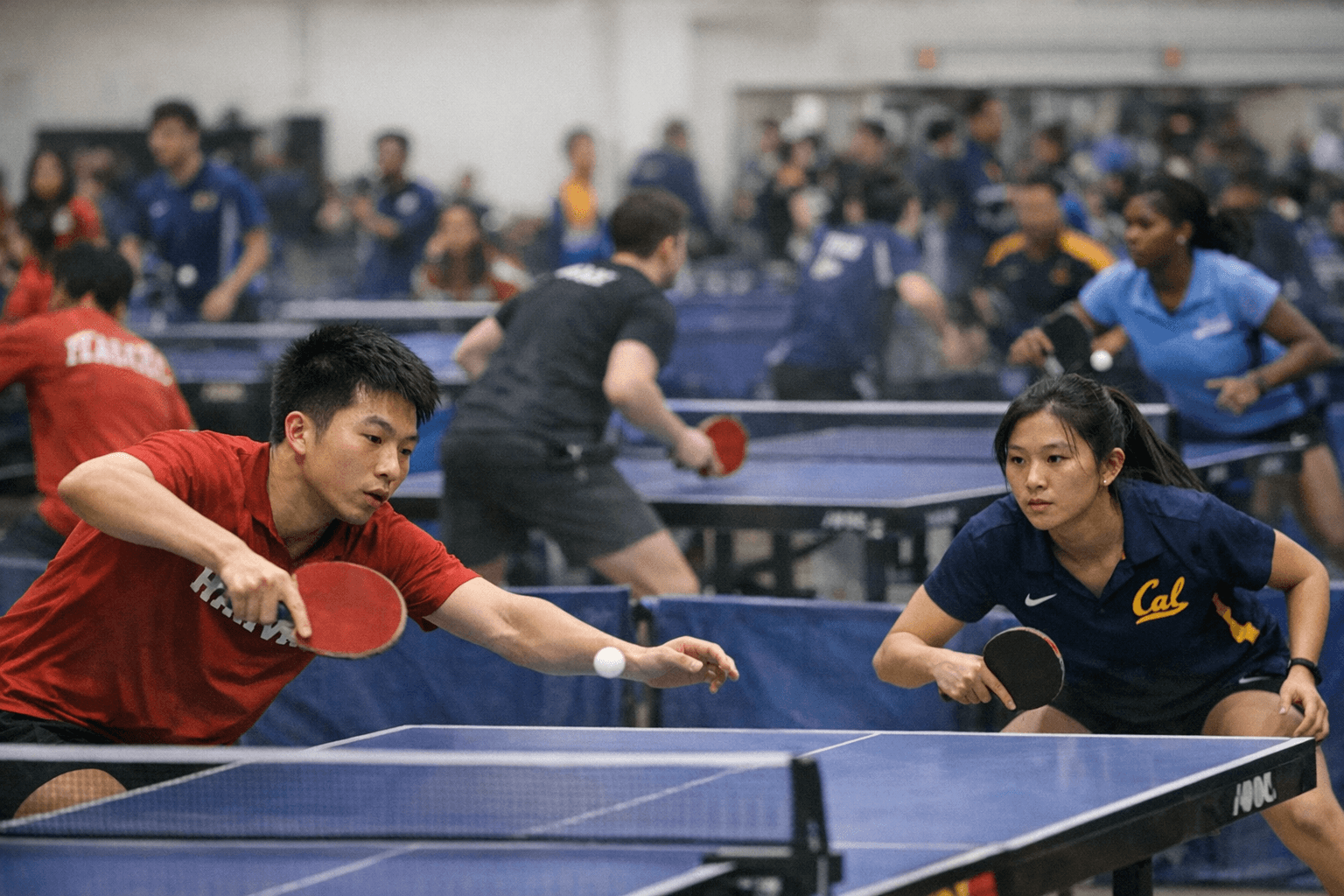
The most important number in American table tennis right now is not a world ranking or a prize purse. It is 250, as in the 250-plus student-athletes from more than 50 colleges and universities who packed the UW Health Sports Factory on South Madison Street in Rockford, Illinois, this weekend for the 2026 National Collegiate Table Tennis Association Championships. Programs from the United States, Canada, and Puerto Rico filled an 80-player Men's Singles draw, a 40-player Women's Singles draw, 24 Coed Teams, 16 Women's Teams, 32 Men's Doubles pairs, and 16 Women's Doubles pairs, all supported by 104 volunteers. By any measure, Rockford hosted the country's biggest annual table tennis gathering.
Harvard's Kelly Yenn and Hannah Song captured the Women's Doubles title, while California's Sid Naresh and Jerry Fung claimed Men's Doubles. On the Women's Singles side, Cal's Amber Liu entered as the top seed, facing challengers including Isabella Xu of North Carolina, Fan Miao of Texas, and Rachel Wang of Columbia. Coed Team competition drew Texas Wesleyan's Senura Silva and Jonatan McDonald, who described their mindset ahead of the team rounds: "We really want this. But most importantly, we're here to have fun, see what we have worked on in practice to carry over to match play."
The Coed Team event is what makes NCTTA structurally different from every other national table tennis competition in the country. Men and women compete together on the same roster and against one another across the net, with results counting equally regardless of gender. Of the 24 teams that qualified this year, 16 deployed women in starting roles. No other national-level table tennis format runs this at scale, and for any campus club trying to build a program from scratch, it offers a practical template: recruit broadly across gender, sort your roster by rating, and let team results carry weight alongside individual draws.
Reaching Rockford requires earning a berth first. The NCTTA pipeline runs from campus club play through league matches and into one of six regional championships; only regional qualifiers receive an invitation to nationals. Equipment at the venue was supplied by Paddle Palace and Nittaku, which provided premium 3-star 40+ balls, the same specification used at the professional level. Sponsors for the overall event included PongSpace, PeakaPong, Major League Table Tennis, Nittaku, and Paddle Palace, with the Collegiate PeakaPong Singles winner earning a custom championship blade called "Stein's Blade," a ZLC/ALC hardbat paddle named after Jack Steinberg.
Rockford is the host for the second consecutive year and the third time in NCTTA history, having beaten out seven competing cities from Florida, Oklahoma, Pennsylvania, Michigan, Minnesota, and New Mexico when NCTTA President Willy Leparulo opened the bidding process. The UW Health Sports Factory's floor space, lighting, and proximity to two official tournament hotels made Rockford's proposal stand out. GoRockford Senior Sales Manager Kara Davis put the city's stake plainly: "We're proud to welcome top collegiate athletes and showcase our community as a premier destination for national competitive events."
Minnesota coach Yuhan Wu framed the event's value beyond the draws and brackets: "Playing with class and integrity is just as important as performance." That philosophy, more than any individual result, captures what a 33-year-old collegiate association is actually building: a domestic pipeline wide enough to move players from campus clubs to the national amateur calendar, one regional qualifier at a time.
Know something we missed? Have a correction or additional information?
Submit a Tip