Analogue 3D Firmware 1.2.4 Adds Startup Actions, Library Detection Fixes
Analogue 3D firmware 1.2.4 finally gives every ROM on an EverDrive its own library slot, saving flash-cart owners from manually resetting per-game settings every time they switch titles.
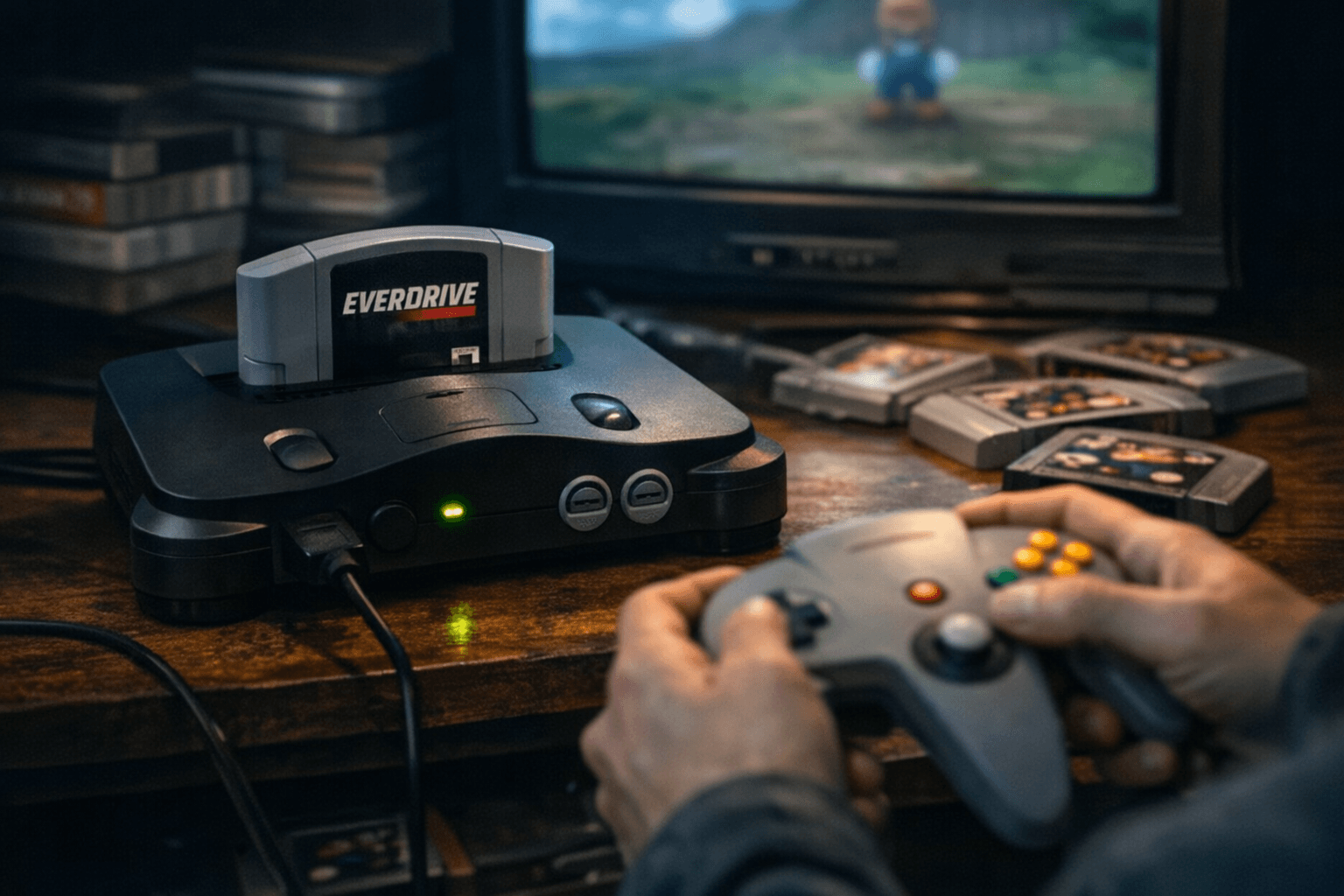
The single most friction-reducing change in Analogue's latest firmware for the $249.99 Analogue 3D is not the splashiest feature on the changelog. It is the fact that your EverDrive now knows which game it is actually running.
Firmware 1.2.4, posted to Analogue's support page on April 5, introduces what the company calls "Advanced Library detection for variable game headers." Every N64 ROM image carries a header containing the game title, country code, and checksum data. When a Krikzz EverDrive 64 X5 or X7 loads a different ROM, that header changes to reflect the new title. Before 1.2.4, the Analogue 3D treated all of those header changes as the same cartridge, collapsing per-game settings into a single persistent entry. Now the system detects each header change, creates a separate library record, and tracks it independently. Every title on a flash cart gets its own saved settings, its own virtual Controller Pak mapping, and its own per-game configuration without any manual intervention.
The practical scale of that fix is significant. The North American N64 library runs to roughly 387 commercial titles. A collector running a well-stocked EverDrive was, until this week, managing what amounts to a settings collision problem: switch ROMs, lose the previous game's context. RetroRGB's Bob, who compiled the full set of changes on April 5 as a single retrospective covering everything since firmware v1.2.0, captured the accumulation well, noting the "ton of small improvements and bugfixes that aim to smooth out the overall experience."
The second standout addition is the Startup Action setting, which lets owners choose whether the console boots directly into the inserted cartridge or opens the library first. That single option closes the gap between the Analogue 3D's menu-driven OS and the instant-on behavior of an original Nintendo 64. RetroRGB noted particular appreciation for this addition, calling it a move toward making the device "feel a bit more like the original experience." A "Ready" label now marks the currently inserted cartridge in the UI, and pressing the B button jumps from anywhere in the OS directly to that cart's library entry.
The update also tightens accessory handling, improving how the system manages virtual Controller Pak and Rumble Pak selections. Three bug fixes round out the release: a GameShark compatibility edge case is resolved, an HDR brightness calibration issue affecting 4K display setups is corrected, and a controller LED behavior problem is patched.
The Analogue 3D launched on November 18, 2025, and the v1.2.0-to-1.2.4 run of updates represents a meaningful accumulation of post-launch polish. Firmware is distributed as a manual download from Analogue's support page, not over-the-air.
Before updating, export any virtual Controller Pak saves from the library settings menu. Firmware changes affecting library structure can occasionally reset peripheral assignments, and those saves do not recover automatically. After the update installs, the fastest way to confirm the detection fix is working: load two different ROMs on an EverDrive, then check the library. Each should appear as a distinct entry with its own row. A single persistent entry regardless of which ROM loads means the firmware did not apply correctly and the process needs to be repeated.
Flash-cart owners who have not updated since launch have the clearest reason to apply 1.2.4 immediately. Collectors running only original cartridges will benefit from the Startup Action setting and the peripheral handling improvements, but the library detection change will not affect their workflow. Either way, the gap between v1.2.0 and v1.2.4 is wide enough that the Analogue 3D is a meaningfully different device to use day-to-day than the one that shipped in November.
Know something we missed? Have a correction or additional information?
Submit a Tip