Open-Source DSpico Flash Cart Now Available as Prebuilt Unit From Community Vendors
DSpico, the world's first fully open-source DS flash cart, is now available prebuilt from LaserBear Industries for $30 and Phenom Mods for $20, no soldering required.

For years, running DSpico on your DS meant sourcing PCBs, populating an RP2040, and having enough bench skills to pull it off. That barrier came down on April 1, when LaserBear Industries began shipping finished, injection-molded units at $30 apiece. Phenom Mods followed with their own prebuilt version priced at $20, and the cart also surfaced on AliExpress. The DS homebrew and preservation community now has a legitimate, auditable flash cart it can simply buy.
Designed by the LNH Team, a group of enthusiasts dedicated to preserving classic consoles and software, DSpico is built around the Raspberry Pi RP2040 microcontroller and features a USB-C port, a microSD slot, dual LED indicators, and onboard flash memory. It draws roughly 57 milliwatts during operation and runs on unmodified DS and DS Lite hardware, unhacked DSi units, and 3DS consoles after setup. The Pico Launcher and Pico Loader tools handle the interface: browsing and launching homebrew, testing archives against real hardware, and backing up save data.
LaserBear's Greg is shipping the grey colorway now, with a clear variant arriving in early May. Neither LaserBear, Phenom Mods, nor AliExpress sellers are affiliated with the LNH Team. The open-source license, which covers the PCB design, enclosure, firmware, stickers, and box art in their entirety, explicitly permits independent commercial production, and the LNH Team has clarified they are not involved in any commercial sales.
That legal clarity is one of the sharpest contrasts with the old flash cart landscape. The R4 era produced dozens of competing clones sharing the same brand name with zero accountability: no auditable firmware, no community recourse when a cart stopped working, and a well-documented pattern of vendors shipping timegated firmware that rendered units unusable after a year or two. Community members waiting on a trustworthy option noted the R4 and its descendants effectively became "timegated bombs." DSpico's model is the structural opposite. The firmware source is public and community-verified, updates arrive as UF2 files requiring nothing more than drag-and-drop over USB, and because the PCB design is open, the hardware can be reproduced indefinitely by anyone with access to a fabrication house. For preservation workflows specifically, that reproducibility matters: DSpico creates a durable, open record of how DS cartridges interface with modern microcontrollers, one that can't be deprecated by a vendor going dark.
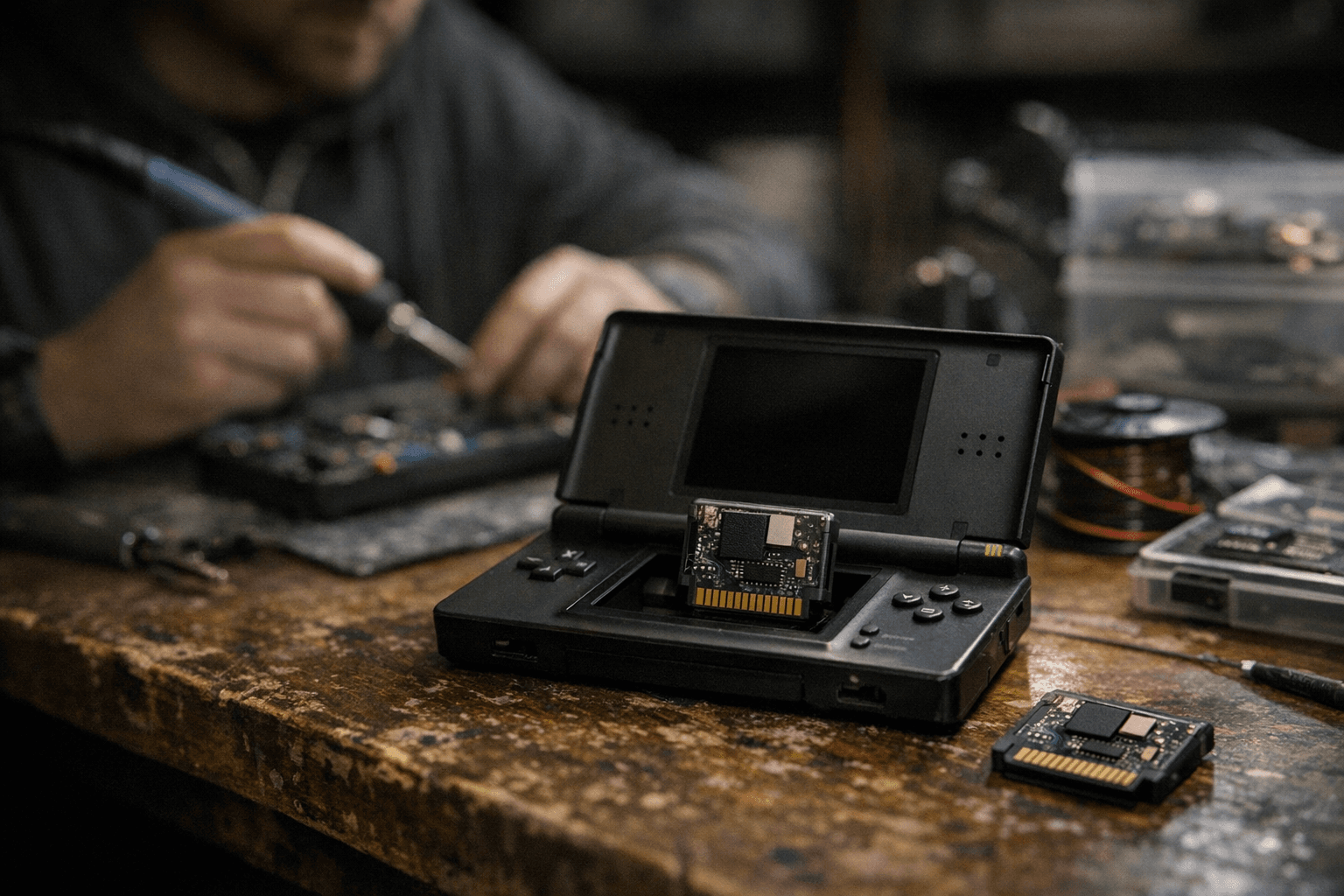
The firmware-less shipping policy is the one friction point prebuilt buyers need to understand before checking out. LaserBear's product page states it plainly: "The firmware for this device is not installed before you receive it, you will need to find a copy of the firmware to install." Installation itself is frictionless: connect the cart via USB-C, it mounts as a mass-storage device, and you drop the UF2 file in. No special software, no drivers. What vendors cannot do is point toward ROM archives or third-party setup guides: "We can not offer direct links to archive orgs or setup guides that host these files, not even in support emails or support chats," LaserBear notes on the product page.
Verifying authenticity before plugging in takes a few specific steps. Confirm that the seller's listing explicitly references the LNH Team and the official project page as the firmware source; any seller omitting that attribution is a flag. The LNH Team's official firmware repository is the authoritative source for UF2 builds; avoid preloaded microSD images from unknown origins since there's no way to audit what's on them. On arrival, connect the cart via USB-C before flashing anything: a genuine unit mounts immediately as mass storage; a board that fails to enumerate may be defective or non-genuine. After flashing the official firmware, Pico Launcher's interface matches community screenshots and documentation exactly. If the UI looks unfamiliar or prompts for any kind of activation, the firmware is not the official build.
Twenty years after the DS launched, the preservation case for this hardware has only strengthened. An open-source, community-audited cart at $20 to $30 is a fundamentally different proposition than anything the R4 era produced, and the RP2040 at its core means the platform keeps pace with modern tooling rather than aging into obsolescence.
This article was produced by Prism’s automated news system from verified source data, official records, and press releases, then run through automated quality and moderation checks before publishing. The system is built and supervised by the people who set the standards it runs under. Read our full AI policy.
Did this article answer your question?