MAME docs explain why arcade 3D hardware is so hard to emulate
MAME’s docs show why late-80s arcade 3D still costs accuracy, speed, and patience: the emulator must rebuild buffers, layers, and timing in software.
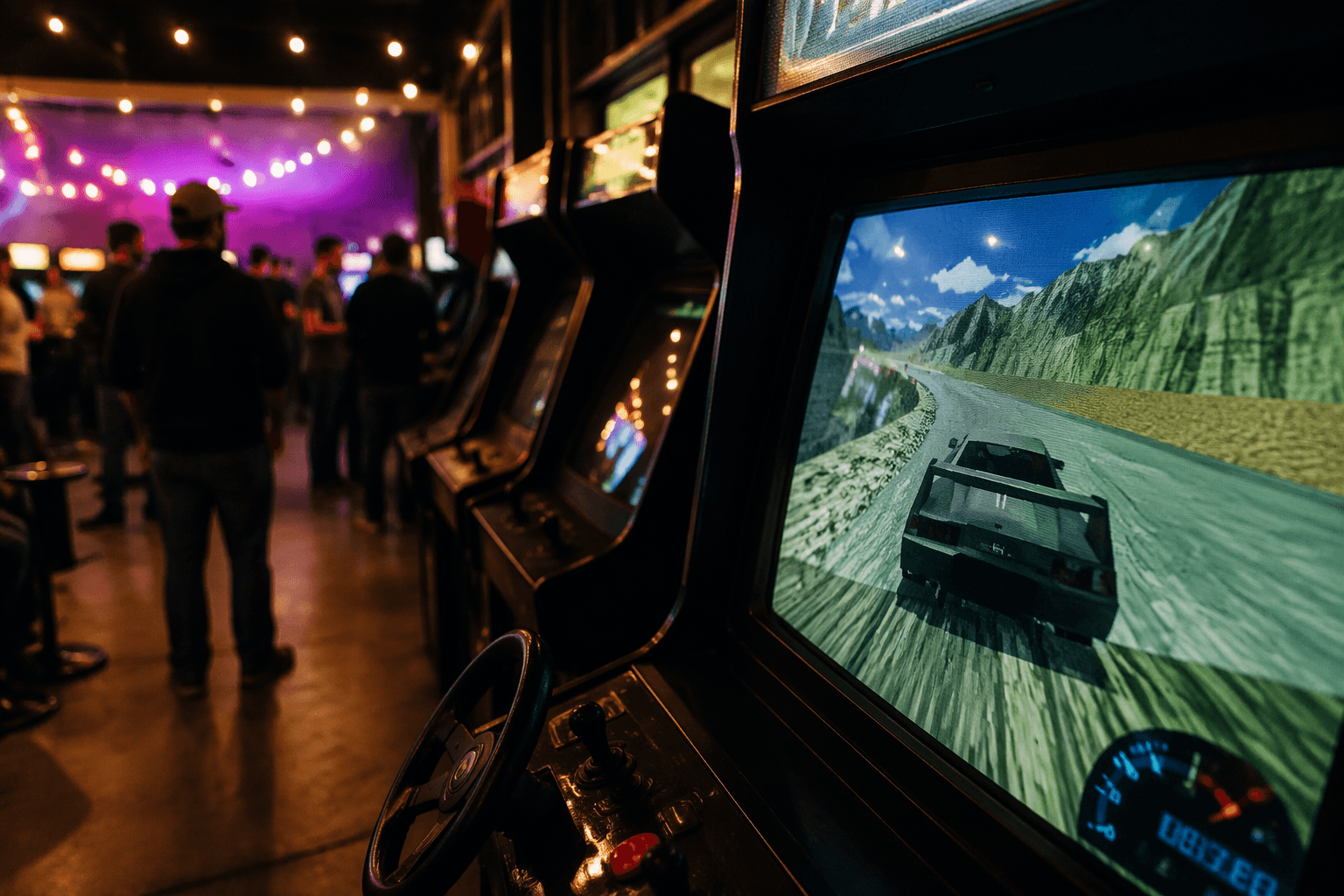
Late-1980s arcade boards often wrote hardware-rendered 3D graphics into double- or triple-buffered frame buffers before blending them with tilemaps and sprites. The frustrating part of emulating arcade 3D is reproducing that full video pipeline, which often means slowdowns, missing effects, or layering that looks slightly off even on a capable PC. These machines were built around hardware-rendered 3D graphics, then wrapped in buffer management, tilemaps, sprites, and timing rules that an emulator has to rebuild piece by piece.
The part most players never see
Many arcade games started adding hardware-rendered 3D graphics in the late 1980s. Those graphics were typically created from low-level primitives and written into a frame buffer before being blended with other visual elements like tilemaps or sprites. That means the game is not just drawing a 3D scene and calling it done. It is coordinating several graphic layers and deciding exactly when each one appears on screen.
For you, that becomes a practical issue the moment the emulator has to decide whether the scene is being composed the same way the original board did it. If the buffer swaps, compositing order, or timing are off, the result can be a game that runs but does not look or behave quite right. In this corner of emulation, “close enough” often still feels wrong.
Why software rendering matters
MAME’s poly_manager system is the key clue here. Instead of simply handing geometry to the host GPU and trusting modern hardware to make it look acceptable, MAME uses software rendering techniques to recreate how the original machine behaved. That is a preservation-first decision, and it is a big reason arcade 3D boards remain difficult.
This is where the average player expectation runs into emulation reality. A faster graphics card can help with some workloads, but the real bottleneck may be the CPU-side recreation of the original board’s behavior. The emulator is not only drawing shapes. It is simulating how primitives were transformed, how buffers were managed, and how those 3D elements were combined with the rest of the machine’s video system. That kind of work is expensive because it is reconstruction, not a simple translation.
- slower performance on boards with more complex video paths
- missing or altered effects when a game depends on exact compositing
- accuracy tradeoffs when the emulator has to balance speed against faithful timing
For practical play, that often means:
Why some games feel heavier than others
Arcade 3D gets harder as the hardware gets newer because the systems lean more heavily on custom video pipelines and exact CPU coordination. Once 3D is intertwined with 2D overlays, the emulator has to track more than the visible result. It has to model how the board got there in the first place. That is why some late-1980s and 1990s cabinets can feel far more demanding than older 2D arcade titles, even before you start caring about shaders or upscale settings on your own setup.
This is also why a game can be playable and still not feel fully settled. You may get a frame rate that is good enough, but the visual timing or layered presentation can still differ from original hardware.
MAME is built as documentation first
MAME describes itself as a multi-purpose emulation framework whose purpose is to preserve decades of software history by documenting hardware and how it functions. The source code serves as documentation, and usability mainly exists to validate whether that documentation is correct. That philosophy explains why the project treats technical fidelity as more than a convenience feature.
Its technical specifications are written for programmers working on MAME’s source or on scripts inside the framework, not just for players launching games. The documentation is a work in progress, with status tracked through MAME’s issue tracker.
How long this project has been building toward this
The first official release was in February 1997. Aaron Giles says he first discovered emulation in 1996, started working on MAME in July 1997, and kept detailed logs of his contributions from 1997 to 2007.
There were once two separate projects, MAME and MESS, before they were combined under the current framework approach.
What this means for your own setup
If you mostly think in terms of frontends, shaders, and controller maps, MAME’s 3D docs are a useful reality check. The challenge is not only whether your handheld, mini PC, or desktop can brute-force a game at full speed. It is whether the emulator can reproduce the original board’s video logic with enough fidelity that the output still matches the hardware’s timing and layering.
That is also why ROM and set management remains such a common source of confusion and frustration. Even before you get to rendering, MAME asks you to keep track of a huge amount of hardware-specific detail. When the game finally boots, the emulator is already carrying the burden of preserving the machine’s structure, not just its final image.
This article was produced by Prism’s automated news system from verified source data, official records, and press releases, then run through automated quality and moderation checks before publishing. The system is built and supervised by the people who set the standards it runs under. Read our full AI policy.
Did this article answer your question?