RPCS3 Now Supports PlayStation Move Controllers, Making Just Dance 3 Playable on PC
Megamouse reverse-engineered PS3's cellGem motion library so any modern gamepad can fake Move input, finally making peripheral-locked games like Just Dance 3 playable on PC.
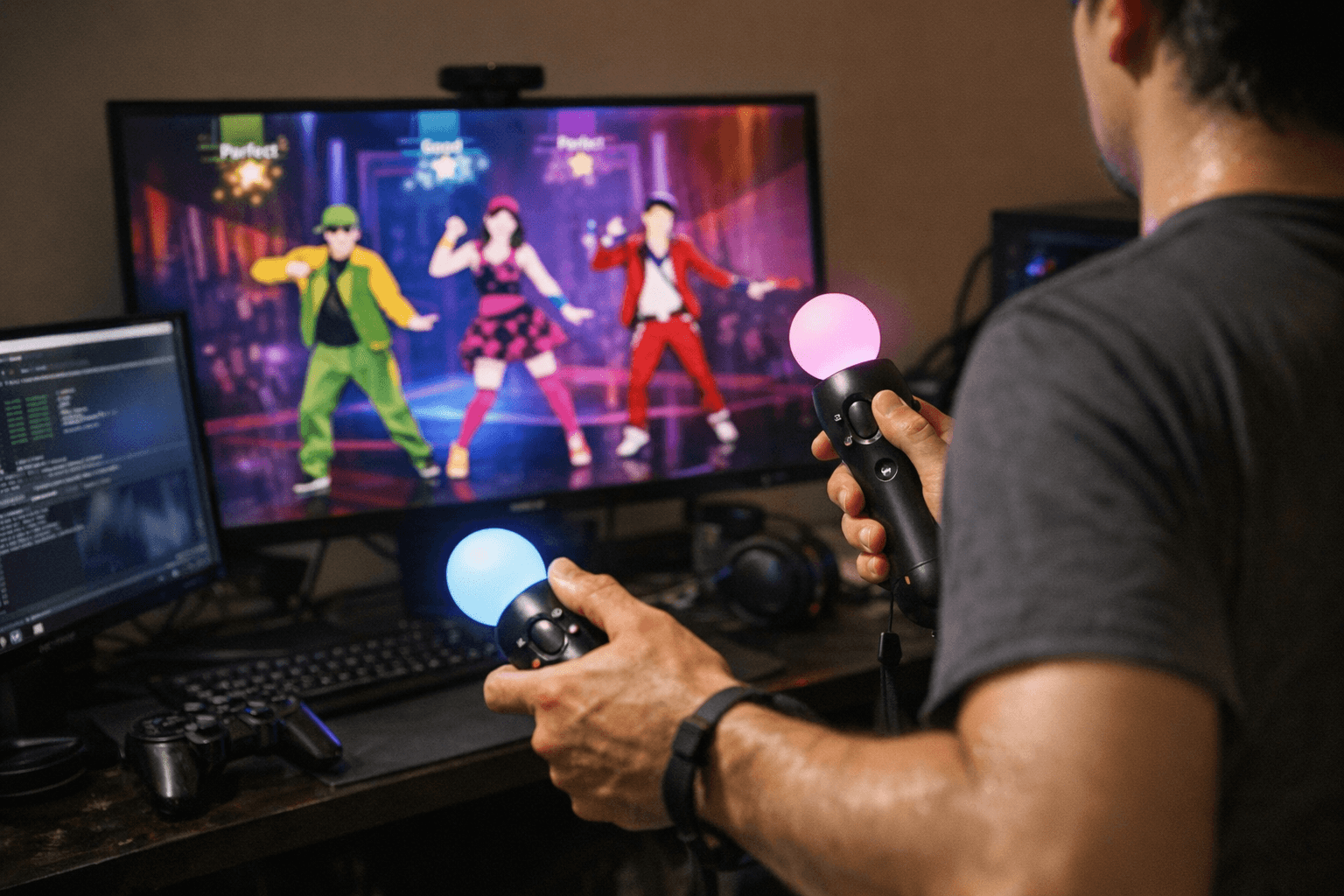
Nine years after the first GitHub feature request landed in the RPCS3 tracker, contributor Megamouse cracked open the PS3's cellGem motion library and built working PlayStation Move support into the emulator. The implementation doesn't require actual Move hardware. Instead, it routes standard PC controllers through a "fake mode" that convinces PS3 games the peripheral is physically present, unlocking an entire category of motion-dependent titles that had been sitting at zero real playability for over a decade of emulation development.
The cellGem library is the system-level interface Sony built into the PS3 specifically to handle Move controller input. Bypassing or correctly reimplementing it is what makes any Move-reliant game function at all, and getting it wrong means the game either refuses to detect a controller or behaves as though no motion input exists. Megamouse's work, spread across three pull requests, tackled the problem in deliberate stages. PR #14527 established navigation controller support as the foundation. PR #15130 introduced the multi-controller fake mode, allowing up to four simultaneous Move inputs while keeping ports 1 through 3 free for standard gamepad assignments. PR #16527 extended the implementation with full sensor orientation support, piping gyro data from controllers capable of providing it, including DualShock 4, DualSense, and SDL-based devices, into the Move's expected motion format. Together, the three PRs constitute a complete reverse-engineering of the cellGem interface that the PS3's game layer cannot distinguish from an actual Move peripheral chain.
Getting Move running in the current RPCS3 build requires a specific path through the settings. Open Configuration, navigate to USB Devices, and select the PS Move (Fake) option that now appears in the menu. Once configured, controllers assigned through Gamepad Settings will register as Move inputs for any compatible game querying the cellGem library. The fake handler accepts DualShock 3, DualShock 4, DualSense, SDL, evdev, and standard XInput devices, which means any modern controller with a built-in gyroscope can supply the motion data Move-dependent games expect. Because PR #15130 specifically preserves ports 1 through 3 for conventional pad input, four-player motion gaming doesn't displace the standard controller layout, which matters directly for party and multiplayer titles where someone in the group may still want a regular gamepad.
One critical distinction before loading up the broader Move library: this is fake mode, not hardware passthrough. A feature request filed on February 10, 2025 asked directly whether genuine PS Move USB passthrough was being actively developed, with a community member noting that "real Move support will increase game compatibility" and identifying Megamouse as the person working the problem. That hardware-level path remains in progress. The fake mode covers full button mapping and motion input, which is sufficient for the substantial majority of Move-compatible games, but titles that additionally relied on the PlayStation Eye camera for precise positional tracking of the Move's color sphere in three-dimensional space may still present additional hurdles. The camera involves separate passthrough considerations that aren't folded into the cellGem implementation. DualShock 3 owners should also be aware that PR #16527's gyro support notes potential inaccuracies for pads with fewer than three accelerometers and three gyros, making a DualShock 4, DualSense, or SDL-compatible controller the more reliable choice for motion-heavy games.
The most immediate beneficiary is Just Dance 3. Developed and published by Ubisoft and announced at E3 2011 on June 6 of that year, the game launched on Wii and Xbox 360 on October 7, 2011, with the PS3 version following on December 6, 2011 in North America, December 8 in Australia, and December 9 in Europe. It was the series' first installment on both PS3 and Xbox 360; Microsoft's platform used the Kinect sensor while the PS3 version depended entirely on the Move for motion tracking. With over 40 songs in its tracklist and a number one position on multi-platform sales charts in both North America and Japan during its launch week, Just Dance 3 was not a peripheral oddity. It was one of the most commercially visible titles in the Move's library. Running the PS3 version in RPCS3 before this update produced a game that could load but not be meaningfully played, because the controller interface didn't exist at the emulation level. Now it does.
The PlayStation Move's own history makes the preservation angle here more significant than it might first appear. Released September 15, 2010 in Europe and PAL territories, September 19 in North America, and October 21 in Japan, the controller moved 4.1 million units worldwide in its first two months alone, roughly 1.5 million in Europe and 1 million in North America within the first month. By November 2012 cumulative sales had reached 15 million units, with support from more than 400 PS3 titles across the library. Popular Science named it the Most Immersive Game Controller of 2010. That commercial footprint created an enormous catalog of peripheral-dependent software that simply cannot be experienced as designed without working motion input. Sony has since discontinued the Move as a PS3 peripheral, closing off the retail hardware path entirely. For anyone wanting to run those 400-plus titles as they were built to be played, functioning cellGem emulation is no longer an optional improvement; it is the only viable route.
The scope of games that can now realistically be tested extends well beyond dance titles. Sports Champions, Tumble, Beat Sketch, Kung Fu Rider, and the rail-shooter sections of Time Crisis: Razing Storm all required Move input in ways that couldn't be meaningfully substituted with a standard pad under previous RPCS3 builds. Rail shooters and light-gun-style titles benefit particularly from the gyro support added in PR #16527, since pointing accuracy maps directly to the orientation data that DualShock 4 and DualSense controllers already provide natively. Fitness titles, motion-action games, and the broader catalogue of party software that drove Move's commercial adoption all become realistic targets for compatibility testing now that the underlying library interface is correctly implemented.
RPCS3's path to this milestone stretched across nearly the entire life of the project. Founders DH and Hykem launched the emulator on May 23, 2011, with a build capable of running only simple homebrew. GitHub issue #2297, the first formal PS Move feature request, was filed on January 28, 2017, with the commenter noting "today we got first working game, which needs it." That observation captured the problem precisely: as RPCS3's compatibility expanded, the games gated by peripheral dependencies became the most visible remaining gaps rather than background noise. The emulator now covers more than 70% of the PS3's commercial library, with 1,902 of the 3,185 catalogued titles confirmed playable. Closing the cellGem gap doesn't add a single title to that count in isolation; it reclassifies an entire hardware dependency from an absolute blocker to a configuration step, and that architectural shift is what separates Megamouse's contribution from a typical compatibility fix. The peripheral-preservation problem for PS3 motion gaming just got considerably smaller.
This article was produced by Prism’s automated news system from verified source data, official records, and press releases, then run through automated quality and moderation checks before publishing. The system is built and supervised by the people who set the standards it runs under. Read our full AI policy.
Did this article answer your question?