Microsoft merges Rust-based Windows Reactor for WinUI 3 apps
Windows Reactor just gave Rust a real shot at native WinUI 3 apps, with React-style hooks and a 3 MB binary. Benchmarks showed it beating C# on build time and first window.

Microsoft has merged Windows Reactor into the Rust for Windows stream, and the practical result is bigger than another UI experiment. Reactor is a React-inspired, declarative framework for native WinUI 3 desktop apps in pure Rust, giving Windows developers function components, typed props, context propagation, error boundaries, and hooks like use_state, use_reducer, use_effect, use_context, use_memo, use_callback, and use_resource.
The important part is what Reactor is not. Its README says it is experimental and not a new UI platform. Instead, it is a new way to describe WinUI content, where every rendered control is still a real WinUI control. That means Reactor apps can interoperate with XAML, MVVM, and existing WinUI controls rather than forcing a rewrite. For Rust developers who have wanted a cleaner path into Windows desktop UI, that is the difference between a demo and something that can sit inside an actual app.

The library arrived with more than 55 widgets, plus virtualized lists, theming, and accessibility features. Microsoft also says the footprint stays small, with a single binary of about 3 MB and no runtime framework to deploy. That combination matters on Windows, where app size, startup behavior, and deployment complexity can make or break whether a hobby project becomes a real tool.
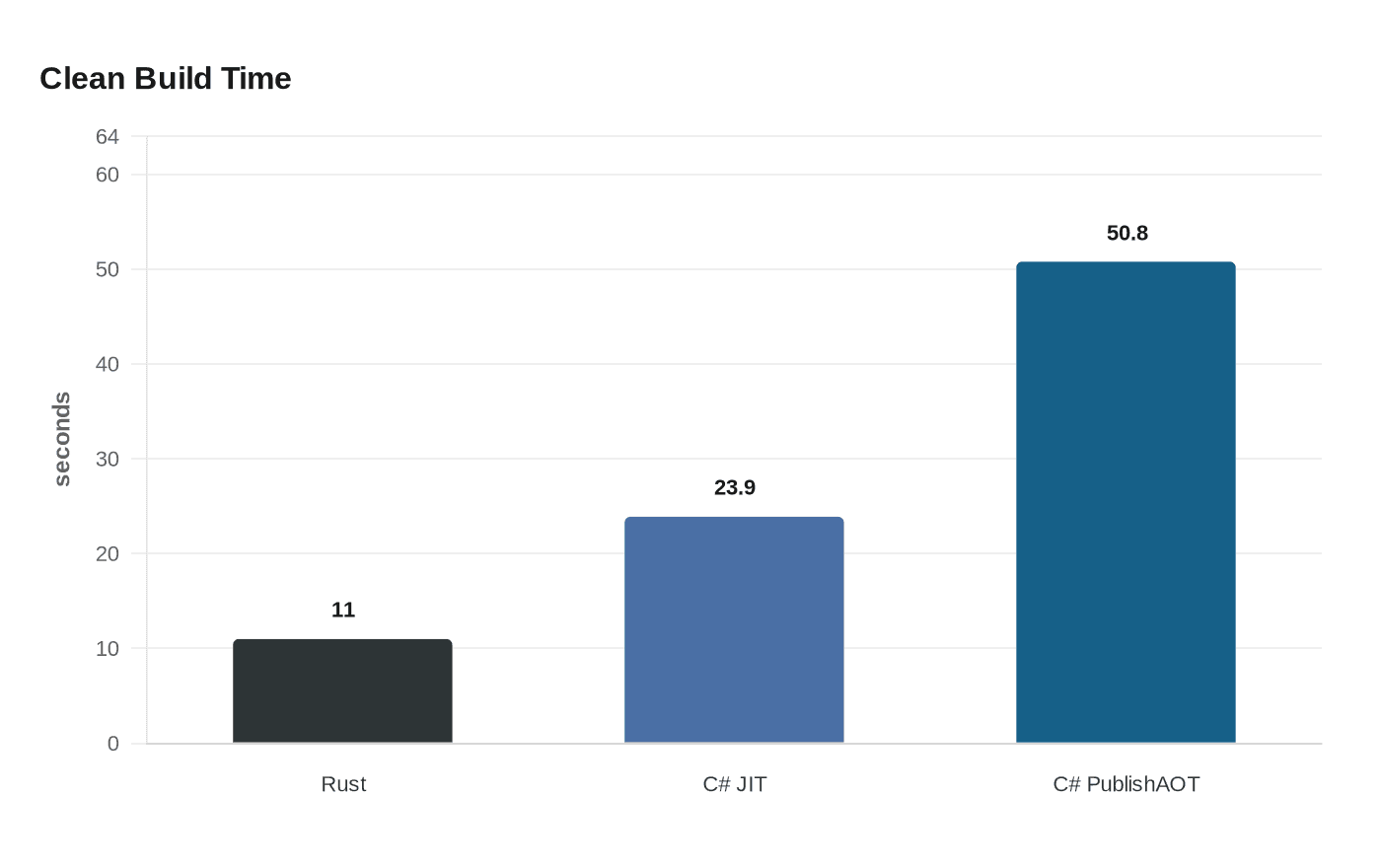
The performance numbers are the part that make Reactor hard to dismiss as just a nice API shape. Measured on May 27, 2026 against the equivalent C# Reactor gallery app, clean build time came in at 11.0 seconds in Rust, versus 23.9 seconds for C# JIT and 50.8 seconds for C# PublishAOT. Time to first window was 160 ms, compared with 465 ms and 364 ms. For a reconcile run over 4,900 cells at 10 percent, Reactor posted 3.1 ms against 27.0 ms and 29.4 ms. Even the memory story cuts in Rust’s favor, with a working set after settle of 109.5 MB versus 162.6 MB and 128.4 MB.
There is also a neat bit of history here. Microsoft’s April 2026 README described Microsoft.UI.Reactor as a declarative, component-based C# framework for WinUI 3 desktop apps, so the project clearly started life in C# before the Rust version landed. The 2020 WinUI 3 Rust support issue drew hundreds of reactions, and Kenny Kerr noted then that Rust/WinRT already handled the language projection and packaging side. Five years later, Reactor makes that long-standing request feel a lot less hypothetical. For Rust on Windows, the question is no longer whether native WinUI 3 can be expressed in Rust. It is whether this is the first path that feels credible enough to build on.
This article was produced by Prism’s automated news system from verified source data, official records, and press releases, then run through automated quality and moderation checks before publishing. The system is built and supervised by the people who set the standards it runs under. Read our full AI policy.
Know something we missed? Have a correction or additional information?
Submit a Tip