RustRover says Rust is becoming a boring, mainstream language
JetBrains is treating Rust’s “boring” phase as a win: stable compiler habits, bigger hiring pools, and tooling built for daily production use.

Rust is starting to look less like a badge of taste and more like a default choice for serious work, and JetBrains is leaning into that shift. When the RustRover team says Rust is becoming boring, the point is not that the language has lost its edge. It is that Rust is getting predictable in the way teams want from infrastructure, backend services, and production code that has to ship on time.
That maturity shows up in the numbers JetBrains has been publishing around the ecosystem. Its 2025 Developer Ecosystem Survey pulled in 24,534 developers from 194 countries, and JetBrains said 85% of them regularly use AI tools for coding and development, with 62% relying on at least one AI coding assistant, agent, or code editor. In the same work, JetBrains’ Language Promise Index placed Rust among the languages with the highest perceived growth potential. That is the shape of a language moving from enthusiast energy to routine workplace expectation.

The Rust project’s own 2025 State of Rust survey points in the same direction. The 10th edition ran for 30 days, from November 17 to December 17, 2025, and collected 7,156 responses. The report said most respondents use the stable compiler, while nightly is mainly reserved for features that have not stabilized yet. That is a big marker of normality. People are not living on the bleeding edge just to use Rust at all. They are choosing the stable path and only reaching for nightly when they have to.
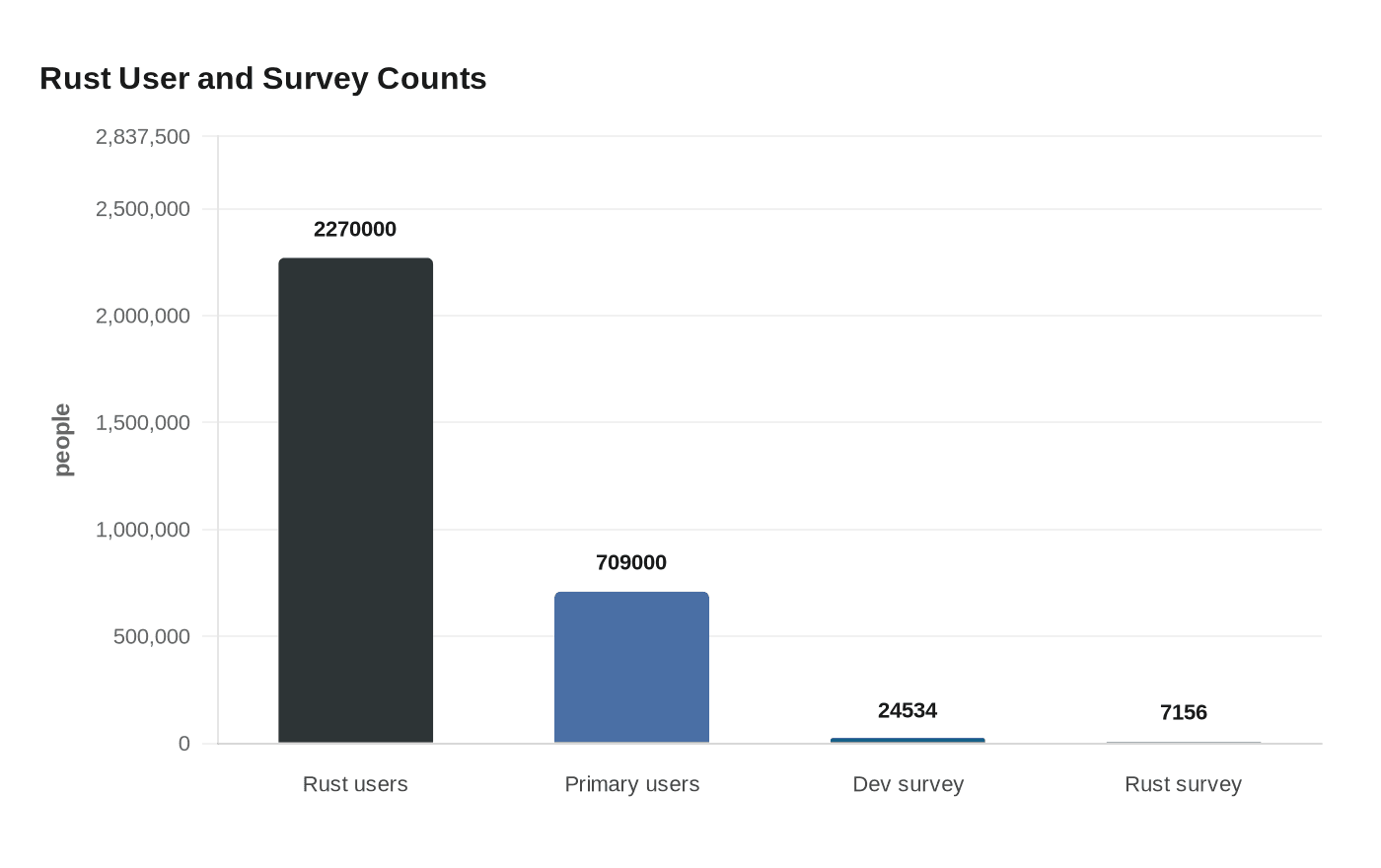
JetBrains has also been quantifying that pull in adoption terms. In a June 2025 Rust-vs-Go article, it said Rust had about 2.27 million developers using it in the last 12 months and 709,000 primary users, while about one in six Go users was considering a switch to Rust. That is not just hobbyist curiosity. It is a hiring and planning signal, the kind managers notice when they are deciding which stack can survive another three years of product churn.
Rust’s own arc explains why this feels different now. The language moved from a Mozilla Research project associated with Graydon Hoare to Rust 1.0 in May 2015, and the ecosystem has had a decade to harden. JetBrains has repeatedly pointed to Tokio as the de facto async runtime for high-performance networking in Rust, which is exactly the sort of boring infrastructure marker that matters when a language graduates from experiment to standard kit. The novelty is fading. The default is settling in.
This article was produced by Prism’s automated news system from verified source data, official records, and press releases, then run through automated quality and moderation checks before publishing. The system is built and supervised by the people who set the standards it runs under. Read our full AI policy.
Know something we missed? Have a correction or additional information?
Submit a Tip