PulseBeam cuts Rust SFU latency with thread-per-core scheduling
PulseBeam moved its Rust SFU to thread-per-core scheduling, cutting P99.99 latency from 70 ms to 10 ms and boosting capacity 25 percent.
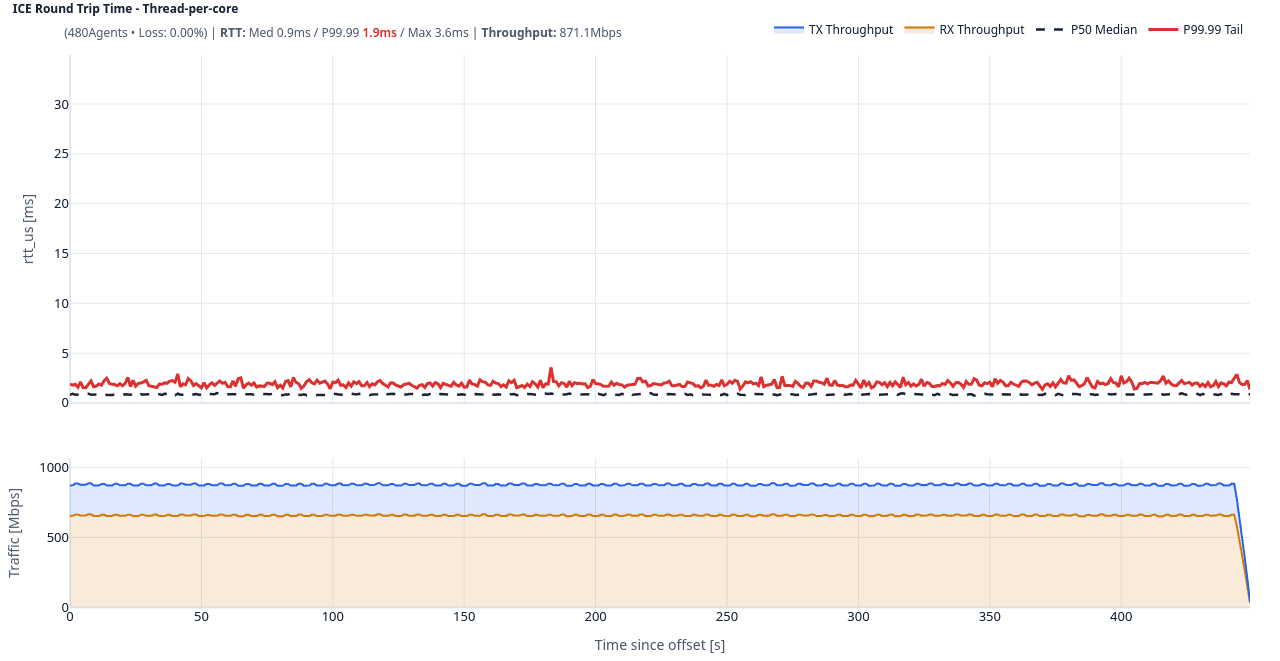
PulseBeam’s Rust WebRTC selective forwarding unit moved from Tokio’s default multi-threaded work-stealing runtime to a thread-per-core design, and the switch cut P99.99 end-to-end latency from a spiky 70 ms to a stable 10 ms while lifting capacity 25 percent. The change landed in a July 10 technical update from PulseBeam, a lightweight end-to-end media stack with a Rust SFU core and HTTP signaling.
An SFU is the traffic cop of a live call. It forwards video, audio, and data without doing the expensive transcoding work of a full media server, so tail latency and jitter show up immediately in the user experience. In PulseBeam’s benchmark, a fully interactive four-person conference ran on four CPU cores, and WebRTC statistics showed unstable inbound-rtp jitter before the redesign. That instability fed into congestion control and produced visible stutter.

The older architecture followed a familiar async Rust pattern. Each participant, room, controller, and API lived as its own task, with channels carrying messages between them. That approach avoided mutex-heavy coordination, but the benchmark exposed its cost. Tokio’s runtime bundles an I/O driver, a scheduler, and a timer, and its multi-thread scheduler uses a work-stealing strategy. Contended blocking work can stall every other task on the same thread, which becomes a real problem when the hot path is packet handling and scheduler overhead rather than waiting on network I/O.
PulseBeam’s answer was thread-per-core, or TPC. The new layout kept work pinned to cores and made packet processing more synchronous, which cut down on async handoffs and reduced the chance of priority inversion. Tokio’s defaults are a strong starting point for general concurrency, but they are not automatically the right fit when a service starts behaving like a latency-sensitive media router.
PulseBeam is an opinionated stack for real-time video, audio, and data; LiveKit is an open source system for scalable, multi-user conferencing based on WebRTC; and WebRTC.rs leans into an async-friendly, sans-IO approach.
This article was produced by Prism’s automated news system from verified source data, official records, and press releases, then run through automated quality and moderation checks before publishing. The system is built and supervised by the people who set the standards it runs under. Read our full AI policy.
Did this article answer your question?