A DIY sculling oar helps a Typhoon sail mostly engine-free
A Typhoon's DIY sculling oar turns a small cruiser into its own backup plan, moving Merlot when the outboard, battery, or fuel cannot.
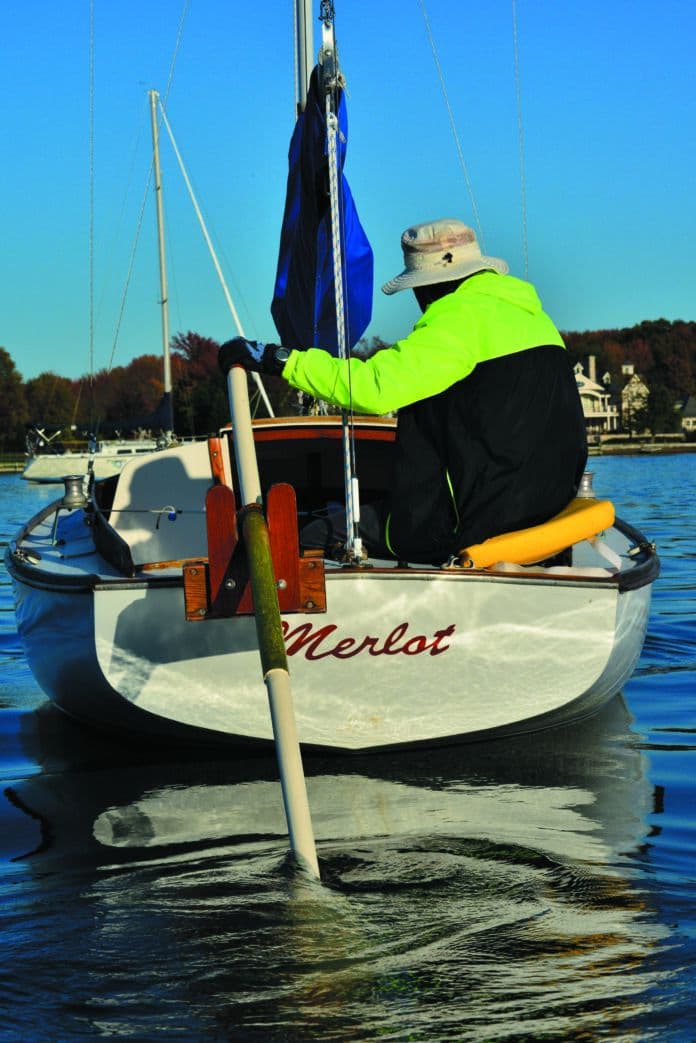
The best reason to build a sculling oar is not nostalgia, it is self-reliance. When a small sailboat needs to get out of trouble, a low-tech backup can matter more than another horsepower number, especially if the outboard refuses to start, the battery is dead, or quiet movement is the point. In Robert Michelin’s account, that idea lands on Merlot, a 19-foot Cape Dory Typhoon, as her owner moves toward a mostly engine-free future and a simpler life with one fewer boat to maintain.
What makes the story useful is that it treats the sculling oar as seamanship, not ornament. A single oar worked off the transom is a long-established way to propel a vessel by side-to-side motion, and it sits neatly between rowing and motor assistance. In close quarters, calm water, or tight harbors, it can give a skipper just enough control to keep moving without fuel, noise, or the stress of wondering whether the starting battery will cooperate.
Merlot is a fitting boat for that lesson. The Cape Dory Typhoon was designed by Swedish-born naval architect Carl Alberg and built by Cape Dory Yachts from 1967 to 1986, with more than 2,000 produced. That production run made the Typhoon one of the builder’s most successful models, and it helps explain why a single boat’s change of hands can resonate far beyond one slip or one mooring. Cape Dory Yachts itself began in 1963, founded by Andrew Vavolotis in East Taunton, Massachusetts, and the company’s small-boat legacy still has a loyal following.
The Typhoon’s appeal is not just numbers. Independent coverage has long described it as a conservative, seaworthy small boat with a solid hand-laid fiberglass hull and a yacht-like feel packed into a daysailer-sized package. That combination makes the boat feel like exactly the sort of platform where a sculling oar earns its keep. If the boat is small enough to respond quickly, but substantial enough to feel like a real cruiser, then a compact backup propulsion system starts to look less quaint and more sensible.
The build itself teaches a bigger lesson than the finished tool. Michelin’s project centered on designing a sculling oar and an oarlock that could be transom mounted, and the actual work took three times longer than expected. That matters because it shows how quickly a supposedly simple idea can turn into a real design problem once stowage, mounting, leverage, and durability all have to work together. A sculling oar that lives aboard has to be practical in the boat, not just elegant in theory.
That is where materials choice and storage become part of the seamanship discussion. A tool intended for emergency propulsion cannot be so bulky that it is left ashore, and it cannot be so delicate that it feels risky when a harbor approach gets tight. The value of the DIY version is that it forces the owner to think about how the oar will live aboard, how it will mount on the transom, and how it will be ready when the boat needs moving with no engine in sight.
The performance benchmarks are modest, and that is exactly why they are helpful. In later Practical Sailor reporting on a Cape Dory 36, sculling produced about 1.5 knots on average and could sprint to 2 knots in calm conditions. The same report made the limitation plain: sculling works best when the water is calm and when the helmsman anticipates the boat’s movement instead of fighting it. That is not a disappointment; it is the operating envelope, and knowing the envelope is what turns a backup method into a dependable one.
The Typhoon story also sits inside a broader culture of engineless sailing that still shapes how many cruisers think. Lin and Larry Pardey became the great reference points for that mindset, sailing the equivalent of five or six times around the world in engineless boats, and their first circumnavigation took 11 years and carried them through 47 countries. Larry Pardey was also known for explaining how to make a sculling oar in his sailing writing, which is part of why the tool still feels like a direct line to practical seamanship rather than a museum piece.
That legacy matters because the idea is bigger than one boat or one builder. The Cape Dory Sailboat Owners Association, Good Old Boat, and the wider Cape Dory community keep these boats in circulation as living craft, and Merlot’s transition fits that pattern perfectly. A classic small cruiser can still be about judgment, not just equipment, and a DIY sculling oar is a reminder that some of the smartest gear aboard is the simplest gear you can actually trust.
In the end, the point of Merlot’s new setup is not that an engine is unnecessary in every situation. The point is that a sailor who knows how to move a boat with one well-made oar has a real answer when the outboard quits, the battery dies, or silence matters. That is why the sculling oar deserves space aboard: it is a backup system, a seamanship tool, and a practical way to keep a Typhoon moving mostly engine-free when the moment demands it.
This article was produced by Prism’s automated news system from verified source data, official records, and press releases, then run through automated quality and moderation checks before publishing. The system is built and supervised by the people who set the standards it runs under. Read our full AI policy.
Did this article answer your question?