Choosing the Right Respirator for Sanding, Grinding, and Painting Boats
Wrong cartridge, broken seal, or an expired filter can expose you to fiberglass dust and isocyanates that no N95 can stop. Here's exactly what to wear and why.
Grab the wrong mask before a bottom-sanding session and you might as well not bother. The N95 stuffed in your toolbox drawer handles wood dust in a carpentry shop reasonably well, but it does nothing for the organic vapors rising off fresh antifouling paint, and a reused, slightly crumpled disposable leaks around the bridge of your nose before the first pass of the longboard. Respiratory hazards in boat work are not theoretical. Sanding fiberglass, grinding gelcoat, and rolling two-part polyurethane coatings produce dusts and vapors with documented acute and chronic health consequences: airway irritation, narcosis, occupational lung disease, and elevated cancer risk. Knowing which respirator to reach for, and how to verify it actually fits before you start, is a straightforward skill that costs almost nothing to learn.
What You're Actually Breathing
The hazard profile changes completely depending on the job, which is why a single mask-for-everything approach fails. Dry-sanding a fiberglass hull generates respirable glass fibers and resin dust that penetrate deep into the airways. Grinding gelcoat adds a finer silica-like fraction to that mix. Wet-sanding antifouling paint, particularly ablative copper-based bottom paint, releases biocide particles that are toxic by inhalation. Move belowdecks to mix or apply epoxy and you're dealing with amine hardener vapors, which are potent sensitizers; once sensitized, even trace exposures can trigger severe asthmatic reactions. And if you're spraying a two-part linear polyurethane topside finish, you're working with isocyanates, one of the most hazardous substance classes in any marine trade. Isocyanates are strong respiratory sensitizers; research on spray painting environments confirms that a respirator with an assigned protection factor of at least 25 is required to prevent overexposure during application.
The Respirator Spectrum: From Nuisance Mask to PAPR
Think of protection as a tiered ladder, and match your rung to the job.
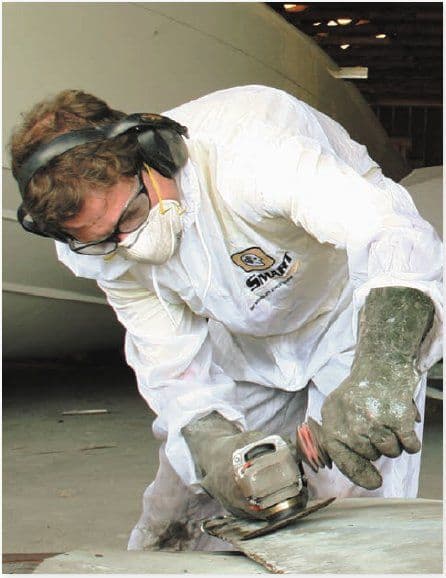
At the base is the disposable N95 filtering facepiece. For brief, low-concentration fiberglass dust exposure in a well-ventilated open yard, it can satisfy the minimum threshold. Practical Sailor's guidance published by Darrell Nicholson makes the entry-level ensemble explicit: a disposable coverall, gloves, goggles, hearing protection, and at least an N95 mask are the minimum PPE for grinding fiberglass dust in a boat shed. Note the word "minimum" doing real work in that sentence. The moment you move into a tented boat, an enclosed bilge, or begin any job involving solvents or coatings, the N95 is no longer adequate.
The next rung is the half-face elastomeric respirator, which covers nose and mouth and accepts replaceable cartridges. This is the workhorse for most serious DIY boat projects. Properly fitted, a half-face unit delivers substantially better protection than any disposable because the silicone or thermoplastic seal conforms to the face, the straps maintain consistent pressure, and the cartridge system can be matched precisely to the hazard. Full-face respirators add eye protection to that seal and become relevant when working in spaces where vapors are heavy enough to cause eye irritation, or when the concentration of airborne contamination is high enough to warrant the added protection factor.
At the top of the ladder sit powered air-purifying respirators (PAPRs) and supplied-air systems. PAPRs use a battery-driven blower to push filtered air into a hood or loose-fitting facepiece, eliminating the seal problem entirely. Supplied-air systems pipe clean air from a compressor or compressed-air cylinder. Both are appropriate when contaminant concentrations exceed the capability of air-purifying cartridges, or when the work environment, such as a partially sealed spray tent, makes adequate ventilation structurally difficult.
Reading the SDS: Section 8 Is Your Key
Before touching a cartridge blister pack, pull the Safety Data Sheet for every product you plan to use. Every marine paint, solvent, and epoxy system sold in the US must include one, and Section 8, labeled "Exposure Controls/Personal Protection," tells you exactly which class of respiratory protection the manufacturer recommends for that specific formulation. It will distinguish between situations requiring a dust/mist respirator, an organic vapor cartridge, or a combination OV/particulate unit. If Section 8 specifies an air-supplied respirator for spray application, that's not a suggestion.
Cartridge Selection by Task
Once you've confirmed the hazard type, the cartridge choice follows a clear logic:
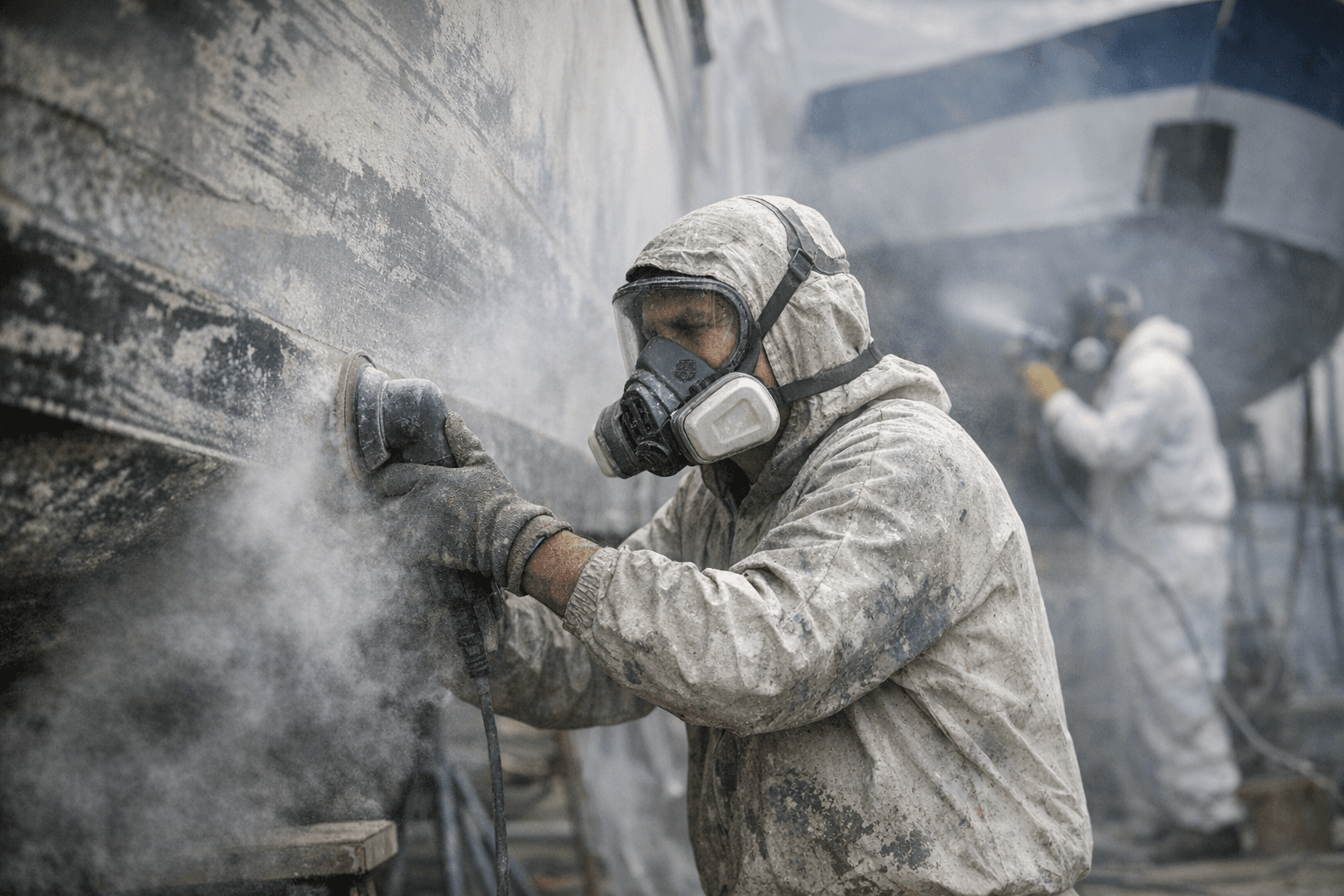
- Dry sanding fiberglass, gelcoat, or fairing compound: P100 particulate filter on a half-face respirator. P100 (HEPA-equivalent) filters capture 99.97 percent of airborne particles, far outperforming N95's 95 percent threshold at comparable particle sizes.
- Working with liquid epoxy or sanding cured epoxy: OV (organic vapor) cartridge combined with a P100 particulate layer. The OV cartridge's activated-carbon bed absorbs amine and epoxy vapors; the P100 layer captures the dust fraction from sanding.
- Applying solvent-based primers, antifouling paint, or varnish: OV/P100 combination cartridge. Products like the 3M 60921 are purpose-built for this mixed-hazard scenario.
- Spraying two-part polyurethane topcoats containing isocyanates: At minimum, a properly fitted half-face respirator with OV/P100 cartridges and verified seal; many professionals step up to a supplied-air system because isocyanate sensitization can occur rapidly and the consequences of even a single overexposure are permanent.
Engineering Controls Come First
Cartridge selection matters, but respiratory protection is always the last line of defense, not the first. Ventilation, vacuum sanding, and material substitution are more effective and less error-prone because they reduce the concentration of contaminants before they reach your breathing zone.
Vacuum sanding with a shrouded pad and a HEPA shop vac is one of the most impactful upgrades a DIY boatowner can make: it captures the majority of sanding dust at the source, dramatically reducing the burden on any respirator. Working upwind when hand-sanding open hulls, opening all ports and running forced-air ventilation belowdecks before solvent work, and choosing waterborne coatings over solvent-based formulations where performance allows are all steps that reduce exposure at the source. Tented boats present a specific risk: a poly tent that traps vapors during spray painting can build concentrations that exceed the service life of OV cartridges in minutes. Adequate exhaust ventilation into the tent is not optional.
The 5-Minute Fit Check and Maintenance Routine
This is where most DIY sailors lose the protection they paid for. A respirator sitting on the shelf since last season can fail before the first breath.
Before each use, run through this sequence:
1. Inspect the facepiece for cracks, tears, or hardening of the silicone seal, especially along the nose bridge and chin cup. A stiff or cracked seal cannot conform to your face.
2. Check the headbands or straps for brittleness or stretched-out elasticity. Sagging straps reduce clamping force and break the seal under jaw movement.
3. Examine cartridges or filters for physical damage and verify they were stored sealed. Organic vapor cartridges begin adsorbing contaminants the moment they're exposed to air, even when not in use; an opened cartridge left on a workbench between sessions is consuming its service life. Once opened, most manufacturers recommend discarding OV cartridges within 30 days regardless of use time.
4. Confirm you are clean-shaven along the sealing surface. A day's stubble is enough to break the seal and channel unfiltered air directly to the airway. This is not a minor degradation: a beard or even heavy stubble makes fit testing impossible and reduces an elastomeric half-face to roughly the protection level of a loose cloth mask.
5. Perform a positive-pressure seal check: cup both hands over the cartridges and exhale gently. The facepiece should pressurize slightly and hold without air escaping around the seal. Then perform a negative-pressure check: cover the cartridge inlets and inhale; the mask should collapse slightly and hold against the face. If either check fails, reseat the mask and retry, or try a different size. Do not start work on a failed check.
A selection checklist before any job runs three questions: What is the hazard type (dust, vapor, or both)? What is the expected concentration (open yard vs. enclosed tent vs. spray application)? And how is the breathing zone configured (open air vs. confined space vs. positive-pressure tent)? Answering those three questions honestly points directly to the right tool.
Upgrading from a crumpled disposable to a properly fitted half-face respirator with correctly chosen cartridges is a one-time investment of around $30 to $60 for most DIY setups. That's a fraction of the cost of a haul-out, and orders of magnitude less than the long-term cost of an occupational lung condition that develops silently across a decade of spring refits. The right gear, fitted correctly, is as fundamental to a proper bottom job as the paint itself.
This article was produced by Prism’s automated news system from verified source data, official records, and press releases, then run through automated quality and moderation checks before publishing. The system is built and supervised by the people who set the standards it runs under. Read our full AI policy.
Did this article answer your question?