West Marine Bottom Paint Guide Helps DIY Boaters Choose Hard or Ablative Coatings
Wrong bottom paint choice can cost 10-40% in fuel efficiency before you leave the dock. Here's how to pick between hard and ablative for spring launch.
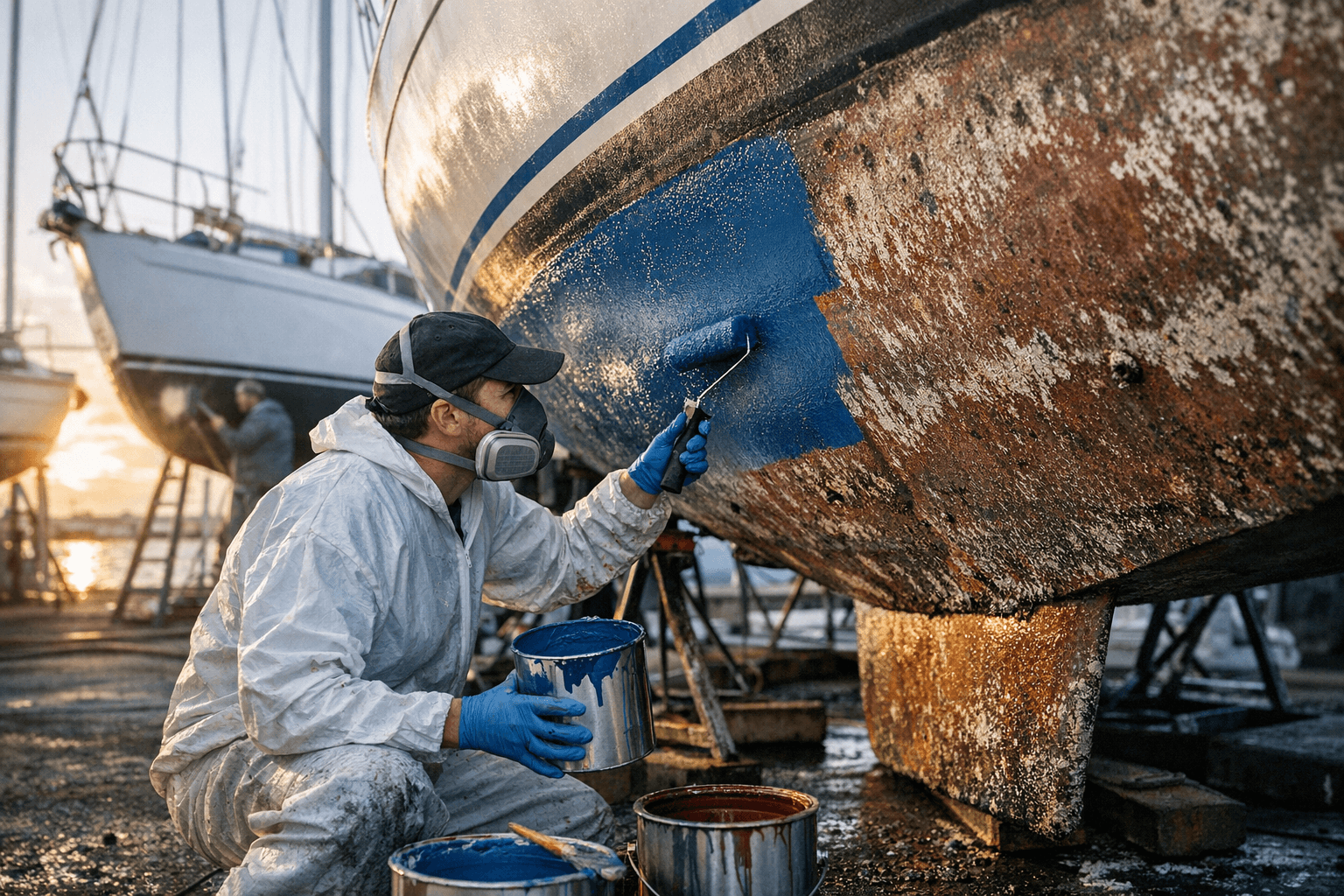
Leave bottom paint off your hull, or pick the wrong formula, and the water does the damage for you. Fouled hulls — coated in barnacles, slime, and algae accumulated over a season in the water — suffer between 10 and 40 percent losses in fuel efficiency or speed depending on the severity of growth. That isn't a cosmetic problem; it's a mechanical one that compounds into engine wear, higher operating costs, and eventually damage to underwater gear. A properly chosen and correctly applied antifouling coating can deliver up to 24 months of protection. The work is a single day on the hard for most 30-foot hulls. Getting the selection wrong, however, means you're back on the hard early or fighting the waterline all season.
What Bottom Paint Actually Does
Bottom paint is a functional protective coating, not a finishing touch. Its job is to prevent biofouling: the accumulation of barnacles, slime, and algae on the underwater hull that increases drag and cuts performance. Every antifouling formula works through biocides, chemical compounds that make the hull surface inhospitable to marine growth. What separates one product from another is how those biocides are delivered, how long they last, and which hull types and use profiles they suit best. Choosing the wrong delivery mechanism for your boat is the most expensive mistake in the category.
Hard vs. Ablative: The Decision That Shapes Everything
The two principal categories of antifouling paint work through fundamentally different mechanisms, and the choice between them has consequences for every haulout that follows.
Hard bottom paint
Hard antifouling paint, often formulated as a modified epoxy, cures to a tough, non-eroding film. Because it doesn't wear away, the coating can be scrubbed and polished between hauls without losing meaningful film thickness. That makes it the preferred choice for powerboats and any vessel running at high speed, where hull scrubbing mid-season is part of the maintenance routine. The trade-off appears over years: hard paint builds up with successive coats, and layers that have accumulated over multiple seasons eventually have to be stripped rather than simply overcoated. Hard vinyl formulations, a subset of this category, dry quickly and can get a boat back in the water fast, but they impose a compatibility restriction: hard vinyl paint applied over a modified epoxy or ablative finish will fail due to solvent interaction.
Ablative paint
Ablative paint works on a polishing principle. The coating wears away slowly through water contact, continuously exposing fresh biocide at the surface. This self-polishing, self-cleaning action makes ablatives the natural match for sailboats and vessels that spend long stretches in the water between hauls. Because ablatives don't build up the way hard paints do, reapplication is cleaner and compatibility is simpler. West Marine's CPP Ablative, for example, uses Composite Copper Technology (CCT) that releases 35 percent less copper into the environment while matching the antifouling performance of older high-copper formulas. The limitation for ablatives is exposure: a boat hauled frequently or trailered between uses may exhaust its film without getting the water contact needed to activate the wear mechanism, undercutting the whole premise of the system.
Matching Paint to Your Boat's Use Profile
Selecting the right system requires honest answers about how you actually use the boat:
- Frequency of haulout: Seasonal haulouts favor ablatives; extended multi-year immersion may favor a hard paint for sustained protection.
- Speed: High-speed powerboats benefit from the scrub-and-polish durability of hard paints. Displacement sailboats and slow motorsailers are natural ablative candidates.
- Storage mode: A boat trailered between weekends doesn't get the continuous water contact an ablative needs; hard paint performs more predictably in that scenario.
- Local fouling pressure: Warm, nutrient-rich waters like the Gulf Coast intracoastal or Chesapeake Bay demand a more aggressive biocide load than cold northern lakes. Regional choices at the local marina are often a useful first signal, even if they shouldn't be the final word.
Surface Prep: Where the Job Is Won or Lost
No antifouling paint performs better than the surface beneath it allows, and poor adhesion is almost always a prep failure, not a product failure. The sequence matters:
1. High-pressure wash: Strip all loose growth, old paint chalk, and contamination before any sanding begins.
2. Deoxidation for chalked gelcoat: Oxidized or chalked gelcoat requires chemical deoxidation or mechanical cutting before paint will adhere properly. Skipping this step is the single most common cause of peeling on older hulls.
3. Sanding: Profile the surface to the grit recommended by the specific product data sheet. Under-sanding leaves the film without a mechanical key; over-sanding creates furrows that trap solvent.
4. Masking: Tape off the waterline, keel-to-hull transitions, and any hardware that stays bare. Clean masking lines matter for performance at appendage edges as much as for appearance.
Application: Brush, Roller, or Spray
Brush and roller application is the standard for most DIY projects. Rollers lay down consistent film thickness across flat hull sections; a brush handles the cutwork around the prop shaft, keel, and any irregular geometry. Match roller material to the product instructions: foam rollers compress biocide-loaded paint differently than phenolic-core rollers, and the manufacturer's spec exists for a reason.
Spray application produces the most even film and the smoothest result, which matters on racing bottoms or any hull where finish quality is a premium. The trade-off is overspray containment, higher respirator requirements, and regulatory complexity at most boatyards. For the cruiser or weekend sailor, a thorough brush-and-roll application is entirely competitive and keeps the project cost inside a single day's budget.
Temperature and pot life govern both methods. Apply below the product's minimum temperature threshold and solvents won't flash properly, leaving a tacky, under-cured film. Apply above the maximum and biocide can begin leaching before the paint enters the water. Flash time between coats is equally non-negotiable: antifouling paint applied wet-on-wet without adequate drying time lifts, wrinkles, or fish-eyes.
Health, Environmental, and Regulatory Considerations
Antifouling paints contain biocides and solvents that require proper handling throughout the project. A dust mask is not sufficient; the correct respirator cartridge type is specified in each product's Safety Data Sheet, and cross-referencing that before purchasing PPE is not optional. Gloves, eye protection, and disposable coveralls are baseline requirements for any spray or heavy roller application.
Disposal is a regulatory matter. Used brushes, rollers, and leftover paint are classified as hazardous waste in most jurisdictions; local regulations govern how they're stored and where they go. Contaminated rinse water from spray equipment cleanup falls under the same framework. Pouring anything down a marina drain is both an environmental violation and a liability.
Troubleshooting Common Problems
Even careful application produces problems on occasion. The three most common:
- Fish-eyeing: Usually caused by surface contamination, wax, oil, or silicone residue, or by insufficient flash time between coats. Strip the affected section, re-clean thoroughly, and reapply once the surface is confirmed dry and uncontaminated.
- Poor adhesion on glossy gelcoat: Antifouling paint needs a mechanical key. Glossy, unsanded gelcoat is the leading cause of peeling finishes; the fix is always more prep, not more paint.
- Blotchy coverage: Almost always a mixing issue. Antifouling paints settle quickly and need to be stirred continuously throughout application, particularly high-density biocide formulations where the active ingredient sinks to the bottom of the can within minutes.
The Cost-Benefit Case
Bottom paint sits at the top of the impact-per-dollar chart for any refit season. The math is direct: a well-applied antifouling coating prevents the fuel penalty of a fouled hull (up to 40 percent in severe conditions), reduces engine wear from compensating throttle, and avoids the cost of an unscheduled haulout to address heavy growth that has worked into underwater gear.
Weigh the spray-yard option honestly. A professional spray finish is the right call for performance-focused boats where surface smoothness translates directly to speed. For the cruiser or coastal weekender, the brush-and-roll project, done correctly with proper prep, delivers protection that is entirely comparable at a fraction of the yard bill. The right choice is determined by use profile, budget, and how closely your local fouling pressure demands a flawless surface. Get those factors sorted, and the paint handles everything else below the waterline for up to two seasons.
This article was produced by Prism’s automated news system from verified source data, official records, and press releases, then run through automated quality and moderation checks before publishing. The system is built and supervised by the people who set the standards it runs under. Read our full AI policy.
Did this article answer your question?