DIY Cockpit Table Solves Tiller-Steered Sailboat Space Challenge
A tiller boat can still carry a real cockpit table if you build around the swing arc. Gary Gerber’s removable teak-and-hinge solution keeps meals, charts, and crew space in play.
Why the wrong table idea fails
The usual mistake is simple: build the table where it looks centered, then discover the tiller cannot sweep its full arc. On a tiller-steered boat, there is no pedestal to hide the problem, so the cockpit table has to solve clearance first and comfort second.
Wheel-steered boats get an easier path. Good Old Boat’s tiller explainer points out that a wheel pedestal naturally becomes the place for a grabrail, compass mount, and cockpit-table mount. A tiller boat starts without that central anchor, which is why Gary Gerber’s design works: it is built around the steering system instead of against it.
Gerber’s answer: a table that leaves the tiller alone
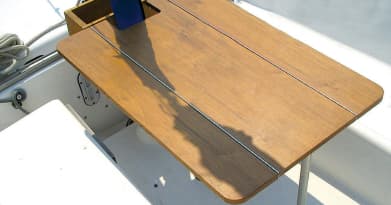
Gerber wanted a table that could be set up when the boat was in use, removed easily when it was not, and still let the tiller move freely or hinge upright when parked. That is the key design constraint, and it changes everything about the shape of the build. Rather than forcing a fixed furniture piece into a moving cockpit, he made the table a removable module with a defined footprint and a clear path for the helm.
The bridge between the tiller base and the aft bulkhead is an open teak box. On Gerber’s boat, that box measures 14 x 5 1/2 x 8 3/4 inches, and it does more than fill dead space. It sets the tabletop height, holds bottles, napkins, and utensils, and gives the whole assembly a structural base that makes the cockpit feel organized instead of crowded.
Measure the human space first
The smartest part of the layout is not a hardware choice. It is the kneeroom check. Gerber measured from a seated position so the table would not crowd the cockpit, which is exactly the kind of detail that separates a clever idea from a usable one.
That decision leads to a tabletop sized for real cockpit life. The surface is 24 x 36 inches, large enough for a meal, a chart, a laptop, or a spread of tools, but it folds to a 12 x 36-inch storage footprint when the cockpit needs to breathe. That narrower shape is what makes the table practical below or out of the way when you are not using it.
Hardware that lets the table disappear
The mounting choices matter as much as the dimensions. Gerber used pintle-and-gudgeon-style brackets to mount the condiment box, and stainless-steel pull-apart hinges to attach the tabletop. That combination is what makes the assembly removable without tools, so the table can come apart quickly and be stored in the cabin when necessary.
This is the difference between a permanent obstruction and a proper cruising fitting. The table can be deployed at anchor, then broken down before a passage or any time the cockpit needs full steering travel and open deck space. For a tiller boat, that flexibility is the whole point.
Why the cockpit payoff is bigger than one meal
Edson Marine describes cockpit tables as a way to increase cockpit versatility and turn the cockpit into the social center of the boat, and Gerber’s design fits that perfectly. A cockpit table on a tiller boat is not just a nice place for a sandwich. It becomes the place where you sort lines, lay out a chart, stage a laptop, or keep the evening drinks from sliding across the sole.
That everyday value is what makes the design worth copying. On a boat where every inch is contested, the table has to earn its keep by making the cockpit more livable without stealing steering room. Gerber’s layout does that by giving the crew a stable surface, an organized condiment box, and a cockpit that still works when the tiller needs to move.
A proven solution, not a one-off trick
There is also a clear lineage here. A DIY plan from the C&C27 Association solved the same tiller-specific problem by mounting a cockpit table extending forward from the aft end of the cockpit. That reinforces the basic lesson: on tiller-steered boats, the table belongs where it respects the arc of the helm and the traffic pattern of the crew.
Gerber’s version sharpens that idea with careful measurement, simple joinery, and marine-grade hardware. It is a reminder that the best cockpit furniture on a small sailboat is not the biggest piece you can fit, but the smartest one you can remove, fold, or stow when the boat needs to sail. On a tiller boat, that kind of restraint is what turns a cramped cockpit into a genuinely useful living space.
This article was produced by Prism’s automated news system from verified source data, official records, and press releases, then run through automated quality and moderation checks before publishing. The system is built and supervised by the people who set the standards it runs under. Read our full AI policy.
Did this article answer your question?